From opposition to cooperation
pp. 23-24 · Read in the full issue
Interview
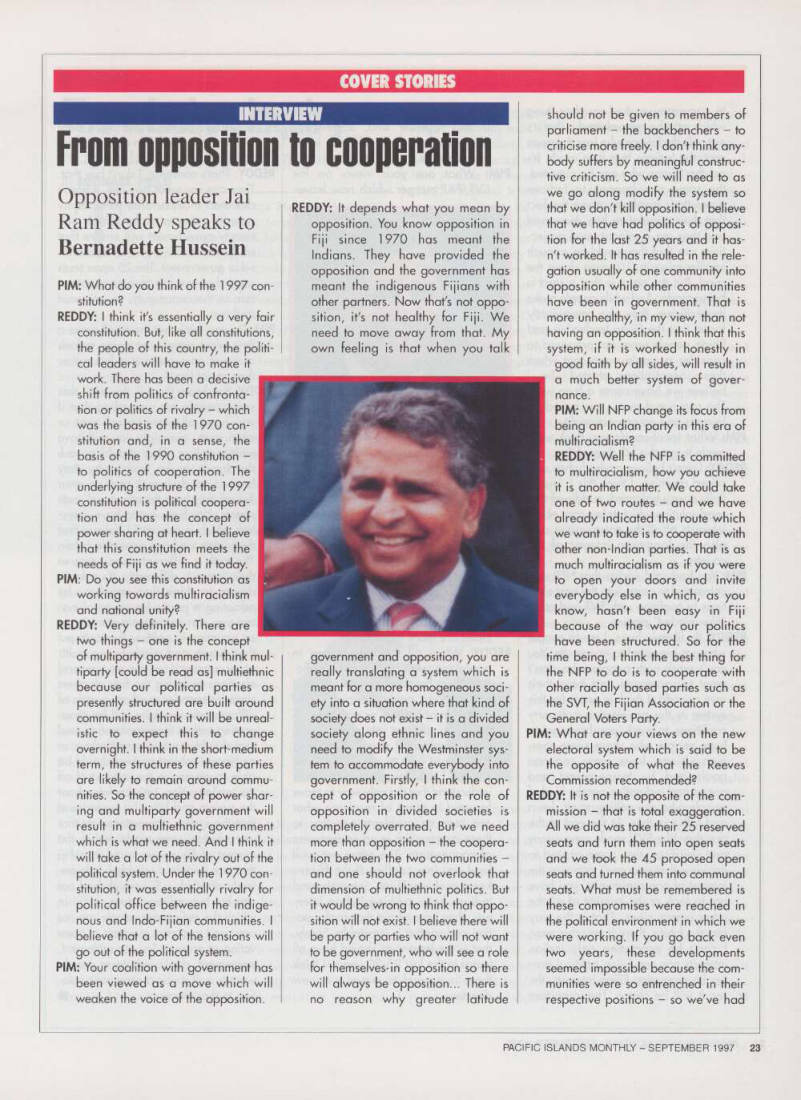
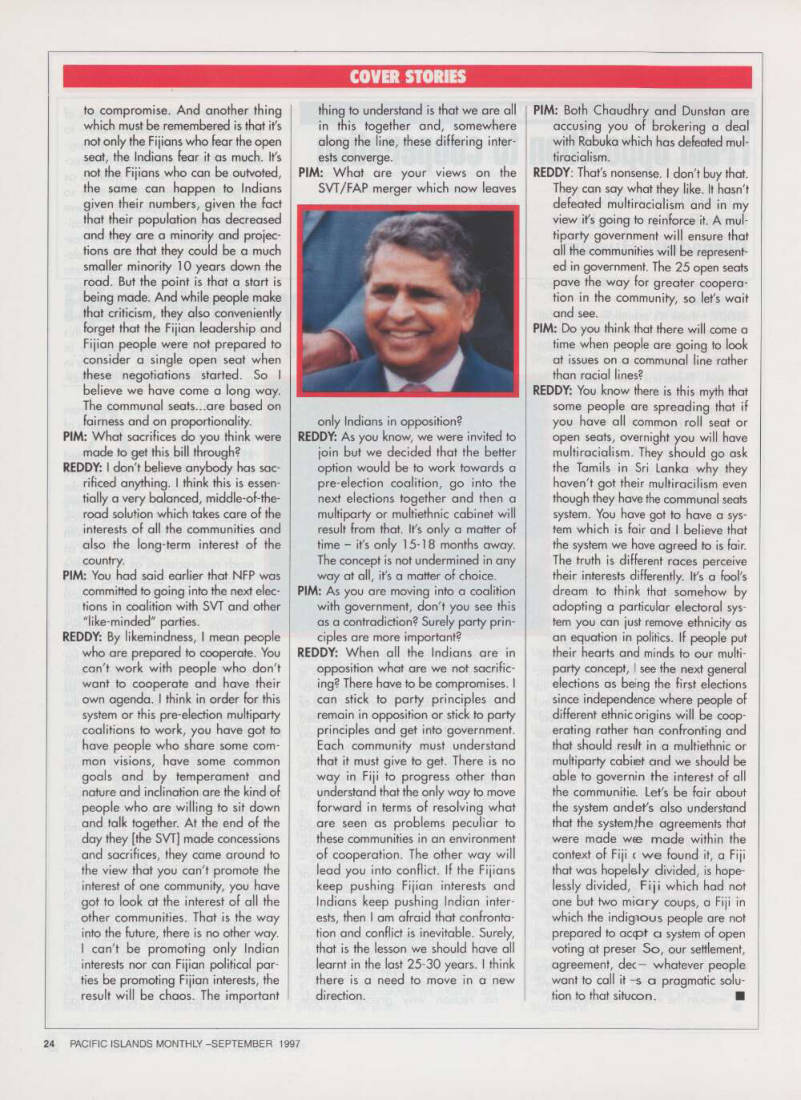
Opposition leader Jai
Ram Reddy speaks to
Bernadette Hussein
PIM: What do you think of the 1 997 con stitution?
REDDY: I think it's essentially a very fair constitution. But, like all constitutions, the people of this country, the politi cal leaders will have to make it
work. There has been a decisive shift from politics of confronta tion or politics of rivalry - which was the basis of the 1 970 con stitution and, in a sense, the basis of the 1 990 constitution to politics of cooperation. The underlying structure of the 1 997 constitution is political coopera tion and has the concept of power sharing at heart. I believe that this constitution meets the needs of Fiji as we find it today.
PIM: Do you see this constitution as working towards multiracialism and national unity?
REDDY: Very definitely. There are two things - one is the concept
of multiparty government. I think mul tiparty [could be read as] multiethnic because our political parties as presently structured are built around communities. I think it will be unreal istic to expect this to change overnight. I think in the short-medium term, the structures of these parties are likely to remain around commu nities. So the concept of power shar ing and multiparty government will result in a multiethnic government which is what we need. And I think it will take a lot of the rivalry out of the political system. Under the 1 970 con stitution, it was essentially rivalry for political office between the indige nous and Indo-Fijian communities. I believe that a lot of the tensions will go out of the political system.
PIM: Your coalition with government has been viewed as a move which will weaken the voice of the opposition.
REDDY: It dep ends what you mean by opposition. You know opposition in Fiji since 1970 has meant the Indians. They have provided the opposition and the government has meant the indigenous Fijians with other partners. Now that's not oppo sition, it's not healthy for Fiji. We need to move away from that. My own feeling is that when you talk
government and opposition, you are really translating a system which is meant for a more homogeneous soci ety into a situation where that kind of society does not exist - it is a divided society along ethnic lines and you need to modify the Westminster sys tem to accommodate everybody into government. Firstly, I think the con cept of opposition or the role of opposition in divided societies is completely overrated. But we need more than opposition - the coopera tion between the two communities and one should not overlook that dimension of multiethnic politics. But it would be wrong to think that oppo sition will not exist. I believe there will be party or parties who will not want to be government, who will see a role for themselves-in opposition so there will always be opposition... There is no reason why greater latitude
should not be given to members of parliament - the backbenchers - to criticise more freely. I don't think any body suffers by meaningful construc tive criticism. So we will need to as we go along modify the system so that we don't kill opposition. I believe that we have had politics of opposi tion for the last 25 years and it has n't worked. It has resulted in the rele gation usually of one community into opposition while other communities have been in government. That is more unhealthy, in my view, than not having an opposition. I think that this system, if it is worked honestly in
good faith by all sides, will result in a much better system of gover nance.
PIM: Will NFP change its focus from being an Indian party in this era of multiracialism?
REDDY: Well the NFP is committed to multiracialism, how you achieve it is another matter. We could take one of two routes - and we have already indicated the route which we want to take is to cooperate with other non-Indian parties. That is as much multiracialism as if you were to open your doors and invite everybody else in which, as you know, hasn't been easy in Fiji because of the way our politics have been structured. So for the
time being, I think the best thing for the NFP to do is to cooperate with other racially based parties such as the SVT, the Fijian Association or the General Voters Party.
PIM: What are your views on the new electoral system which is said to be the opposite of what the Reeves Commission recommended?
REDDY: It is not the opposite of the com mission - that is total exaggeration.
All we did was take their 25 reserved seats and turn them into open seats and we took the 45 proposed open seats and turned them into communal seats. What must be remembered is these compromises were reached in the political environment in which we were working. If you go back even two years, these developments seemed impossible because the com munities were so entrenched in their respective positions - so we've had
to compromise. And another thing which must be remembered is that it's not only the Fijians who fear the open seat, the Indians fear it as much. It's not the Fijians who can be outvoted, the same can happen to Indians given their numbers, given the fact that their population has decreased and they are a minority and projec tions are that they could be a much smaller minority 10 years down the road. But the point is that a start is being made. And while people make that criticism, they also conveniently forget that the Fijian leadership and Fijian people were not prepared to consider a single open seat when these negotiations started. So I believe we have come a long way.
The communal seats...are based on fairness and on proportionality.
PIM: What sacrifices do you think were made to get this bill through?
REDDY: I don't believe anybody has sac rificed anything. I think this is essen tially a very balanced, middle-of-the road solution which takes care of the interests of all the communities and also the long-term interest of the country.
PIM: You had said earlier that NFP was committed to going into the next elec tions in coalition with SVT and other "like-minded" parties.
REDDY: By likemindness, I mean people who are prepared to cooperate. You can't work with people who don't want to cooperate and have their own agenda. I think in order for this system or this pre-election multiparty coalitions to work, you have got to have people who share some com mon visions, have some common goals and by temperament and nature and inclination are the kind of people who are willing to sit down and talk together. At the end of the day they [the SVT] made concessions and sacrifices, they came around to the view that you can't promote the interest of one community, you have got to look at the interest of all the other communities. That is the way into the future, there is no other way.
I can't be promoting only Indian interests nor can Fijian political par ties be promoting Fijian interests, the result will be chaos. The important
thing to understand is that we are all in this together and, somewhere along the line, these differing inter ests converge.
PIM: What are your views on the SVT/FAP merger which now leaves
only Indians in opposition?
REDDY: As you know, we were invited to join but we decided that the better option would be to work towards a pre-election coalition, go into the next elections together and then a multiparty or multiethnic cabinet will result from that. It's only a matter of time - it's only 15-18 months away.
The concept is not undermined in any way at all, it's a matter of choice.
PIM: As you are moving into a coalition with government, don't you see this as a contradiction? Surely party prin ciples are more important?
REDDY: When all the Indians are in opposition what are we not sacrific ing? There have to be compromises. I can stick to party principles and remain in opposition or stick to party principles and get into government.
Each community must understand that it must give to get. There is no way in Fiji to progress other than understand that the only way to move forward in terms of resolving what are seen as problems peculiar to these communities in an environment of cooperation. The other way will lead you into conflict. If the Fijians keep pushing Fijian interests and Indians keep pushing Indian inter ests, then I am afraid that confronta tion and conflict is inevitable. Surely, that is the lesson we should have all learnt in the last 25-30 years. I think there is a need to move in a new direction.
PIM: Both Chaudhry and Dunstan are accusing you of brokering a deal with Rabuka which has defeated mul tiracialism.
REDDY: That's nonsense. I don't buy that.
They can say what they like. It hasn't defeated multiracialism and in my view it's going to reinforce it. A mul tiparty government will ensure that all the communities will be represent ed in government. The 25 open seats pave the way for greater coopera tion in the community, so let's wait and see.
PIM: Do you think that there will come a time when people are going to look at issues on a communal line rather than racial lines?
REDDY: You know there is this myth that some people are spreading that if you have all common roll seat or open seats, overnight you will have multiracialism. They should go ask the Tamils in Sri Lanka why they haven't got their multiracilism even though they have the communal seats system. You have got to have a sys tem which is fair and I believe that the system we have agreed to is fair.
The truth is different races perceive their interests differently. It's a fool's dream to think that somehow by adopting a particular electoral sys tem you can just remove ethnicity as an equation in politics. If people put their hearts and minds to our multi party concept, I see the next general elections as being the first elections since independence where people of different ethnic origins will be coop erating rather ban confronting and that should resilt in a multiethnic or multiparty cabiiet and we should be able to governin the interest of all the communitie. Let's be fair about the system andet's also understand that the system/he agreements that were made wee made within the context of Fiji c we found it, a Fiji that was hopelsly divided, is hope lessly divided, Fiji which had not one but two miary coups, a Fiji in which the indigious people are not prepared to accpt a system of open voting at preser So, our settlement, agreement, dec— whatever people want to call it -s a pragmatic solu tion to that situcon. ■