Towards productivity and quality
pp. 34-36 · Read in the full issue
Advertising Feature
Fiji National Training Council
FNTC director-general Nelson Delailomaloma talks to Bernadette Hussein about the organisation and its role in
providing a productive work
force able to deliver quality goods and services.
Training, quality and pro ductivity are on company agendas around the world - and Fiji is no different.
Companies, with the help of the Fiji National Training Council, are doing much to attain internationally recog nised standards. The FNTC has come a long way since it started in 1973, but as it forges ahead it has maintained its initial goal - to provide skilled and
productive labour.
“When the country was heading for independence in 1970, the British govern ment set up a number of study missions.
Some of these missions [funded] by the World Bank indicated there were certain needs in Fiji that needed to be adjusted and addressed.
“One of the studies indicated there was a lack of skilled labour at the time. There was only one institute providing training and it was the Derrick Institute which is now called the Fiji Institute of
Technology.”
Setting up the FNTC In recognising this shortage, moves were under way to set up the FNTC. As far as funding went, the government of the day decided the beneficiaries of the council would pay for the training. This saw the
one per cent levy.
The one per cent levy applies to employers, including the government; exempt are the armed forces, education authorities, social welfare, agriculture and fisheries.
“I don’t think any records were kept of the number of people who benefited, but I have reason to believe through discussions I have had with employers that the contri bution that this organisation has made towards the skilled labour of the workforce has been very real and significant,” the
director-general said.
“We got into the area of training in supervision, middle management and office practices to certify some of the other needs employers had indicated to us.
“And then, in the last six years, the ideas of productivity and quality have come up.”
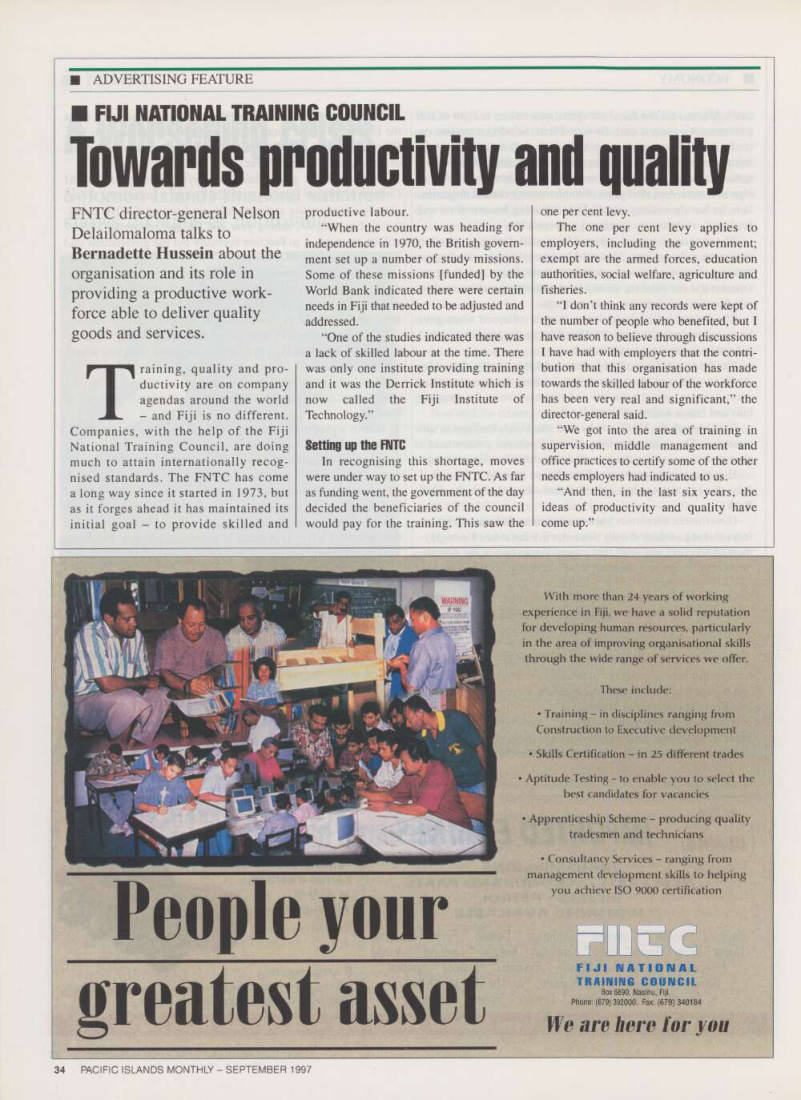
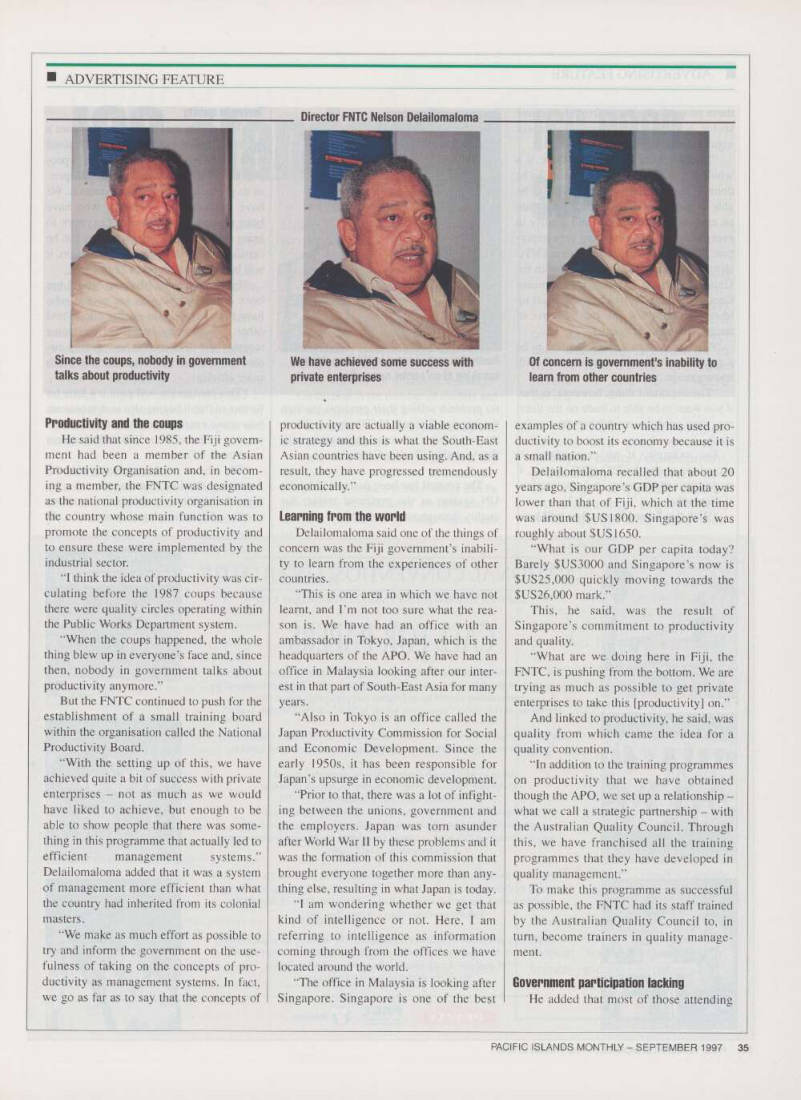
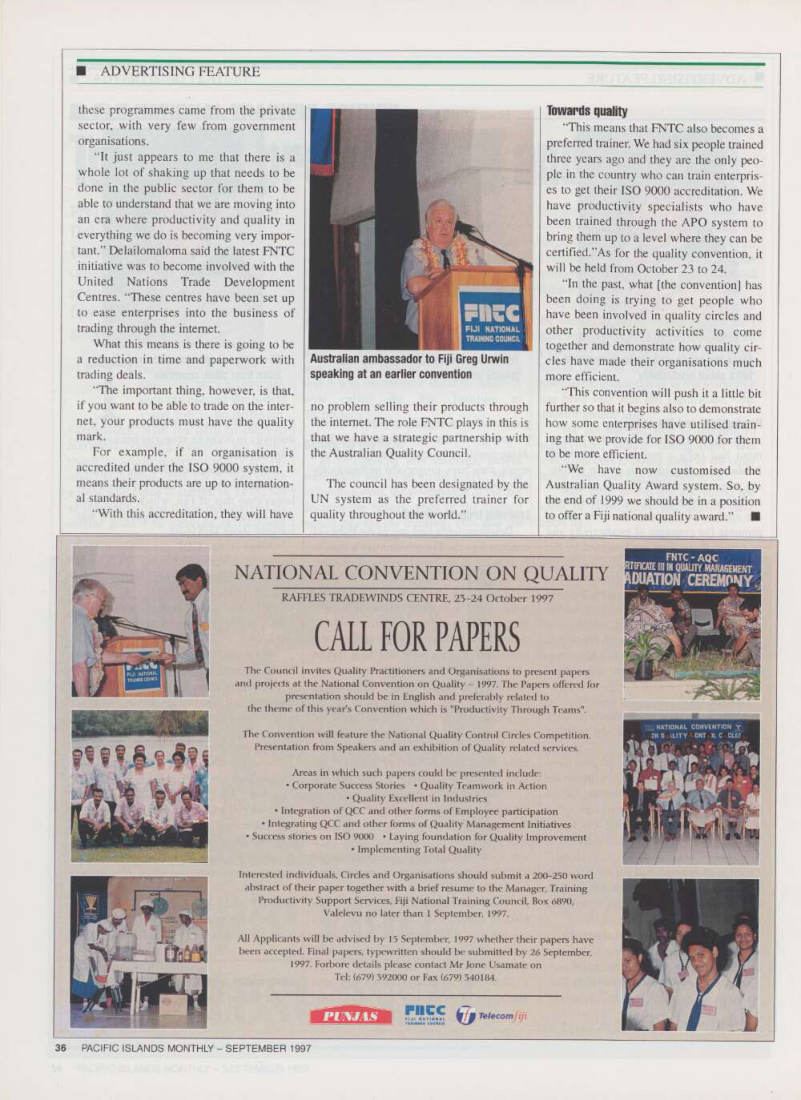
Director FNTC Nelson Delailomaloma
Productivity and the coups He said that since 1985, the Fiji govern ment had been a member of the Asian Productivity Organisation and, in becom ing a member, the FNTC was designated as the national productivity organisation in the country whose main function was to promote the concepts of productivity and to ensure these were implemented by the industrial sector.
“I think the idea of productivity was cir culating before the 1987 coups because there were quality circles operating within the Public Works Department system.
“When the coups happened, the whole thing blew up in everyone’s face and, since then, nobody in government talks about productivity anymore.”
But the FNTC continued to push for the establishment of a small training board within the organisation called the National Productivity Board.
“With the setting up of this, we have achieved quite a bit of success with private enterprises - not as much as we would have liked to achieve, but enough to be able to show people that there was some thing in this programme that actually led to efficient management systems.”
Delailomaloma added that it was a system of management more efficient than what the country had inherited from its colonial masters. ”We make as much effort as possible to try and inform the government on the use fulness of taking on the concepts of pro ductivity as management systems. In fact, we go as far as to say that the concepts of
productivity are actually a viable econom ic strategy and this is what the South-East Asian countries have been using. And, as a result, they have progressed tremendously economically.”
Learning from the world Delailomaloma said one of the things of concern was the Fiji government’s inabili ty to learn from the experiences of other countries.
“This is one area in which we have not learnt, and Fm not too sure what the rea son is. We have had an office with an ambassador in Tokyo, Japan, which is the headquarters of the APO. We have had an office in Malaysia looking after our inter est in that part of South-East Asia for many years.
“Also in Tokyo is an office called the Japan Productivity Commission for Social and Economic Development. Since the early 19505, it has been responsible for Japan’s upsurge in economic development.
“Prior to that, there was a lot of infight ing between the unions, government and the employers. Japan was torn asunder after World War II by these problems and it was the formation of this commission that brought everyone together more than any thing else, resulting in what Japan is today.
"1 am wondering whether we get that kind of intelligence or not. Here, I am referring to intelligence as information coming through from the offices we have located around the world.
"The office in Malaysia is looking after Singapore. Singapore is one of the best
examples of a country which has used pro ductivity to boost its economy because it is a small nation.”
Delailomaloma recalled that about 20 years ago, Singapore’s GDP per capita was lower than that of Fiji, which at the time was around SUSIBOO. Singapore’s was roughly about SUSI6SO. ”What is our GDP per capita today?
Barely SUS3OOO and Singapore’s now is $U525,000 quickly moving towards the $U526,000 mark.”
This, he said, was the result of Singapore’s commitment to productivity and quality. ‘‘What are we doing here in Fiji, the FNTC, is pushing from the bottom. We are trying as much as possible to get private enterprises to take this [productivity] on.”
And linked to productivity, he said, was quality from which came the idea for a quality convention.
“In addition to the training programmes on productivity that we have obtained though the APO, we set up a relationship what we call a strategic partnership - with the Australian Quality Council. Through this, we have franchised all the training programmes that they have developed in quality management.”
To make this programme as successful as possible, the FNTC had its staff trained by the Australian Quality Council to, in turn, become trainers in quality manage ment.
Government participation lacking
He added that most of those attending
Since the coups, nobody in government talks about productivity
We have achieved some success with private enterprises
Of concern is government’s inability to learn from other countries
these programmes came from the private sector, with very few from government
organisations.
“It just appears to me that there is a whole lot of shaking up that needs to be done in the public sector for them to be able to understand that we are moving into an era where productivity and quality in everything we do is becoming very impor tant.” Delailomaloma said the latest FNTC initiative was to become involved with the United Nations Trade Development Centres. “These centres have been set up to ease enterprises into the business of trading through the internet.
What this means is there is going to be a reduction in time and paperwork with
trading deals.
"The important thing, however, is that, if you want to be able to trade on the inter net, your products must have the quality mark.
For example, if an organisation is accredited under the ISO 9000 system, it means their products are up to internation al standards.
"With this accreditation, they will have
no problem selling their products through the internet. The role FNTC plays in this is that we have a strategic partnership with the Australian Quality Council.
The council has been designated by the UN system as the preferred trainer for quality throughout the world.”
Towards quality
"This means that FNTC also becomes a preferred trainer. We had six people trained three years ago and they are the only peo ple in the country who can train enterpris es to get their ISO 9000 accreditation. We have productivity specialists who have been trained through the APO system to bring them up to a level where they can be certified."As for the quality convention, it will be held from October 23 to 24.
"In the past, what [the convention] has been doing is trying to get people who have been involved in quality circles and other productivity activities to come together and demonstrate how quality cir cles have made their organisations much more efficient.
"This convention will push it a little bit further so that it begins also to demonstrate how some enterprises have utilised train ing that we provide for ISO 9000 for them to be more efficient.
"We have now customised the Australian Quality Award system. So, by the end of 1999 we should be in a position to offer a Fiji national quality award.” ■
Australian ambassador to Fiji Greg Urwin speaking at an earlier convention