A time of change
pp. 16-18 · Read in the full issue
Cover Stories
As Fiji pats itself on the back over the new constitution, it must also realise that the real test is still to come
By Bernadette Hussein
They say time heals all wounds, especially as Fiji adopts a new constitution seen by many as one serv ing the interests of the nation rather than any one racial group. But it remains to be seen whether the pass ing of the new constitution will bring to an end the political crises, racial divisions, ailing economy, high unem ployment and increasing crime rates which have become the sad reality in this island country. Fiji’s political leaders seem confident it will. But it has been pointed out that the constitution itself is only the means to this end. And while Prime Miniter Sitiveni Rabuka admits that decisions are often made along racial lines, he believes there will come a time when there will be more national unity among the peoples of Fiji.
"The constitution will force us to work together whether we like it or not because we are there together,” PM Rabuka said.
The sentiment is echoed by Josevata Kamikamica, the leader of the Fijian Association Party. “In politics there has always been a racial divide but this consti tution will help move away from that, and this is a healthy development in terms of a democratically elected government.”
He added that people would have to work together to achive national unity.
"The constitution itself will not provide that. It will be based on the willingness of people to see their future together and work together for the future of the coun try.” Opposition and National Federation Party leader Jai Ram Reddy feels the same.
He says that the structure of the 1997 con stitution is cooperation with the concept of powersharing at heart.
"I think it will take a lot of the rivalry out of the political system. Under the 1970 constitution, it was essentially rivalry for
political office between the indigenous community through their political parties
and the Indo-Fijian community through
their political party. I believe that a lot of tensions will go out of the political sys tem.”
A multiparty cabinet The FAP recently merged with Rabuka’s ruling Soqosoqo ni Vakavulewa ni Taukei party and have two members in the new cabinet announced early last month. However, the SVT/FAP merger was itself based on race. In July, Rabuka had invited the NFP to form a multiparty and multiracial - cabinet, as provided for in the 1997 constitution. The offer was declined by Reddy, who has preferred to remain in opposition until the next general elections in 1999. “He is very noble and mature enough to realise that he can make constructive contributions to issues of national importance from either side of the house,” the PM said of Reddy at the time, agreeing to defer the multiparty concept.
But it was only a few weeks later that the PM made similar overtures towards the FAP. This time the offer was accepted. The SVT and FAP have had something of a his tory of always nearly merging since their split in 1993; the latter was formed by SVT breakaway members. (The SVT is also in a coalition with the General Voters Party which is made up of general voters or, racially speaking, mainly those of European and Fijian descent.) The common ground for the SVT/FAP merger seems to have been Fijian interests.
At the time of the offer, Rabuka had stated the SVT's aim to be the unity of the Fijian people. "If there is a merger with the FA, then it will show the nation that we have at least tried before we go for national unity,” he said. Ironically, the SVT had only recently proclaimed it was turning multira cial by opening membership to all races.
Reddy said the reason he had turned down the multiparty cabinet offer was because they were not ready for the merg
er at the time. On claims that NFP’s merg er would weaken the voice of opposition Reddy said: “Opposition in Fiji since 1970 has meant the Indians. They have provided the opposition and the government has meant the indigenous Fijians with their partners.
"We need to move away from that. My own feeling is that when you talk govern ment and opposition, you are really trans lating a system which is meant for a more homogeneous society. I think that the con cept of opposition is completely overrated.
But we need more than opposition - the cooperation between the two communities and one that should not overlook that dimension of multiethnic politics. But it would be wrong to think that opposition will not exist. 1 believe there will be party or parties who will not want to be govern ment.”
Electoral arrangements Mahendra Chaudhry, parliamentary leader of the Fiji Labour Party (the ruling party before the 1987 coups), while acknowledging that the constitution is a major breakthrough in Fijian politics, has also admitted his reservations about the document. The constitution was certainly a long-awaited development, Chaudhry said. "It has now been passed and, to a large extent, the grievances of the people against the 1990 constitution have been satisfied. The new constitution has a lot of provisions which were not in the 1970 and the 1990 constitutions and will provide good governance. It has a very compre hensive section on the Bill of Rights and the public service. So, from that view, I would say that we have good document with most of the recommendations by the Constitution Review Commission being approved.”
But the issue of race comes into play again. Of concern to the Labour leader are the electoral arrangements, which, he said, were contrary to the Constitution Review Commission’s recommendations.
"Commission head Sir Paul Reeves emphasised the need for us to move away from the very decisive communal politics, and I'm afraid that has not happened.
"Under the new arrangement, the enact ing of parliament is largely on a communal basis. Two-thirds of parliament will be elected along communal lines.
"In respect of the open seats, Sir Paul had recommended that there be multi-
member constituencies. Here again what we can see is that that has been converted from multi-member constituencies to sin gle-member constituencies; so they are really communal seats in disguise.” And Chaudhry blames Rabuka and Reddy for
letting this through. The JPSC committee was made up largely of SVT and NFP members, with the Labour Party having only two members. The thinking was dom inant that they keep the segregation, which is that SVT remain a Fijian party and NFP
an Indian party. I think this arrangement suits these people fine. They want the sta tus which protects their interest.”
And, Chaudhry said, in this process, the Indian community was cheated of a seat.
“Whatever the arrangement was, at the end of the day, it was agreed that commu nal seats would be shared on the basis of coagulation of the respective communities and, on that basis, the Indians were enti tled to 20 seats, Fijians 23 seats, and the general voters and Rotumans one seat each.
“But what has happened is that the Indian seat was traded off ...[and] it went to the general electors.”
During parliamentary debate on the Constitution Amendment Bill, Chaudhry was shouted down and I pretty much ostracised when he moved that Indian seats be increased from 19 to 20, which is the number of seats he said Indians were proportionately entitled to. When put to the vote, the amendment was defeated and, interestingly, among those voting against were two Labour parliamentarians. “The
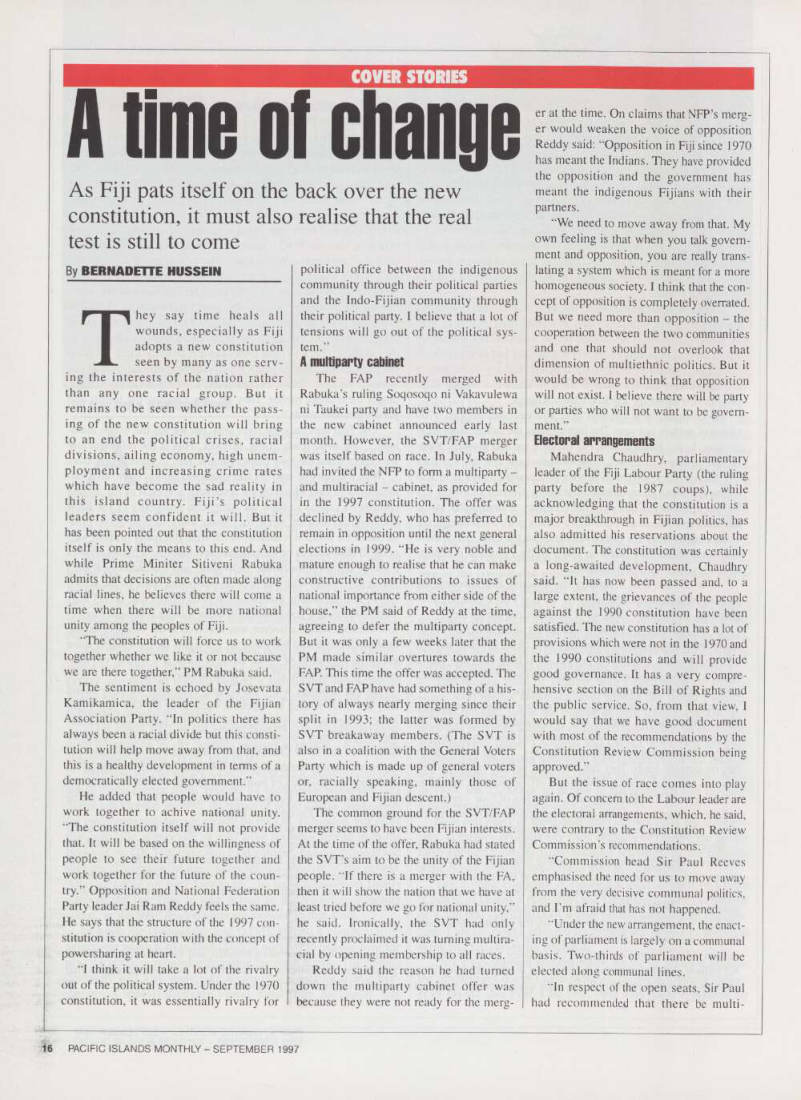
Members of the Joint Parliamentary Select Committee with President Ratu Mara (middle)
fact remains that the Indians were cheated
of their rightful representation,” Chaudhry
maintains. But Reddy feels that there is nothing wrong with the electoral system.
On claims that the JPSC went totally against the commission on this, Reddy said; “All we did was to take their 25 reserved seats and turn them into open seats and took the 45 propsed seats and turned them into communal seats. What must be remembered is these compromises were reached in a political environment in which we were working. The communal seats guarantee representation and they are not arbitrary, they are based on fairness and on proportionality.”
Indigenous rights
Extremist Fijians, who carried much clout in Fiji’s coup era, have been strange ly silent since the passage of the new con stitution. There was a protest march by extremists and a burning of the JPSC report while the bill was before parliament. The only other incident of note occurred after the Constitution Amendment Bill was passed by the senate, when Fijian national ist Sakeasi Butadroka reportedly verbally abused the attorney-general, Etuate Tavai, outside parliament. No charges were pressed and the incident was soon forgot ten. The extremist view was that the new constitution had gone against all that the two military coups of 1987 had stood for.
They saw the 1997 constitution take away the Fijian dominance provided for in the 1990 constitution. However, Kamikamica is quick to say that this is a completely wrong interpretation of the constitution. “I think the interpretation arises out of the assumption that Fijians should be given the numbers, the power and all the things they
want. But the world does not operate that way. You have to work and compete with others to get what you want. That is the reality of the situation and you advance because of your hard work and skills. "The extremists force that line. They, I believe, are suppressing indigenous initiatives to excel and to succeed. I think the Fijians need to rethink their strategy. We need to free the Fijians to compete.”
This view was also shared by Rabuka who said objectives of the coups were achieved because the position of Fijian leadership had been secured in the sense that the pinnacle leadership of Fiji - the president - would be appointed by the Great Council of Chiefs, the highest assem bly in the land. (The new constitution, how ever, allows for an Indian PM, which is a major step from the 1990 constitution.) The new constitution has found much favour with the international community, putting Fiji on the path back into the Commonwealth. Fiji has been invited to the Commonwealth Heads of Government meeting in Edingburgh next month. But while the country’s political leaders gener ally accept that the new constitution is a step in the right direction, they are also very conscious that there is much hard work that still needs to be done.
As Kamikamica said: “All these years, our political development has been based on racial stance, and it is a major challenge for us to move away from it and focus on issues that affect the lives of people and their development as one group rather than two separate groups.”
Only time will tell how much headway Fiji has made with its new constitution and whether it has indeed healed all wounds. ■
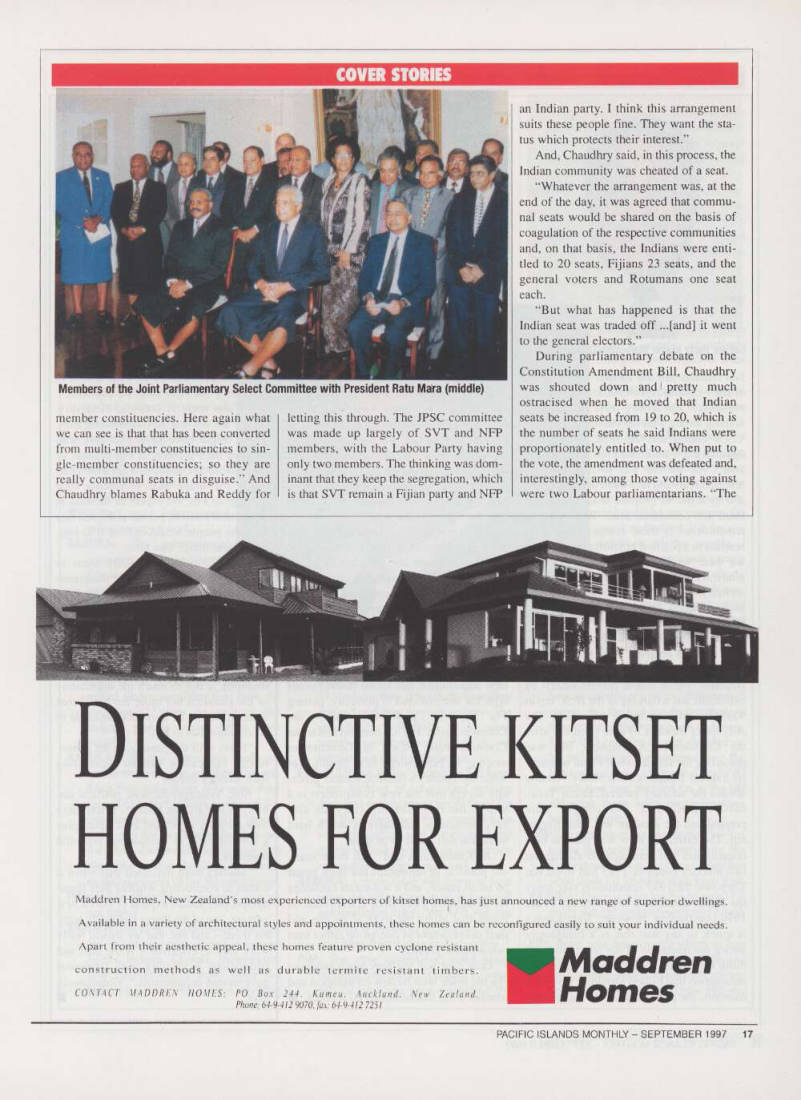
Labour Party leader Mahendra Chaudhry
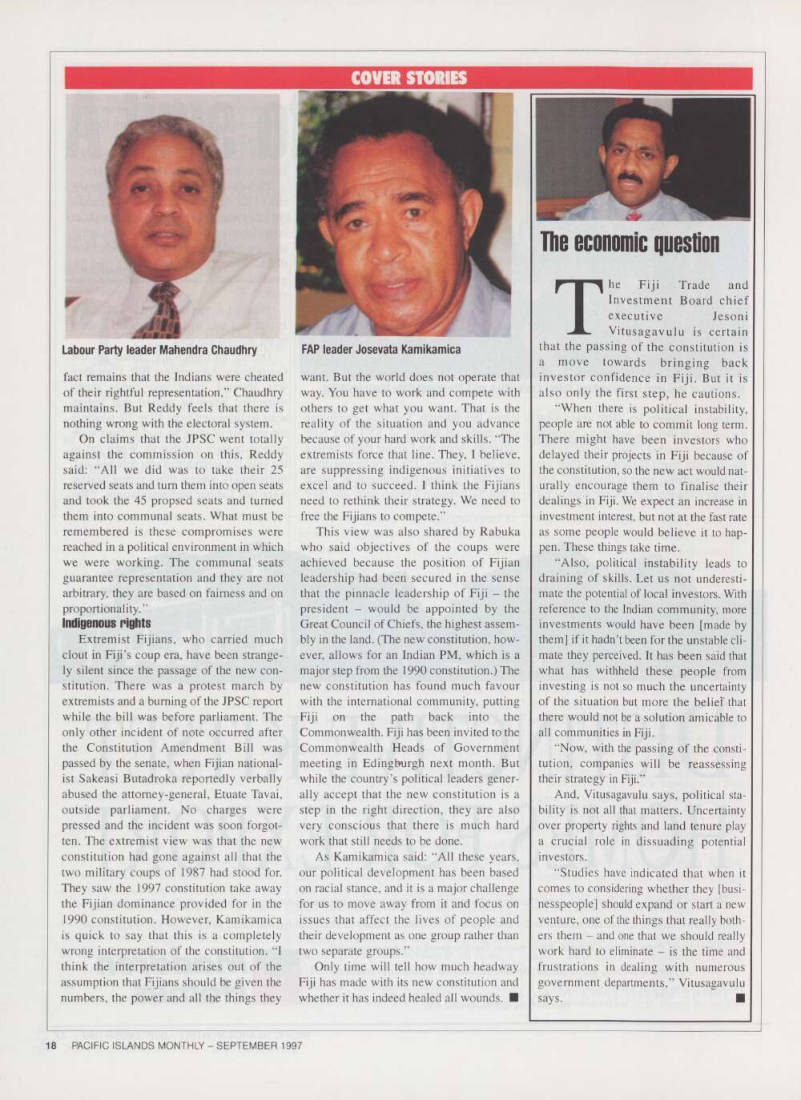
FAR leader Josevata Kamikamica