Mining giant spreads benefits
pp. 14-15 · Read in the full issue
By Kalinga Seneviratne
After successfully negotiating an out-of-court compensation settlement with landowners along the 1200 km Fly River for environmen tal damage caused by the OK Tedi gold and copper mine, the Australian multinational mining company BHP is keen to show the world that a rich mining company does care about the long-term survival of communities affected by its activities.
BHP’s local subsidiary OK Tedi Mining Ltd (OTML) has set up the OK Tedi Development Trust (OTDT) and allocated over K 4 million (SUS 3 million) a year to help build local infrastructure and introduce sustainable development projects among the com munities in one of the remotest and least developed areas in Pqpua New Guinea.
The mine, which makes an annual profit of over SUS3OO mil lion a year, has at least another 12-13-year operational period. If OTDT succeeds in leaving behind a sustainable development model for the communities, it would set a precedent for mining companies around the world.
“This could well be the single biggest community develop ment programme by any mining company anywhere,” Robin Ette, senior supervisor of OTDT told PIM.
BHP was rocked by a SA4-billion (SUS2.B-million) compen sation claim against them brought by Melbourne-based law firm Slater and Gordon in 1995 on behalf of 6000 village landowners for environmental damage caused by the OK Tedi mine. For more than a decade, a grey tide of mud from the mine spread from the banks of the OK Tedi river into food gardens, fishing grounds and villages, disrupting the age-old traditional lifestyle of the people.
After agitating for over four years, the local landowners finally allowed the law firm to take action in the Victorian supreme courts, as the BHP headquarters are situated in that state.
In May, the landowners and OTML signed a compensation agreement worth K4O million (SUS2B million) to be paid over the next 13 years, in return for dropping the court action. The mining company will also undertake a two-year dredging trial down stream. A special dredging vessel hired from Singapore was
expected to start operation in the area last month).
Company officials, however, are quick to point out that the development trust they have set up to help villagers in the area is not a result of the court action. OTDT was, in fact, set up in 1990 with an initial budget of K 2.5 million (SUSI.S6 million) and has since spent over K2O million (SUSI2.S million) on development projects in over 100 villages scattered in an area of 76,000 sqkm, most of which is covered in pristine rainforest and inaccessible terrain.
“The development trust is not designed in any shape or form to be part of a compensation package,” says Ette. “This is an initia tive of the company to split the benefits of the company outside the mine lease area alongside the river.”
In the first six years of its operations, the OTDT has placed emphasis on projects increasing access to drinking water, health care and education, and on building community meeting places.
Now they are moving to introducing sustainable industries such as rubber plantations and rabbit farming into the communities.
This mining town of Tabubil, with a population of 4000, is some 2000 metres above sea level and has the world’s second highest rainfall. Set in the middle of solid jungle, the OK Tedi mine has produced a number of spin-off businesses. In addition to supermarkets, shops, a hospital and schools, there is a hotel and engineering businesses which are joint ventures between the min ing company and landowners. Before the mine operations began in 1984, the 25,000 or so people in this province had lifestyles which remained unchanged for centuries.
Now that many of them have been introduced to the 20th cen tury, company officials say they are keen to ensure the people have enough turnover from business activities by the time the mine closes in 2010, to continue their new lifestyles.
The mining company is funding a local branch of CODE (College of Distance Education and University Centre) to the tune of K 400,000 ($U5250,000) a year to train locals from the "pre ferred areas” (areas affected by mining activities) in technical skills and for university entrance.
“It’s a government responsibility, but we’re doing it because the government doesn’t have money,” lan Wild, training manag er of OTML told PIM. Last year, there were 1000 applicants for
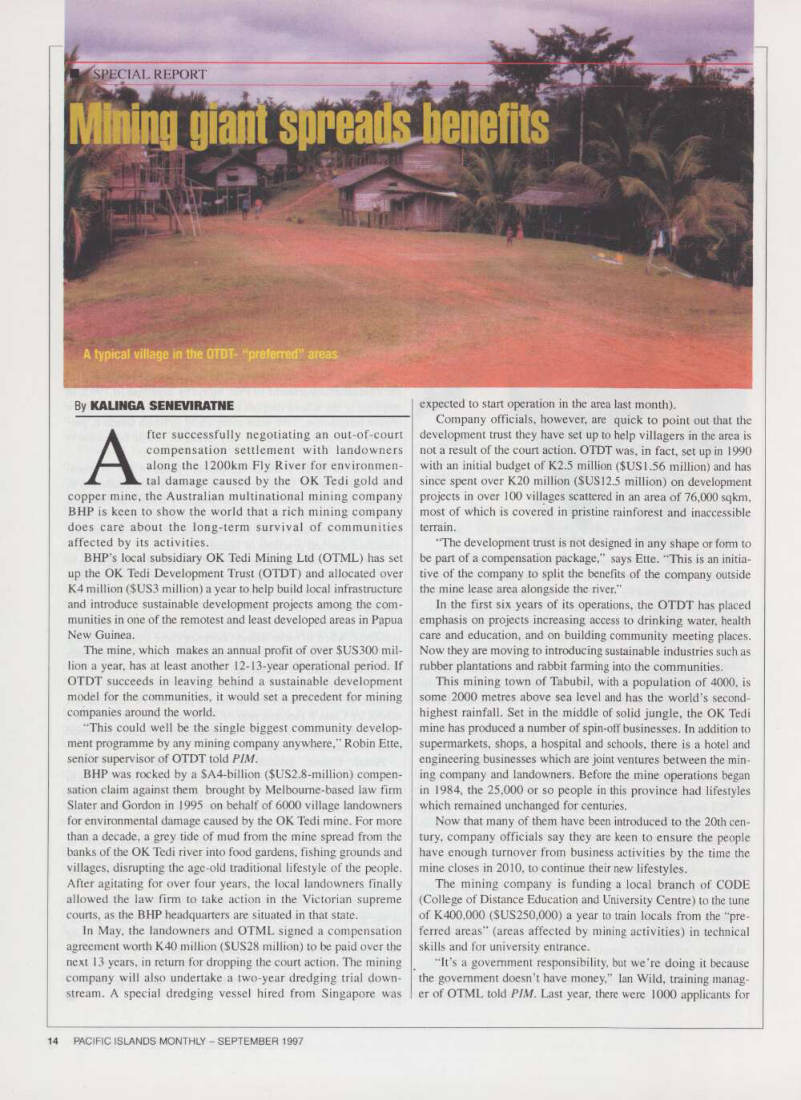
A typical village in the OTDT-“preferred” areas
40 first-year apprenticeships offered here. Wild says the increase is due to more locals now having completed Grade 10.
“Earlier, locals couldn’t qualify because schools started only recently here.”
OTML officials, however, are aware that training locals in such technical fields may not help the communities in the long run because once the mining operations are over, there will be limited technical jobs available. Thus, they are looking at intro ducing more sustainable industries to the area.
“We’re trying to establish rubber plantations to provide people with cash incomes,” explains Ette. “It is not overnight invest ment, but takes five to eight years to develop a resource that can be harvested later.”
Rubber was first planted in the province in the 19605, but because of the prohibitive costs of transporting rubber to Port Morseby, the industry never took off. In 1994, OTDT teamed up with a private company North Fly Rubber Pty Ltd in a joint-ven ture project to set up a rubber-processing factory in Kuinga, a township about 150 km south of Tabubil. There is a regular ship ping service down the Fly River from Kuinga.
The company now employs over 20 locals and shipped 1700 tonnes of rubber last year. The factory buys the rubber from local growers. In the Kuinga district alone there are 860 growers plant ing 898 hectares of rubber. “The local customs and the way they live blends very well with rubber production,” says 800 Kui Chew, the Malaysian-trained managing director of North Fly Rubber company. Chew says the company is financially stable and has been able to give growers a steady price even though the world market price for rubber fluctuates all the time. Since there is no local market for rubber in PNG, all their produce is export ed to Italy, Germany and Australia.
“Now we are into sustaining the industry and encouraging planting of new trees,” he says. “If we don’t do replanting pro grammes, in 10 years’ time, we’ll have to close the factory.”
OTDT is chipping in to help villages set up nurseries by bring ing in seeds from outside. “Anybody who clears the land and has a ground nursery established, can get seeds from us,” says David Wissink, agricultural superintendent of OTML. "In Kuinga area there 11,000 farmers right now wanting rubber to plant.”
Wissink is also introducing rabbit farming to the communities.
He is certain such an industry will be sustainable beyond the life of the mine and not have any adverse environmental impact.
"They will be fanned domestically,” he says. "These rabbits don't rely on outside feeds. They can eat sweet potato, banana, beetle leaves - all grown locally.” Wissink’s office provides rabbits to the villagers at K 5 (SUS3.IO) each in batches of four - one male and three females. He says only nine months into the project, there’s a high degree of interest in the scheme already.
Recent changes to PNG’s tax system has given OTDT added incentive. Mining companies providing infrastructure develop ment to remote communities can claim up to two per cent of their taxable income in tax credits. Depending on world copper and gold prices, OTDT will have access to an extra K5-I0 million (SUS3.I-6.3 million) a year to spend on the communities under this scheme from this year. "This year, the trust budget is K 3.5 million (SUS2.I9 million) and all of a sudden we’ll get another K 5 million. It's an enormous boost to our work,” observes Ette.
He says they have plans to build a high school and a hospital in
Kuinga and other health and educational facilities along the Fly River further to the south.
“We see ourselves as providing infrastructure development which governments don’t have funds to do. We leave the govern ment to fund health and educational services,” says Ette. The court action by villagers against OK Tedi has obviously made the locals aware about their rights, especially when environmental damage is concerned. OTML officials also seem to be very sensi tive to this and have appointed a number of community liaison officials, who are PNG nationals, in an attempt to build bridges with the community. Willie Uho, who is a councillor in the vil lage of Gii near Kuinga, is one who seems to know how to get things done in this new environment. He has lived in this com munity for 20 years “because the government moved us here to make use of the infrastructure”. He told PIM he would like a road constructed to his village of Ningerun and a school built there, so they could go back to their own land and develop them into rub ber plantations. “For 27 years, no government official went to our village,” he says. “Now, as councillor, I have gone to my village, taught them about rubber. They are now clearing the forests and planting rubber seeds.”
“OK Tedi sees only the river area, but we see the whole main land... We need roads going, schools. This is the infrastructure we expect when the time comes for OK Tedi to leave,” says Uho.
With a history of conflict and suspicion behind them, environ mentalists in Port Morseby are somewhat sceptical of the mining company’s claims to have the long-term prosperity of the local communities at heart, while they make multi-million-dollar prof its out of the mineral resources in the area. But many of them wel come OTDT’s focus on sustainable development schemes. Powes Parkop, the director of the Individual and Community Rights Advocacy Forum who has been an outspoken critic of the activi ties of foreign mining companies in PNG agrees that OTDT may well be creating a good model for other mining companies to fol low. Parkop, who is a lawyer, was involved in the villagers’ action against OK Tedi and has since set his sights on the Porgera mine up in the highlands of PNG. He says there is a similar environ mental problem there affecting a major river system.
"In our dealings with the mining company, we have found they are more willing to negotiate because of the OK Tedi expe rience. They are more willing to deal with social and environ mental problems.” observed Parkop. Greg Anderson, executive director of the PNG Chamber of Mines and Petroleum, does not agree that court action against OK Tedi was instrumental in changing the attitudes of mining companies in PNG towards the local communities, but acknowledges that OTDT may well be setting a model for others to follow. ■’There’s starting to be a realisation that you have to look at the project impact area and try to provide some benefits to all those people,” he told PIM. Though Anderson believes the government must provide those services from the taxes the mining companies pay, this is not happening. He observes there are big disparaties between communities in the immediate vicinity and those on the
periphery.
”We've had problems with the projects because immediate landowners have enormous benefits and the concentric rings of people have nothing or get very little,” he says and agrees that what OTDT is doing ”is a method of dealing with this”. ■