Pennywise...
pp. 12-13 · Read in the full issue
Special Report
Are World Bank reforms contributing to a looming education crisis?
By Kalinga Seneviratne
Educationists and teachers' unions in the South Pacific are warning that Melanesian countries face a serious education crisis before the turn of the century. Vanuatu, Papua New Guinea and Solomon Islands are already having difficulty accomo dating the large numbers of children leaving primary schools. Fiji, which has traditionally had a good education system, is feeling the pinch with private schools increas ingly having to take on added burdens as the government slashes its education budget.
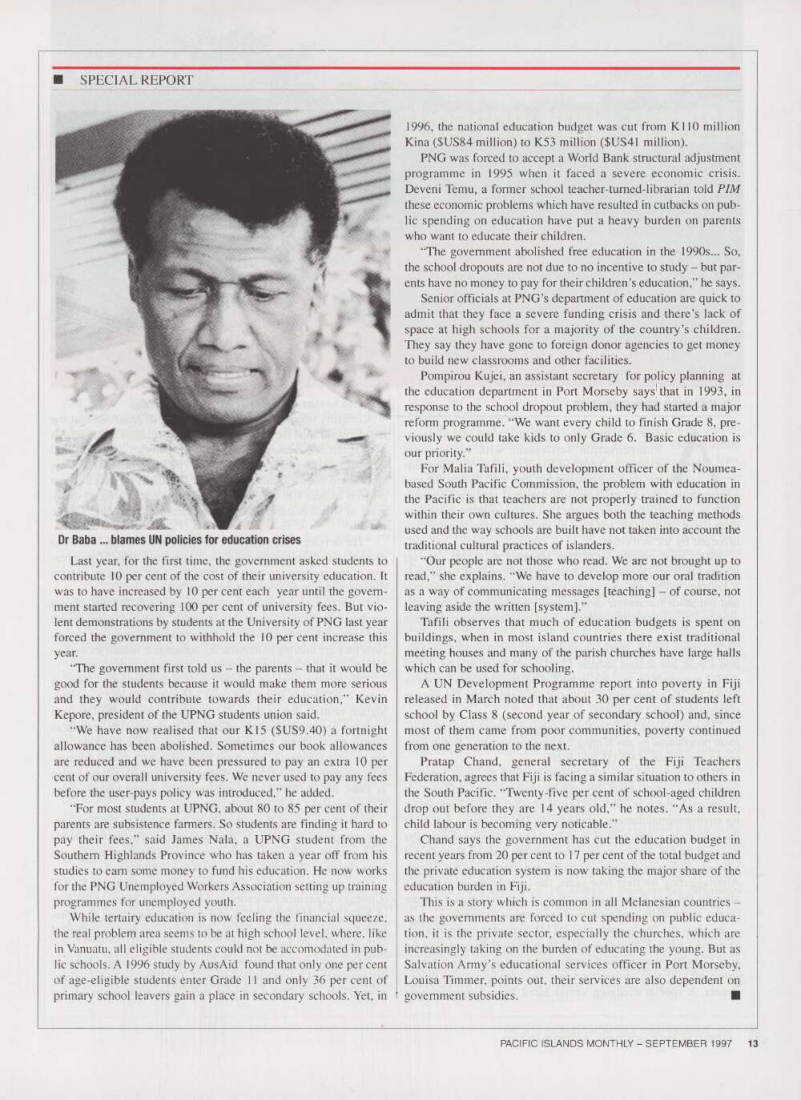
Professor Tupeni Baba, head of the department of education at the University of the South Pacific in Suva, blames United Nations policies and their advisers for the education crisis facing the region. Obed Massing, president of the Vanuatu Teachers’
Union agrees. He says it is the World Bank-IMF (International Monetary Fund) structural adjustment policy prescriptions (espoused by the Asian Development Bank in the Pacific) which are forcing governments to cut education budgets.
The Vanuatu government cut this year's education budget from VI billion (SUS9.S million) to V7OO million (SUS 6.3 million) and moved to sack over 180 temporary school teachers around the country.
“We believe it’s a policy adopted from the World Bank’s struc tural adjustment programmes,” Massing told PIM. “At a time when the population is growing, we can’t see the point in govern ment laying off teachers.
“The government can only provide room in secondary schools for 30 to 40 per cent of students who pass the Year 6 (final year of primary school) exam. Lots of students have to go back to their villages and that’s the end of their education.”
John Liu, secretary to the Vanuatu ministry of education argues that these students are not really school dropouts. "They have passed Year 6 but don’t have a place to go to from Year 7 upwards... We are working with our donor agencies to build more room in secondary schools for them,” he told PIM.
Liu says just building rooms won’t solve the crisis and, because of budget cuts, it will always be a problem for his min istry to find the money to run these schools.
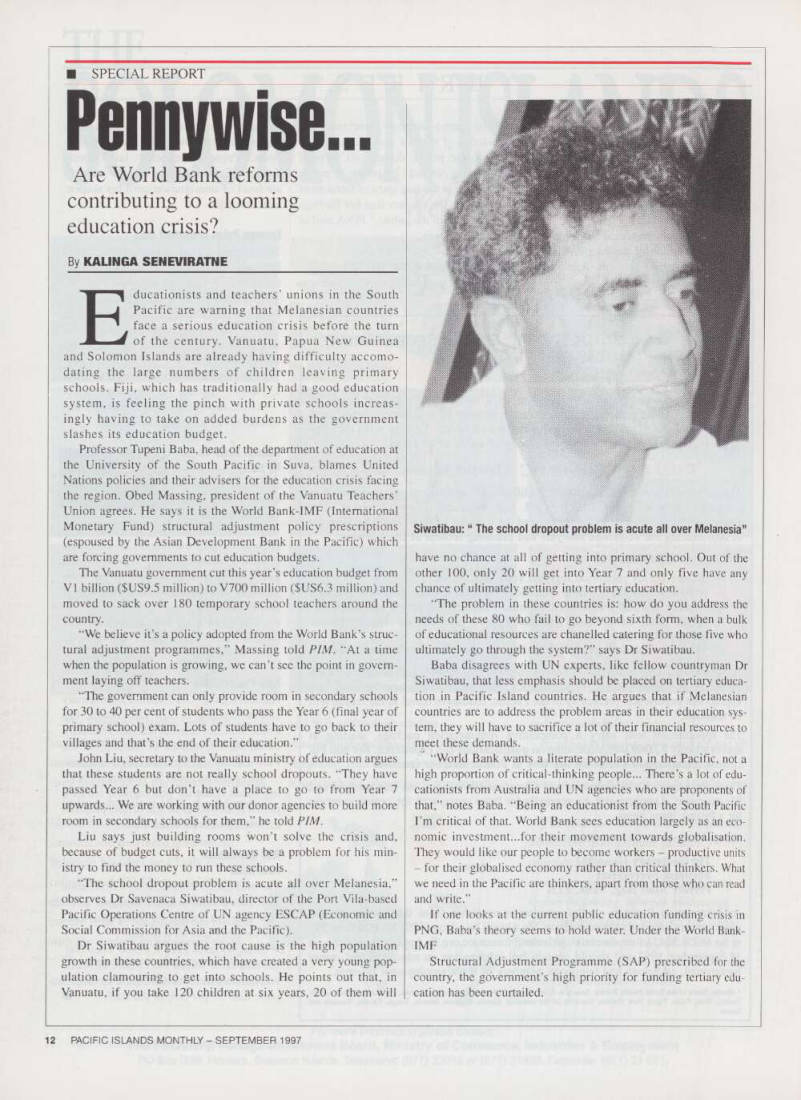
“The school dropout problem is acute all over Melanesia,” observes Dr Savenaca Siwatibau, director of the Port Vila-based Pacific Operations Centre of UN agency ESCAP (Economic and Social Commission for Asia and the Pacific).
Dr Siwatibau argues the root cause is the high population growth in these countries, which have created a very young pop ulation clamouring to get into schools. He points out that, in Vanuatu, if you take 120 children at six years, 20 of them will
have no chance at all of getting into primary school. Out of the other 100, only 20 will get into Year 7 and only five have any chance of ultimately getting into tertiary education.
“The problem in these countries is: how do you address the needs of these 80 who fail to go beyond sixth form, when a bulk of educational resources are chanelled catering for those five who ultimately go through the system?” says Dr Siwatibau.
Baba disagrees with UN experts, like fellow countryman Dr Siwatibau, that less emphasis should be placed on tertiary educa tion in Pacific Island countries. He argues that if Melanesian countries are to address the problem areas in their education sys tem, they will have to sacrifice a lot of their financial resources to meet these demands.
“World Bank wants a literate population in the Pacific, not a high proportion of critical-thinking people... There’s a lot of edu cationists from Australia and UN agencies who are proponents of that,” notes Baba. "Being an educationist from the South Pacific Tm critical of that. World Bank sees education largely as an eco nomic investment...for their movement towards globalisation.
They would like our people to become workers - productive units - for their globalised economy rather than critical thinkers. What we need in the Pacific are thinkers, apart from those who can read and write.”
If one looks at the current public education funding crisis in PNG, Baba’s theory seems to hold water. Under the World Bank-
Imf
Structural Adjustment Programme (SAP) prescribed for the country, the government’s high priority for funding tertiary edu cation has been curtailed.
Siwatibau: “The school dropout problem is acute all over Melanesia”
Last year, for the first time, the government asked students to contribute 10 per cent of the cost of their university education. It was to have increased by 10 per cent each year until the govern ment started recovering 100 per cent of university fees. But vio lent demonstrations by students at the University of PNG last year forced the government to withhold the 10 per cent increase this year.
“The government first told us - the parents - that it would be good for the students because it would make them more serious and they would contribute towards their education,” Kevin Kepore, president of the UPNG students union said.
"We have now realised that our Kl 5 (SUS9.4O) a fortnight allowance has been abolished. Sometimes our book allowances are reduced and we have been pressured to pay an extra 10 per cent of our overall university fees. We never used to pay any fees before the user-pays policy was introduced,” he added.
"For most students at UPNG, about 80 to 85 per cent of their parents are subsistence fanners. So students are finding it hard to pay their fees,” said James Nala, a UPNG student from the Southern Highlands Province who has taken a year off from his studies to earn some money to fund his education. He now works for the PNG Unemployed Workers Association setting up training programmes for unemployed youth.
While tertairy education is now feeling the financial squeeze, the real problem area seems to be at high school level, where, like in Vanuatu, all eligible students could not be accomodated in pub lic schools. A 1996 study by AusAid found that only one per cent of age-eligible students enter Grade 11 and only 36 per cent of primary school leavers gain a place in secondary schools. Yet, in
1996, the national education budget was cut from KllO million Kina (SUSB4 million) to K 53 million (SUS4I million).
PNG was forced to accept a World Bank structural adjustment programme in 1995 when it faced a severe economic crisis.
Deveni Temu, a former school teacher-tumed-librarian told PIM these economic problems which have resulted in cutbacks on pub lic spending on education have put a heavy burden on parents who want to educate their children.
“The government abolished free education in the 19905... So, the school dropouts are not due to no incentive to study - but par ents have no money to pay for their children’s education,” he says.
Senior officials at PNG’s department of education are quick to admit that they face a severe funding crisis and there’s lack of space at high schools for a majority of the country’s children.
They say they have gone to foreign donor agencies to get money to build new classrooms and other facilities.
Pompirou Kujei, an assistant secretary for policy planning at the education department in Port Morseby says 1 that in 1993, in response to the school dropout problem, they had started a major reform programme. “We want every child to finish Grade 8, pre viously we could take kids to only Grade 6. Basic education is our priority.”
For Malia Tafili, youth development officer of the Noumea based South Pacific Commission, the problem with education in the Pacific is that teachers are not properly trained to function within their own cultures. She argues both the teaching methods used and the way schools are built have not taken into account the traditional cultural practices of islanders.
“Our people are not those who read. We are not brought up to read,” she explains. “We have to develop more our oral tradition as a way of communicating messages [teaching] - of course, not leaving aside the written [system].”
Tafili observes that much of education budgets is spent on buildings, when in most island countries there exist traditional meeting houses and many of the parish churches have large halls which can be used for schooling.
A UN Development Programme report into poverty in Fiji released in March noted that about 30 per cent of students left school by Class 8 (second year of secondary school) and, since most of them came from poor communities, poverty continued from one generation to the next.
Pratap Chand, general secretary of the Fiji Teachers Federation, agrees that Fiji is facing a similar situation to others in the South Pacific. "Twenty-five per cent of school-aged children drop out before they are 14 years old,” he notes. “As a result, child labour is becoming very noticable.”
Chand says the government has cut the education budget in recent years from 20 per cent to 17 per cent of the total budget and the private education system is now taking the major share of the education burden in Fiji.
This is a story which is common in all Melanesian countries as the governments are forced to cut spending on public educa tion, it is the private sector, especially the churches, which are increasingly taking on the burden of educating the young. But as Salvation Army’s educational services officer in Port Morseby, Louisa Timmer, points out, their services are also dependent on government subsidies. ■
Dr Baba...blames UN policies for education crises