Lawsuits plague Samoan daily
pp. 32-33 · Read in the full issue
Media
By Chris Peteru
Concern is mounting over threats by the Samoan government to stop the country’s only daily newspaper from publishing. In a spe cific reference to the Samoa Observer in parliament, Human Rights Protection Party Prime Minister Tofilau Eti Alesana said he wanted to amend the law in order to withhold or refuse licenses to newspapers “that stir up trouble”.
“I think the prime minister’s unhappy about what’s being said in the paper,” says publisher Savea Malifa sardonically. The antagonism between the two parties goes back to the 1980 s, he said.
Viewed as mainly anti-governnment, the controversial paper is facing a $ 1.6million stack of lawsuits. These include charges of defamation and criminal libel laid by the PM against Malifa and a Samoan editor, plus contempt of court and
defamation by chief executive officer Richard Gates and Polynesian Airlines.
As a result, Alesana’s political and per sonal reputation had been seriously injured and he had been exposed to ridicule and contempt, defence lawyer Katalaina Sapolu told the supreme court. Similarly, Polynesian’s Gates is claiming defamation for an editorial in January following a fatal crash in which three people died when a Twin Otter aircraft careered into a hillside.
For Malifa, the Apia court rooms have become a familiar sight, as have the names of the plaintiffs.
In past years, both the PM and deputy Tuilaepa Malielegaoi have filed huge legal actions against the paper for hundreds of thousands of dollars that were eventually dropped. The paper has responded by call ing the lawsuits a despicable campaign of intimidation. Malifa believes the suits are a ploy to squeeze him financially.
“These cases are going to cost a hell of
a lot to defend.”
More fiscal pressure was applied last year when the government announced a
policy of only advertising in state-owned
media.
Inside the house, Malielegaoi described the Observer as being run “by a bunch of fools” and referring to the publisher “as an opposition candidate who is still angry at losing in last year’s general elections”.
“That is very irresponsible - without any basis. It’s all political manipulation. I lost because there was a lot of money [ille gally] being spent in my constituency on election day,” says Malifa.
First published in 1979, support on the street for the Observer has tended to run between very strong and slightly bemused.
Widely held as the only public forum with a shot at keeping the colourful Tofilau gov ernment accountable, it has also shown an ability to offend sections of its readership with some outrageous copy.
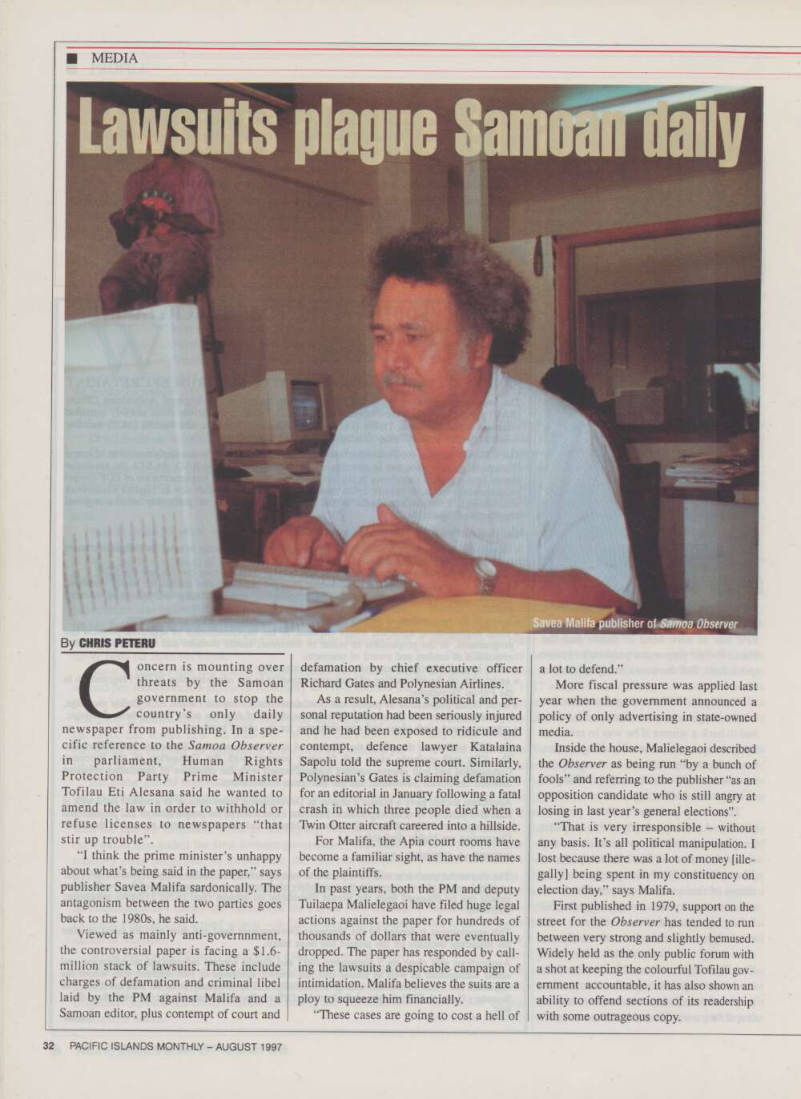
Savea Malifa publisher of Samoa Observer
One infamous editorial last November stated “that women who have been violently abused usually deserve it”.
Penned by Malifa, it asked: “Do woman enjoy being abused?
Many believe that deep down some of them do. It’s the primordial instinct at play causing confusion amongst today’s advanced thinkers.”
Stunned news agencies overseas called local correspondents asking if it was some kind of prank. It wasn’t.
Other editorials could best be described as something akin to character assassination rather than thought-provoking treatises on issues or people. Alternatively, a government which refuses to
admit even the smallest indiscretion, promotes supporters with criminal records has earned its reputation as marginalising public interest for its own gain.
Pacific Island News Association president Monica Miller has come out in support of the Observer with a public appeal to the government to respect the rights of freedom of speech and infor mation. Nevertheless Malielegaoi called PINA’s allegations “absolute rubbish”.
“What is being written in the Observer in Samoan would be unprintable in English’ he told Radio New Zealand.
“The truth hurts you know, the government realises there are people actually reading what is going on, especially the Samoans out in the villages. It frightenes them,” counters the publisher.
Media sanctions have not been restricted to one publication or person. For years now, the opposition leader Tuiatua Tamasese has been banned from both national radio and television, a move the government frivolously explains is payback for similar treat ment when they were in opposition years ago.
“There was one single instance where Televise Samoa came to my house and interviewed me. I was told by the television station later that the interview was not aired on specific instructions from the prime minister.
“He is the chief promoter of a ban that has existed for 10 years which makes government media inaccessible to the opposition.”
Alesana is “one of the most brutal, tough and cunning political operators inthe Pacific”, he said.
Neither situation augurs well when it comes to providing the public with informed decisions. Not that the public is in any great hurry to see what goes on after the first-ever broadcasts of parlia ment went to air on state television recently. This Mecca of visionary decision-making, where journalists are allowed to watch, but not take notes, was for those two sessions punctuated by a mixture of barnyard noises and bar room language, starring the country’s two elder statesmen.
Within 10 minutes of the opening prayer, the PM, supposedly a bom-again Christian, might have been speaking in tongues when calling Tamasese (a direct royal descendent) a pig, a horse, an adulterer, who was high minded and, when last prime minister, had been a supreme skirt chaser of women in his department. All in one sentence.
Happy to repay the compliment, Tamasese told the nation Alesana was a liar on a global scale and a thief; in fact, “the only PM in the whole world confirmed [in court) as a thief’. Little wonder the parliamentary debates have never been screened before.
Significantly government supporters who believe the HRPP chant that Malifa’s paper is a payed-up opposition supporter may have short memories. The Observer is credited with, in 1981, playing a role in the ousting of Tamasese’s government following a 13-week strike by civil servants. Now in opposition and with only nine members of parliament left, they have not been near the Treasury benches since.
“Despite copping all that back then Tuiatua [Tamasese] did not retaliate against the Observer. He did not say a thing,” recalls Malifa.
“Personally, you get stresed out by all this but if we can no longer scrutinise publicly what the government does, we should bloody well close shop. If we bend to this organised campaign by the government, then there is no point.
“But we will keep on, whatever it takes.” ■