Arms and the man
pp. 30-31 · Read in the full issue
Profile
Dogged by Bougainville and with a penchant for military-style solutions, it may seem Sir Julius Chan’s political life is over. But there’s a feeling, almost, that this is not the end...
By Russell Hunter
When the voters of Tanga Island in Papua New Guinea’s New Ireland electorate of Namatanai rejected Sir Julius Chan in the June election, they brought to a close his 29 years in public life.
“That’s probably the end for me,” he was quoted as saying.
“I’ll re-enter private life.”
Don’t bank on it. While, at the age of 58 on August 29, he’ll probably consider himself too old for politics when the next elec tion comes around in 2002, the public hasn’t heard the last of Sir Julius Chan. After 29 years in the public eye, there’s a feeling, almost, that the process of government cannot continue without him.
And in those 29 years, controversy and Sir Julius have rarely been far apart.
Bom on Tanga Island in 1939, the son of Chinese trader Chin Pak Chan and village girl Miriam Tinkonis, the young Julius was educated in Brisbane though his early life was dominated by vil lage culture and by his father’s Chinese identity. True to the latter, he has helped to develop the family business from its island trad ing base through shipping, hotels and now an airline. Business has never been far from his mind.
But it is politics that has made the Chan name. He entered the second pre-independence House of Assembly in 1968, formed the People’s Progress Party two years later and has led it ever since.
The party is named after the group led, for so long, by his politi cal hero, Lee Kwan Yew. As leader of the PPP, Sir Julius was elected as the member for Namatanai in the first independent par liament in 1976. He was to hold the seat until this year.
His name gained regional prominence in 1980 when the then deputy prime minister led a no-confidence vote against the gov ernment led by his former ally. Sir Michael Somare. Sir Julius, with the late Sir lambakey Okuk as his deputy, successfully put the motion that ended the first Somare government. The parlia mentary coup propelled Sir Julius into the PM’s office (even though the fiercely ambitious Sir lambakey would be a thorn in his side for the next two years) and he soon gained world fame as he enthusiastically hailed the success of the Papua New Guinea Defence Force’s first armed action - in the newly independent nation of Vanuatu.
While France and Britain, the former joint rulers of the colony of The New Hebrides, dithered, the fledgling Lini government turned to PNG for help and the Kumul Force (led by the then Brigadier-General Ted Diro) crushed the Jimmy Stevens rebellion on Espiritu Santo.
Basking in the reflected glory of the military. Sir Julius milked the success for all it was worth. Yet it can be argued that this was the beginning of his love for military solutions - he consistently pushed for a standing Pacific Forum “peace force” - that would lead to the Sandline affair and his political undoing.
And if the 1997 prime minister embarked on an election cam paign bathed in controversy, the 1982 prime minister was no dif ferent.
The ’B2 campaign was punctuated by street demonstrations calling for Sir Julius’ political head. The controversy this time sur rounded the Sir Julius-Sir lambakey cabinet’s purchase of a SUS million Grumman Gulfstream executive jet. The plane - bought despite howls of protest from the opposition, the media and just about everybody else who was unlikely ever to sit in it - was burnt in effigy by Port Moresby students during a street demonstration.
Yet despite the din. Sir Julius displayed his customary disdain for criticism, insisting that the aircraft would save the country money.
It had no impact on the vote in Namatanai but Sir Julius’s PPP was unable to gather sufficient seats to be a major force in parlia ment and he and all other contenders were outmanoeuvred by Sir Michael Somare in the post-election horse trading that is the hall mark of PNG government-making. It would be 13 years before he returned to the prime minister’s suite.
Sir Michael, at the head of Pangu Pati, swept back to power, relegating Sir Julius to the opposition benches. But not for long.
By the time the 1987 election came along, he was back in the deputy prime minister’s office after Sir Michael disappeared in yet another no-confidence motion, this time planned by his former ally Paias Wingti.
And once again, Sir Julius went out on the campaign trail with the howls of protesters ringing in his ears. This time it was money.
In 1996, the Canadian mining giant Placer Dome decided to float part of its Pacific assets in the biggest float the Australian sharemarket had then seen.
It was decided that 11 per cent of the float would be set aside for PNG investors with strict limits applied to the number of shares available to each individual. Soon, however, it became apparent that the limits would apply on a selective basis. The mum and dad investors - the small people - were able to secure a handful of shares while the big people somehow managed to cor ner much of the market. As Pacific Islands Monthly pointed out at the time, a glance through the Placer Pacific share register read like a Who’s Who of public life in PNG.
In any case, the float went ahead and the stags - Sir Julius among them - made a killing as the shares doubled in value on the first day of trading. The minister protested strongly that the profit was made by his party, not himself. With an election pending, the
PPP was in sore need of funds and the Placer Pacific play was a good way to raise quick cash. But the controversy refused to die.
Finding his PPP once again with a few - but strategic - number of seats, Sir Julius had to back a winner if he was to return to the government benches. He did just that, becoming a popular and, in many ways, innovative trade minister in Paias Wingti’s new government.
These were perhaps his finest years in
politics. As Wingti enjoyed his popular
image (he drove his own small car and shunned, at least at first, the trappings of power), he left Sir Julius pretty much in charge of trade and commerce. The busi ness community had always regarded Sir Julius as a pragmatist, a minister who would lay down the rules and not change them every time the political whim took him. By now, however, with his plan for a stock exchange among other innovative policies, business had come to love him as one of their own. He enjoyed more support
from the business community than any minister before or since.
It wasn’t to last. As the Bougainville crisis deepened and PNG Budget haemor rhaged millions of kina, the Wingti cabinet succumbed to the inevitable no-confidence
motion, this time instigated by Pangu’s
new leader Rabbie Namaliu.
By the time of the 1992 election, Sir J, as he is known in the PPP, was deputy opposition leader.
He campaigned strongly and was again
rewarded for supporting Wingti with the
position of finance minister and deputy
prime minister.
Two years ago. Sir Julius made his move, returning to the prime minister’s office the same way he arrived - through a vote of no confidence.
Vowing to solve the Bougainville crisis once and for all, the new prime minister offered peace talks but gradually, frustrat ed by the rebels’ intransigence, he moved towards a military solution and the secret Sandline deal. The rest, as they say, is his tory. ■
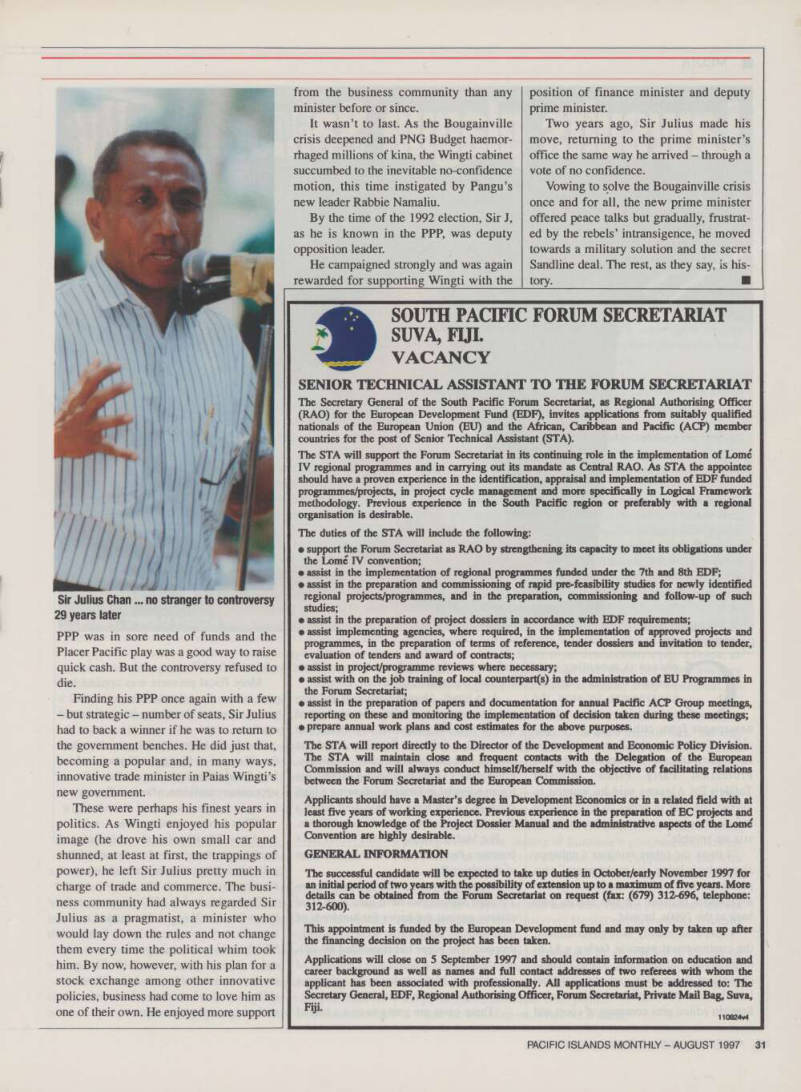
Sir Julius Chan...no stranger to controversy 29 years later