Initiation tradition
pp. 48-49 · Read in the full issue

Culture
Initiation tradition PNG’s oldest surviving male circumcision rites
Sitting astride a wooden dish, Namir could not help but stare at the blood from his severed manhood, forming into a pool at the base of the dish. Mixed tears of relief and pain were streaming down his eyes, dropping off the cheeks and into the pool. The pain was exacerbated by the open wound glaring
back at him. Namir had just gone through what every young male child in the Cape Gloucester dis trict, West New Britain province dread most - one of Papua New Guinea’s oldest surviving and most sacred traditional practices, the male circumcision ritual.
Although he was told about what to expect, everything hap pened so fast that all was over before he was able to work out what had happened to him.
However, he remembered that there were no pain killers of any kind used before he was operated on.
Instead, he was made to bite on a hard betelnut to contain the pain.
He had seen other village boys his senior go through the ritual but he had never imagined the degree of pain they were subjected to, until that moment. He was about six years-old.
Namir, who was circumcised with several other boys, was wail ing by the time everything was over, as he was carried to the veran dah of the family home. The ritual is usually performed in front of the men’s house. It took some effort to calm him until his mother came to his side. The wailing was reduced
to sobs and heaves as he sat there motion less, listening to his mother’s words of comfort. She told him that within weeks, the pain would subside and the wound be healed. She said he had to suffer to avoid being ridiculed in front of women and other men when he grew up. His blood in the dish was later buried safely in a secluded area and he was taken to the men’s house, which became his home - away from his mother, a younger sister and friends - for a
month. Namir spent the period with the other boys confined to the men’s house.
They only went out to use the toilet.
Guardians took care of their food, water and ensured that the wounds did not become infected. No medicine, neither modem nor traditional, was used on the wounds and they also went without show ers. The guardians adorned them daily with
red soil, mixed with coconut oil. They were told to stay naked for at least a week. There were other precautions they had to take to prevent any inflammation of the wounds.
However, there was one that Namir will
never forget.
They were told to avoid contact with cobwebs, especially while going to the toi let. Cobwebs are seen to be the most dan gerous substance and able to cause serious infection to the wounds of newly circum
cised boys. They were only visited daily by their fathers, guardians and other men from the village. According to custom, both dur ing circumcision periods and at any other times, women are not allowed near or into the men’s house. It’s the central meeting place for men where decisions regarding circumcision, other traditional practices and the general well-being of the village are made. The decisions are later announced to the women by a village elder.
After about two days in the men’s house, the villagers brought in several smooth and shiny rounded stones. Each of them was represented by a stone. The
stones were placed above their beds in goufds filled with water.
The belief associated with the stones is that they will pass on spe cial supernatural powers to newly circumcised boys. The stones, which are usually collected from a special creek, are later returned at the end of every confinement.
Namir, who is now a grown man, has come to accept the practice as being part of his people’s since the dawn of time. The pain he had gone through and the sacrifices he had to make have been overshad owed by the realisation of the value and importance of the prac tice to his people’s lifestyle. While men in other parts of PNG and the world choose to be circumcised for health or other reasons, for the Cape Gloucester people, the prac tice is compulsory. It is a rite of passage for men. It gives men pride, identity, power and status. It is a ceremonial event, which involves a lot of feasting and
dancing.
The men display this pride and power through the use of an imag inary and sacred spiritual entity, or the tumbuan in Melanesian pidgin.
The Cape Gloucester people
believe that the tumbuan lives among them.
It is regarded as a godly being which has special deadly powers. Its human form is
seen through prominent and respected
elders in the society, who are usually sor cerers. People are expected to show respect and obedience to the tumbuan. Those who fail to do so will be punished, with death through sorcery being the ultimate form of punishment. The tumbuan is represented in the circumcision ceremonies by two types
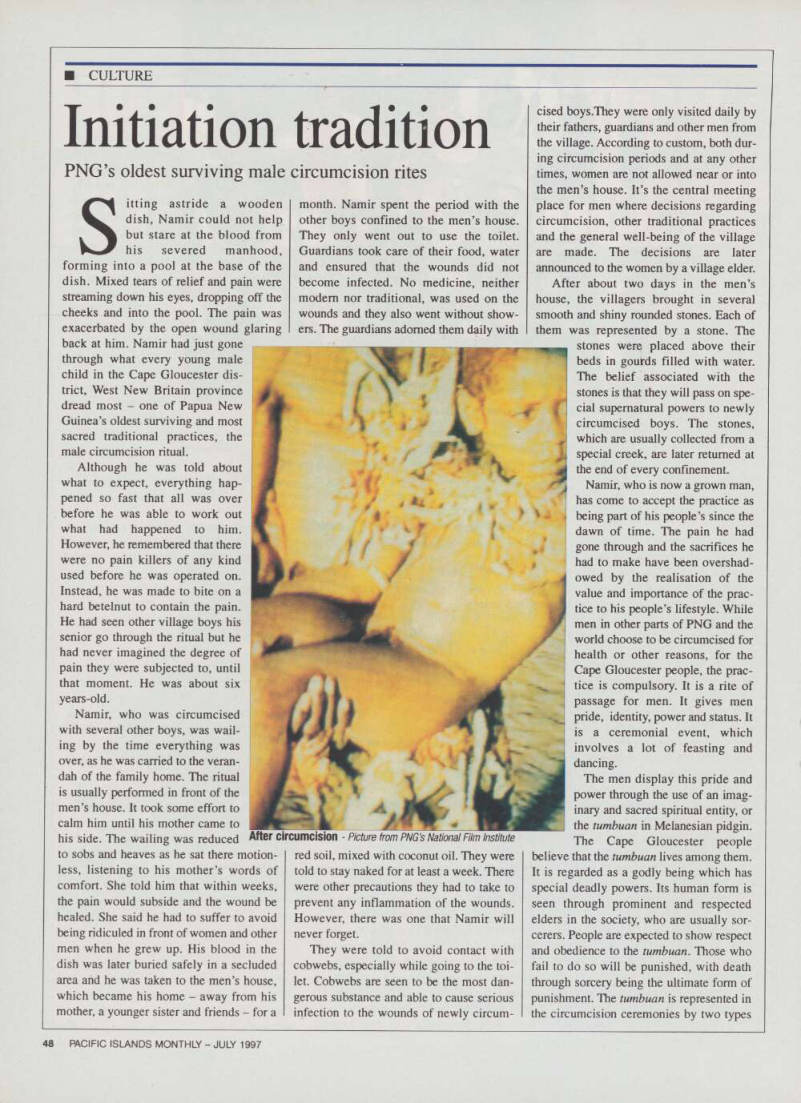
After circumcision - Picture from PNG’s National Film Institute
of dancing masks which are worn by men
during the feasting and dancing.
The tumbuan is the core of the event.
The first type consists of a colourfully painted head guise and a huge umbrella type lower body embellishment, woven out of cane leaves and worn from the neck down. The second consists of a cone-type decorated head mask and a lower body out fit made of dried banana leaves. Only men are allowed to take part in all activities relating to the tumbuan. Everything they do must be kept secret from the women.
There are certain rules which men and women are expected to observe. They are not allowed to complain about their prop erties being confiscated and used upon the request of the tumbuan. They must not also refuse a request from the tumbuan to per form a special chore for the circumcision ceremonies. It also has the power to marry the young. Most often partners are forced to live together, even without love.
Young men are not allowed to be intro duced to the tumbuan unless they pay their way in, using traditional currency such as shell money, wooden dishes, clay pots and
pigs. This is the second part of the initia tion process after going through the cir cumcision ritual. Once a young man enters the men’s house and the sacred camp where all decorations for the dancing masks are made, he will not be allowed back home during the entire duration of the
ceremony period.
He’ll be exposed to the sacred practices of the tumbuan and he will also be taught how special ornaments are made. This is followed by a public flogging to be carried out by several tumbuan, in front of the men’s house which completes the initiation process. During the actual circumcision of the children, several tumbuan form a shield around them to bar off women. A specialist performs the ritual and he is paid hand somely by the children’s parents.
During the dancing, the men beat the drums and sing while the tumbuan, usually numbering to about 10 to 20 in huge cere monies, and the women dance around them in a circle. The women also sing along with the men. Villages from near and far are invited to attend and take part in such cer emonies. Heavy supply of roasted and live
pigs and food, together with shell money and other traditional monetary items are given to the representatives of each village in appreciation of their part in the celebra tions.
The fact that the practice survives is arguably because it is free of health risk, unlike nose and ear piercing, tattooing and other related PNG traditional practices.
With the advent of HIV/AIDS, these prac tices have become increasingly dangerous.
However, while PNG health authorities have regularly warned of the other prac tices, the circumcision practice remains free from concern.
As far as history of the practice is con cerned, no one has ever suffered or even died from an infected wound. The practice is very much entrenched and alive today in Namir’s society as it was many years ago.
Its importance can be seen from the fact it is performed on deceased male children before burial.
Those who live and work in towns and cities are required to arrange with relatives for their male children to be circumcised while on holiday in their villages. ■