Miriam scales the heights
p. 50 · Read in the full issue
Music
By Atama Raganivatu
When, at some future time, a definitive his tory of the South Pacific is written, it will surely recall the 90s as the decade in which people from the region proved themselves able to excel in vir tually all fields of human endeavour.
Opera, a branch of the arts traditionally associated with sophisticated Latin males and formidably plump Teutonic women, is among the latest provinces to be “infiltrat ed” by Pacific Islanders. Papua New Guinea-bom Miriam Gormley spearheads this friendly invasion. Established as one of Australia’s most talented young sopra nos for several years now, Miriam is cur rently with the Vienna State Opera and sharing the stage with many leading European opera stars.
Miriam’s first 10 years were spent in Port Moresby before her Australian father, fearing political upheaval as PNG’s inde pendence loomed, moved his family to Nambour in northern Queensland.
Curiously, neither of Miriam’s parents are particularly musically inclined. Her father occasionally plays the violin and owns a few orchestral and jazz records, while her mother’s interests extend little beyond tra ditional PNG songs. Even today, although two of their daughters are professional sopranos (Clare Gormley, six years Miriam’s junior, has been attached to New
York’s celebrated
Metropolitan
Opera since 1992), they fail to be enchanted by
opera’s glamour.
“We may as well be electricians,”
Miriam laments and then adds that two of her brothers actually are electri cians. The third is a
plumber.
Irrespective
of where Miriam’s desire to entertain comes from, it became apparent at
an early age. While at school, she staged theatrical plays for her classmates, devel oped an interest in ballet and learned to play the cello. It was a passion for theatre which originally led her to opera. “I love my profession and I particularly love the acting aspect of it,” she enthuses. “Getting singing and acting together in a balanced way is the challenge I particularly relish.”
Initially, though, Miriam had little opportunity to display her flair for the dra matic side of opera. The first tentative step towards stardom was taken in the late 70s when her high school music teachers per suaded her to enter aria competitions. She won a large percentage of these and vocal competitions were to be her main public artistic activity for some time. In 1980, Miriam enrolled with the Queensland Conservatorium of Music at Griffith University, Brisbane and, three years later, she gained a Diploma of Music (vocal).
While at the conservatorium, Miriam enjoyed successes in several more contests and collected numerous scholarships. She
continued entering competitions (usually
winning them) up until making her profes sional debut with the Lyric Opera of Queensland, as Barbarino in The Marriage of Figaro, in 1985.
A year later, Miriam took advantage of the most significant of the scholarships accumulated to spend a year with the London National Opera Studio at the British capital’s famous Covent Garden.
She was the youngest there, had received
far less vocal training than her fellow stu dents, found the teaching methods confus ing and was slightly overawed by the expe rience. Back in Australia, though, her career thrived as she appeared with all the
Commonwealth’s major operatic organisa
tions and was showered with further awards.
Twice, she was offered the opportunity to join the company of the world-renowned Australian Opera but declined for personal reasons. Instead, Mirian prefers to operate as a freelancer. Apart from the fruitless trip to Covent Garden, her only career hitch to date came in 1993 when a loss of confi dence led Miriam to turn her back on per forming for 10 mopths and seek the tutor ing of Melbourne voice trainer Gary May.
Her self-assurance regained, Miriam moved into other areas of music and appeared in concert performances of popu lar musicals Showboat and Porgy and Bess, toured Queensland with the Queensland Pops Orchestra and sang seasonal songs at Sydney’s magnificent Carols in the Domain, a pre-Christmas extravaganza watched by many thousands live and mil lions on television. But opera remains her forte. Hailed at various times as the “new Kiri Te Kanawa” and the “Dame Joan Sutherland of the next century”, Miriam possesses the magnetism, fervour and sen suality to develop into a true international star. Being attractive and disarmingly fem inine are hardly handicaps either.
Winning the 1997 Vienna State Opera Scholarship enabled Miriam to gain work experience in Europe for the first time and opportunities to extend her repertoire. At the moment, she is known primarily as a specialist in Mozart and Rossini parts, but this will certainly change as her voice develops. Mimi, the heroine of Puccini’s La Boheme, is the role Miriam covets above all others.
The time spent in Europe has whetted her appetite for more engagements in opera’s heartland. Recently, she stated: “Before going to Vienna, my entire career had been spent in Australia. Up until a year ago, I hadn’t really felt ready to work over seas. But it feels right now.”
If Miriam does fulfil her ambitions and gain lead roles performing in the major opera houses of Europe, her feat will be every bit as meritorious as David Tua’s heroics in the boxing ring, Vijay Singh’s exploits on the world’s golf courses and Jonah Lomu’s deeds on the rugby pitch. ■
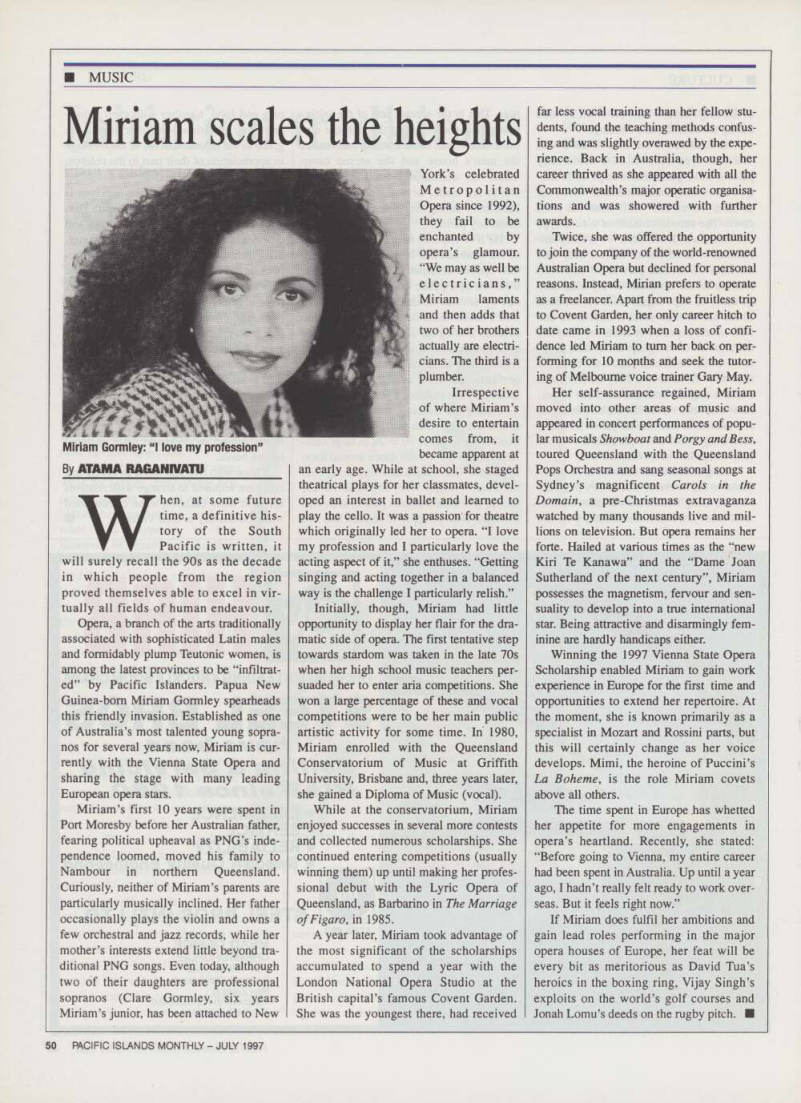
Miriam Gormley: “I love my profession”