Heartening times
pp. 46-47 · Read in the full issue
for Pacific soccer
By Atama Raganivatu
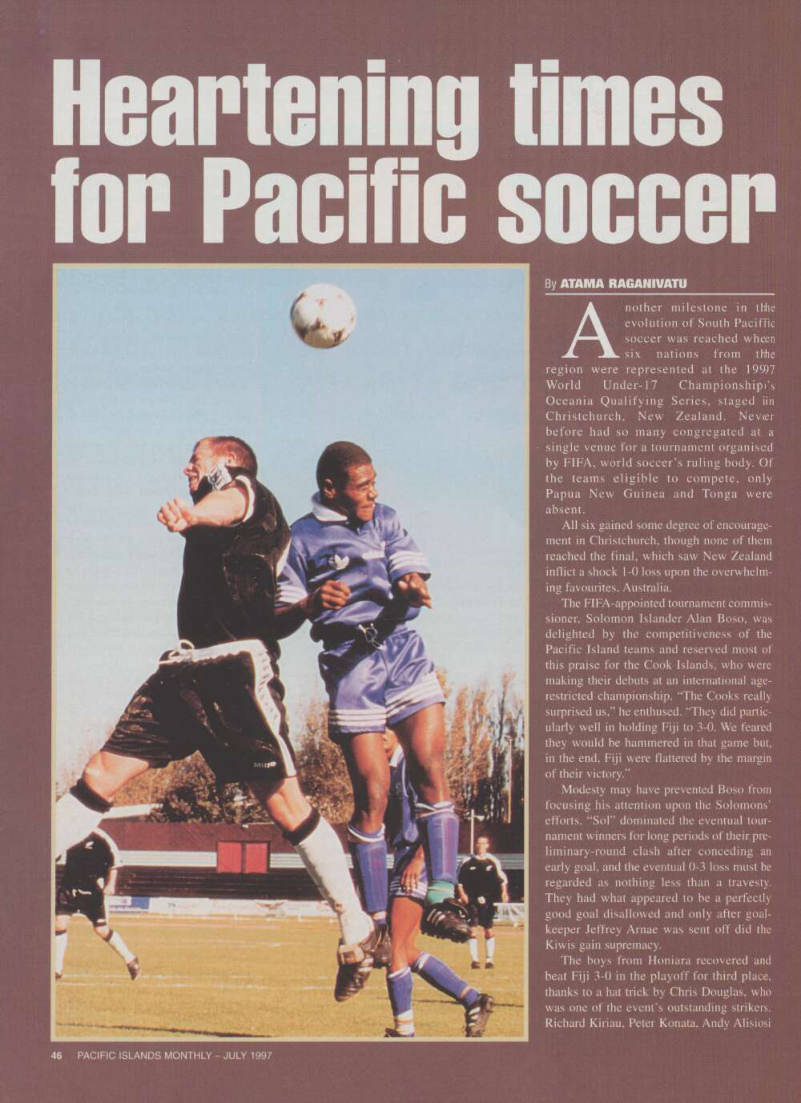
Another milestone in thhe evolution of South Pacifi'ic soccer was reached wheen six nations from thhe region were represented at the 19997 World Under-17 Championshipi’s Oceania Qualifying Series, staged iin Christchurch, New Zealand. Never before had so many congregated at a single venue for a tournament organised by FIFA, world soccer's ruling body. Of the teams eligible to compete, only Papua New Guinea and Tonga were absent.
All six gained some degree of encourage ment in Christchurch, though none of them reached the final, which saw New Zealand inflict a shock 1-0 loss upon the overwhelm ing favourites. Australia.
The FIFA-appointed tournament commis sioner. Solomon Islander Alan Boso, was delighted by the competitiveness of the Pacific Island teams and reserved most of this praise for the Cook Islands, who were making their debuts at an international age restricted championship. "The Cooks really surprised us.” he enthused. “They did partic ularly well in holding Fiji to 3-0. We feared they would be hammered in that game but, in the end, Fiji were flattered by the margin of their victory."
Modesty may have prevented Boso from focusing his attention upon the Solomons' efforts. “Sol” dominated the eventual tour nament winners for long periods of their pre liminary-round clash after conceding an early goal, and the eventual 0-3 loss must be regarded as nothing less than a travesty.
They had what appeared to be a perfectly good goal disallowed and only after goal keeper Jeffrey Arnae was sent off did the Kiwis gain supremacy.
The boys from Honiara recovered and beat Fiji 3-0 in the playoff for third place, thanks to a hat trick by Chris Douglas, who was one of the event’s outstanding strikers, Richard Kiriau. Peter Konata. Andy Alisiosi
and James Dania also caught the eye.
The hard-working Fijian combination,
despite having an
inadequate build-up, acquitted themselves well before meeting the Solomons. A 2-1 victory over archrivals
Tahiti virtually
assured them of a place in the semi finals where New Zealand required an 84th-minute goal to clinch their 2-0 suc cess. Goalkeeper Maika Nasema, in particular, earned
spectators’ admiration. After being beaten by both Fiji and Australia, Tahiti produced their best form when it did not really matter to demolish the Cooks 9-0. Axel Tamartua claimed six of the goals and his emergence may well have made the Tahitians’ journey worthwhile.
Vanuatu were involved in, arguably, the competition’s most entertaining game when going down 2-0 to the Solomons. Earlier, their lack of power in midfield and a dis turbing lack of fighting spirit were primari ly responsible for an 8-1 hammering by New Zealand (despite taking the lead after 10 minutes) but Vanuatu’s flair enabled them to overwhelm Western Samoa 6-0.
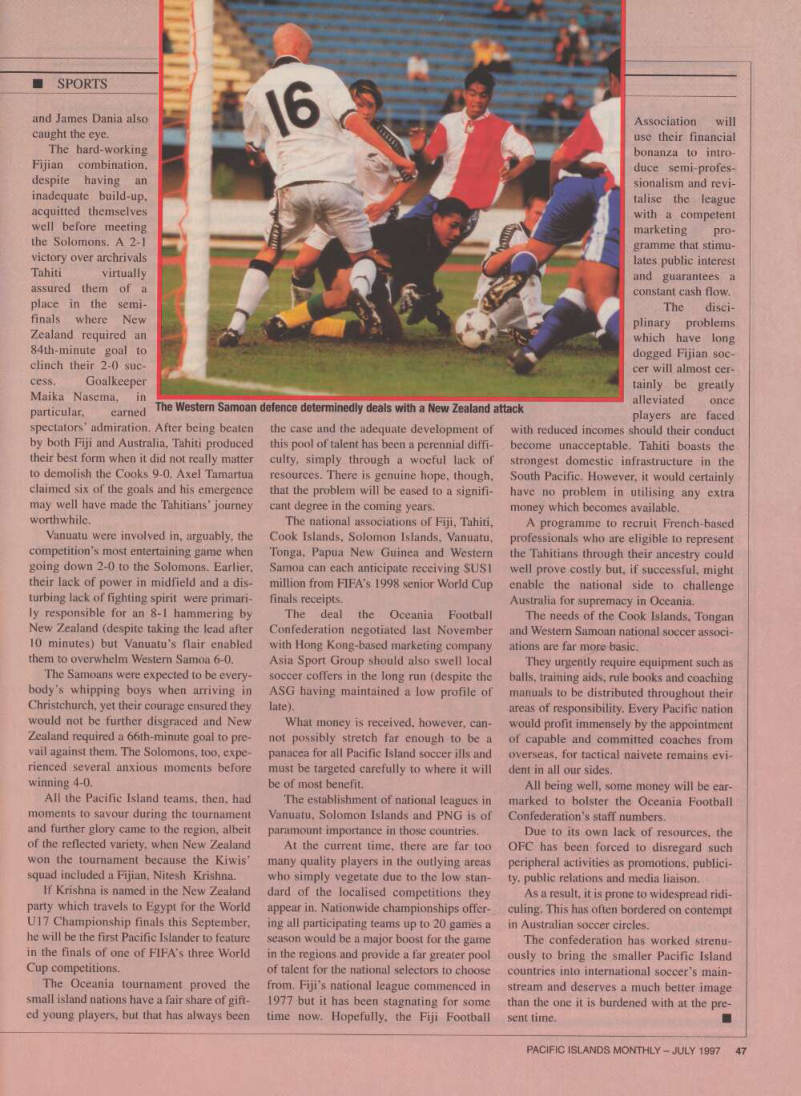
The Samoans were expected to be every body’s whipping boys when arriving in Christchurch, yet their courage ensured they would not be further disgraced and New Zealand required a 66th-minute goal to pre vail against them. The Solomons, too, expe rienced several anxious moments before
winning 4-0.
All the Pacific Island teams, then, had moments to savour during the tournament and further glory came to the region, albeit of the reflected variety, when New Zealand won the tournament because the Kiwis’ squad included a Fijian, Nitesh Krishna.
If Krishna is named in the New Zealand party which travels to Egypt for the World Ul7 Championship finals this September, he will be the first Pacific Islander to feature in the finals of one of FIFA’s three World
Cup competitions.
The Oceania tournament proved the small island nations have a fair share of gift ed young players, but that has always been
the case and the adequate development of this pool of talent has been a perennial diffi culty, simply through a woeful lack of resources. There is genuine hope, though, that the problem will be eased to a signifi cant degree in the coming years.
The national associations of Fiji, Tahiti, Cook Islands, Solomon Islands, Vanuatu, Tonga, Papua New Guinea and Western Samoa can each anticipate receiving SUS 1 million from FIFA’s 1998 senior World Cup finals receipts.
The deal the Oceania Football Confederation negotiated last November with Hong Kong-based marketing company Asia Sport Group should also swell local soccer coffers in the long run (despite the ASG having maintained a low profile of late).
What money is received, however, can not possibly stretch far enough to be a panacea for all Pacific Island soccer ills and must be targeted carefully to where it will be of most benefit.
The establishment of national leagues in Vanuatu, Solomon Islands and PNG is of paramount importance in those countries.
At the current time, there are far too many quality players in the outlying areas who simply vegetate due to the low stan dard of the localised competitions they appear in. Nationwide championships offer ing all participating teams up to 20 games a season would be a major boost for the game in the regions and provide a far greater pool of talent for the national selectors to choose from. Fiji’s national league commenced in 1977 but it has been stagnating for some time now. Hopefully, the Fiji Football
Association will use their financial bonanza to intro duce semi-profes sionalism and revi talise the league with a competent marketing pro gramme that stimu lates public interest and guarantees a constant cash flow.
The disci plinary problems which have long dogged Fijian soc cer will almost cer tainly be greatly alleviated once players are faced
with reduced incomes should their conduct become unacceptable. Tahiti boasts the strongest domestic infrastructure in the South Pacific. However, it would certainly have no problem in utilising any extra money which becomes available.
A programme to recruit French-based professionals who are eligible to represent the Tahitians through their ancestry could well prove costly but, if successful, might enable the national side to challenge Australia for supremacy in Oceania.
The needs of the Cook Islands, Tongan and Western Samoan national soccer associ ations are far more basic.
They urgently require equipment such as balls, training aids, rule books and coaching manuals to be distributed throughout their areas of responsibility. Every Pacific nation
would profit immensely by the appointment
of capable and committed coaches from overseas, for tactical naivete remains evi dent in all our sides.
All being well, some money will be ear marked to bolster the Oceania Football Confederation’s staff numbers.
Due to its own lack of resources, the OFC has been forced to disregard such peripheral activities as promotions, publici ty, public relations and media liaison.
As a result, it is prone to widespread ridi culing. This has often bordered on contempt in Australian soccer circles.
The confederation has worked strenu ously to bring the smaller Pacific Island countries into international soccer’s main stream and deserves a much better image than the one it is burdened with at the pre sent time. ■
The Western Samoan defence determinedly deals with a New Zealand attack