Looking back...
pp. 28-35 · Read in the full issue
Advertising Feature
Solomon Islands
This month, Solomon Islands celebrates 19 years of independence and, as it does so, the peo ple will look back on its history and the events leading up to independence.
The second largest island chain in the region, the Solomons has a population of around 350,000 spread across an area of 28,530 sq km.
The capital, Honiara, is on Guadalcanal, known the world over as the site for some of the bloodiest battles of World War 11.
The country is a scattered double chain of islands which extend 1667 km in a
southeasterly direction from the strife-rid den Bougainville in Papua New Guinea.
Some of the islands are rugged, heavily wooded and mountainous; others are tiny, low-lying coral atolls.
Much of the Solomons is covered with dense rainforest, with mangrove swamps occurring along parts of the coast. Most islands have coral reefs and lagoons around them. Many have formed around an initial volcano cone which has since been over laid with colourful, level-topped terraces of coral rock. Other islands are former reefs lifted high out of the water by vol canic activity. Natural vegetation in the
large islands is mainly dense rainforest.
Mangroves are prolific around river mouths and along stretches of the coastline.
A variety of introduced tropical trees and shrubs have proliferated.
Native animals are few and consist mainly of possums, bats, different types of rats, and mice. There are over 150 species of birds and many varieties of insects brilliantly coloured butterflies and spiders - toads and frogs. Over 170 species of rep tiles, including turtles, crocodiles, lizards and snakes, are found here.
The reefs are home to hundreds of species of tropical fish, colourful coral and other marine life. There are many varieties of rare and poisonous shells. Deep-sea fish,
whales, dolphins and dugongs frequent
these waters.
The Solomons is divided into eight provinces, each headed by a premier with a secretary as overall supervisor of the administration of the province. The provinces are Guadalcanal, Central Malaita, Makira/Ulwa, Isabel, Temotu, Western, Choiseul and Bellona.
Guadalcanal is the country’s largest province.
In the early 15605, rumours swept Spanish-occupied Peru of the existence of a group of islands, or even a great conti nent, far to the west in the Pacific. Inca leg ends told of a sea journey made in the mid 15th century to these islands by one of their
kings.
In 1567, Don Alvaro de Mendana left Peru to find the legendary islands and, on February 7 of the following year, sighted a large island and named it Santa Isabel.
On August 11, Mendana sailed back to Peru with descriptions of the island.
Initially, the name used by Mendana and his crew was “Western Islands” but about two years later, the name “Yslas de Salomon” or “Solomon Islands” became more commonly used.
Many whalers visited the archipelago from 1798 onwards. They were followed by the sandalwood traders who came between the 1840 s and late 1860 s. They bought pigs, turtle shells and mother-of pearl shells in the Solomon Islands to barter for sandalwood with islanders in Vanuatu (New Hebrides at the time). The ships then sailed to China where the san dalwood was sold at very high prices.
Another island product which was pop ular with the Chinese was beche-de-mer.
They paid high prices for it even though
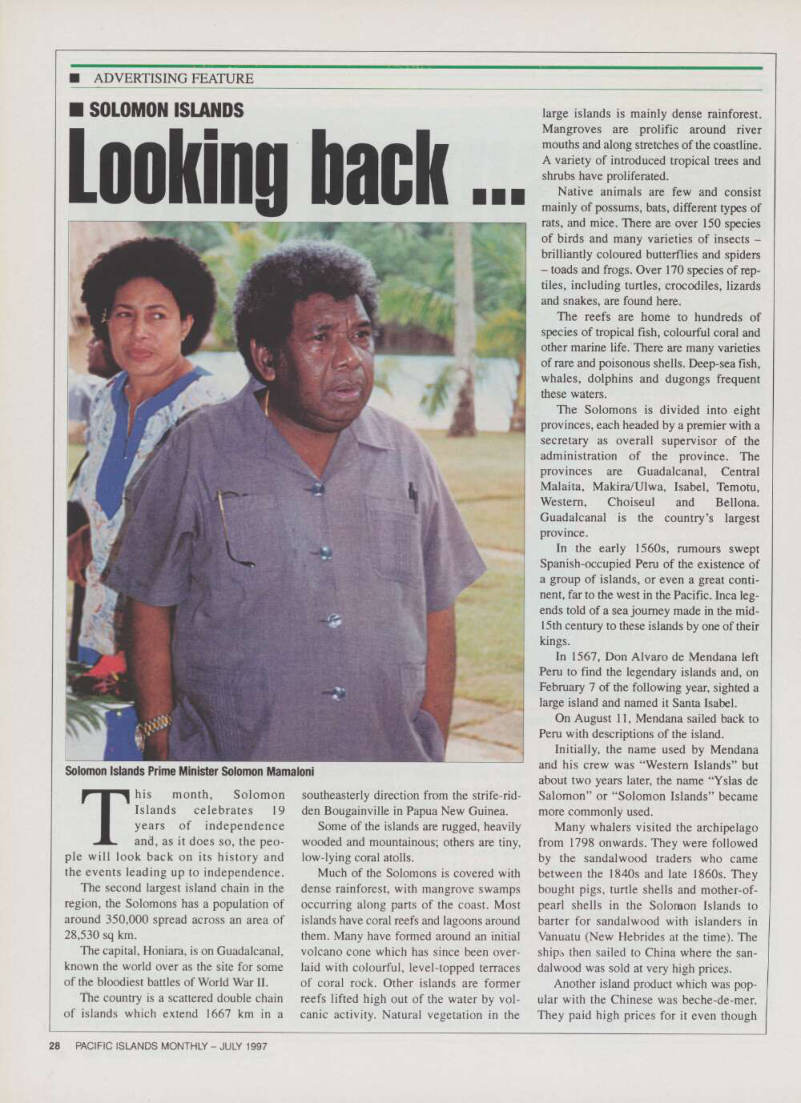
Solomon Islands Prime Minister Solomon Mamaloni
they were in abundance. On October 6, 1893, Britain claimed a protectorate over the southern part of the island group. This claim was extended in 1897 and again in 1898. Education and health issues were left to the missions, as money was scarce.
During the second world war, the coun try was used as a base by the Japanese.
After the war ended, recovery was slow. As Tulagi was gutted, the Quonset-hut town ship of Honiara was replaced as the capital.
Honiara is the main port of entry. It is built on both sides of Point Cruz where Mendana anchored in 1568.
It is also a post-World War II town, which stands on the site of a former coconut plantation. The Japanese had a small base on the site in 1942 and later the Americans built a much larger one after defeating the Japanese in a bitter struggle.
The post-war civil administration used many of the wartime army buildings as offices and quarters until the early 1960 s when both the government and private sec tor carried out a vigorous building pro gramme.
The early 1960 s were years of political awakening in the Solomons, leading to the creation of an elected governing council in 1970.
The British Solomon Islands protec torate was renamed the Solomon Islands five years later and gained independence on July 7, 1978.
Solomon Islands is a constitutional monarchy with the British monarch as the head of state, represented in the country by the governor-general appointed on the rec ommendation of parliament every five years.
With an agro-based economy, income is largely derived from goods and services performed with cash transactions .
About 84 per cent of the people live in rural areas and are self-sufficient in tradi tional foods - root crops, vegetables and fruits - as well as fishing and livestock hus
bandry.
Most settlements are coastal and close to freshwater springs. Each family has a small coconut plantation for copra produc tion and cash income, and a few scattered vegetable plots. There are often bushes and rainforests nearby which provide tradition al crops, wild nuts, ferns and fruits, as well as material for thatched houses and canoes.
Solomon Islands’ main natural resources are its large number of commer cially useful fruit trees, forests, fisheries
and minerals. Over the years, there has been a considerable diversification from a copra-based, one-product rural economy of the colonial era. The seas have become one
Islands has many of the natural resources required for successful eco-tourism.
Approximately two-thirds of children attend school with church-run schools a
of the country’s principal resources. Fish, especially tuna, has become the largest export earner; timber the second; while copra, cocoa and palm oil come jointly third.
Tourism is growing and has potential but currently provides only a minor contri bution to gross domestic product. Solomon
vital part of the education system. The overall objective of the education system is to provide a coordinated programme which can meet the country’s needs for skilled labour as well as provide basic education suited to the village environment where the majority of the population resides. Primary education is not yet compulsory and chil-
Reminder from second world war
Japanese war memorial
dren between the ages of six and nine are admitted into Grade One. There is a preparatory grade for children between the ages of five and eight.
The secondary school system is com posed of national and provincial schools.
Eight national schools provide an academ ic-oriented education over a five-year peri od which leads to the Solomon Islands School Certificate at the end of Form Five.
The provincial schools have a more vocation-oriented syllabus catering for those students who choose to live in their village rather than pursue tertiary educa tion or employment in urban centres.
Approximately 30 per cent of students who complete primary school, attend one
or the other of secondary schools.
Archaeological research has revealed that Solomon Islands has been inhabited for 3000 years. Material excavated on Santa Ana, Guadalcanal and on Gawa in the Reef Islands has been radio-carbon dated to about 1000 BC.
Red pottery thought to have been relat ed to Capita ware was also found on Santa Ana, where it was estimated to be from between 140 and 670 AD. Similar pottery has been found on the Reef Islands.
The immense variety of the Solomon Island culture and customs reflects the existence of 107 indigenous languages and dialects among a population of only 346,000. Officially, there are 63 indigenous
languages and a further 44 dialects. In addition there are three new languages.
They are Solomon Islands Pidgin, English and Gilbertese. It’s quite Common for Melanesians from a few kilometres apart to speak different languages. Dances, cere monies, funerals, weddings, initiation cere monies, status and authority often differ from island to island.
The Solomon Islands, like most other Pacific Island countries prides itself in hav ing a rich and diverse culture. Cultural dis plays are colourful and varied, with islands having their own unique dances and cos tumes.
Weaving is part of Solomons tradition and most weaving is done without looms, using split bamboo, vines, cane and dried coconut and pandanus leaves. Bukaware baskets, trays, tablemats and coasters are made in several parts of the Solomons,
especially Guadalcanal.
The word kastom, meaning custom, is used when villagers refer to traditional beliefs and land ownership. Songs, dances and stories about the past are still common.
They are usually to do with war, harvesting and hunting or the natural world.
Another word which is used frequently is tabu (taboo). Tabu is a very important part of village and island life although rules will vary from place to place. Places which are traditionall tabu, can only be visited with permission from the owners.
Religion plays an important role in most communities, with the church being the central focus in most villages. Christians make up 95 per cent of the population.
Solomon Islanders love sports and take their soccer, basketball, rugby, tennis and athletics quite seriously. Activities such as
fishing and swimming are more necessity
than choice; the first for food the second for cleanliness.
Traditional canoes can still be seen, par ticularly in the outer islands, where people are proud of their production and sailing.
Craft work is also of high quality with much work done with wood inlaid with
mother-of-pearl.
As Solomon Islands, like other coun tries of the world heads into the next mil lennium, it faces the similar challenge of other island countries - how does it enter the new century as a nation that is progres sive and able to make an impact on the world scene while at the same time manag ing to conserve the necessary and impor tant facets of its cultural heritage. ■
Solomon islands... living tradition