17 years after birth
p. 37 · Read in the full issue
Vanuatu
17 years after birth - inocence is lost The problems and the solutions
Reports by Patrick Decloitre
Just like a 17-year-old teenag er, Vanuatu has just gone through another phase in its growth, some even say it has lost its innocence. After 17 years of independence, Vanuatu’s last 12 months have been marked by political instability.
Since late 1995’s general elections, gov ernments have changed four times,
motions of no confidence are something the public is no longer surprised by. A report from Vanuatu’s ombudswoman, Marie-Noelle Ferrieux-Patterson, says there has been no gynaeocologist/obstetri cian since December, 1993 despite offers from Britain to provide assistance.
She adds that “between 1991 and 1-992, the number of deaths of babies at birth dou bled, and tripled the years after - following the departure of experienced midwives and
the absence of a gynaecologist in the coun try”. But all is not bleak - there are signs of a willingness to take steps to remedy the current problems. Under the auspices of the Manila-based Asian Development Bank (ADB), Vanuatu has embarked on measures to define and later implement a comprehensive reform programme, of which the aims include a larger recognition of the private sector and a ‘rightsizing’ of its public service. Since the last general elections, it seems that Vanuatu has
become more mature; paradoxi cally, the context of political instability has entailed more free dom of the local press.
When Vohor took office last September, he pledged to promote more freedom in the media.
Ten months later, it seems that the words have been followed by deeds. Political interference in the government-run media has signif icantly decreased and a Pres Klab blong Vanuatu was formed last year. The island state is also to host this month’s Pacific Island News Association (PINA) region al convention. Vohor’s first secre tary, in charge of media, Antoine Pikioune, recently told a press meeting here that because of political instability in the past 18 months, every party and its politi cians had at one time or another been in opposition, thus realising the importance of free media to be able to convey their views to the public. And, in all this chaos, Pikioune admitted that the media had shown they were responsible, provided they could do their job without political interference.
As President Jean-Marie Leye told parliament while opening its first ordinary session last May: “1996 has been a hard year for the nation but, at the same time, lead
ers should leam a lot of lessons from it. I ask leaders to find every possible way to encourage investment, including from overseas.
This will help us reduce our social prob lems, like unemployment, which rises all the time. “In the interest of the nation, it is everyone’s duty to ensure stability remains in this country at all times to create an environment which will welcome investors”. ■
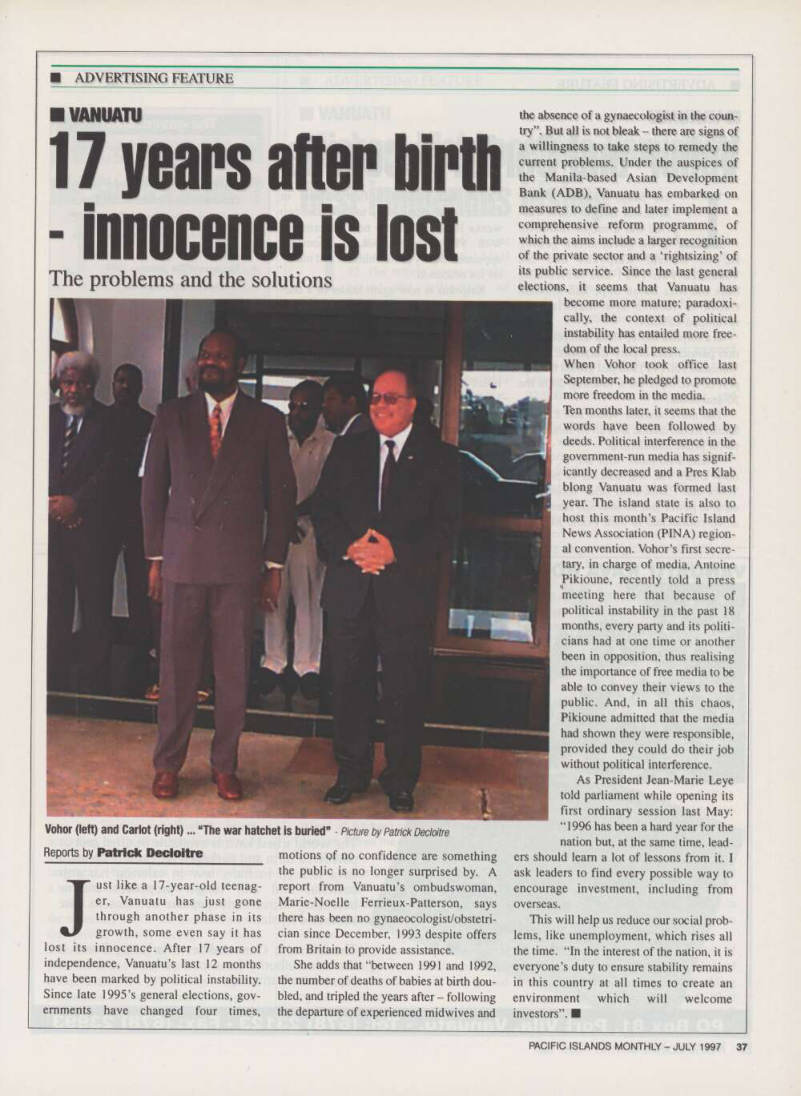
Vohor (left) and Carlot (right)... “The war hatchet is buried” Picture by Patrick Decloitre