Racism at play
pp. 27-45 · Read in the full issue

Sports
By Liu Tuwai
Should racial and religious vilifica tion be accepted as an intricate part of sporting life? Should the past approach to “keep it [sledg ing] on the field” remain?
These are some of the ques tions that Australian sporting organisations and sportspeople have been seriously grappling with. According to Fijian rugby league player Eparana Navale, recent controversy around these issues will work to deter players who practise racism on the field.
“The possibility of the offend ing player receiving heavy fines will make such players think again,” said Navale, who has lived in Sydney for three years. Since switching clubs to Parramatta Eels earlier this year, Navale says he has not had to deal with racist sledging as he had previously.
The first half of 1997 ushered in a clear message from black sportsmen in Australia. An
increasing number of black footballers in all four major codes - Australian football, rugby league, rugby union and soccer have let the nation know they will not accept any level of disrespect on or off the field. Today, in Australia, young black players are enlisting into the football codes at a rate unimaginable a decade ago.
Various clubs throughout New South Wales have sizeable portions of Aboriginal and South Pacific Islanders in their teams.
Many of these players have made it clear that they expect support from whites in order to help combat racial abuse.
The stand from black players had led sporting bodies to not only take steps to stamp out racial discrimination on the field but eradicate it from the minds and mouths of those who engage in such practices.
Leading the way in dealing with the issue of on-field racial abuse is the Australian Football League (AFL).
According to AFL’s Melbourne-based communications manager, Tony Peek, an incident in 1995 between players Damian Monkhurst, from Collingwood, and Aboriginal Michael Long, from Essendon, forced the AFL into taking a no-nonsense stand to support their black players.
Long claimed he had been racially harassed and abused by Monkhurst. His claims were later proven to be correct but, says Peek, “unfortunately at that time we didn’t have any system in place to be able to deal with the issue of on-field racism”.
Peek told Pacific Islands Monthly that AFL would be the first to admit that, at that time, white Australians’ understanding of
the issues were minimal because they had not been exposed to that type of thing before. He said, “We did not understand what it meant to be part of a minority group in soci ety and be abused because of your skin colour or race.”
AFL’s racial and religious vilifi cation rules apply to players from any background but, to date, the focus has been on Aboriginal play ers because five out of six cases reported have involved players from Aboriginal background being
racially abused.
There has only been one com plaint that has been dealt with through confidential mediation involving a player from another eth nic background although there have been comments in the press from players of Italian and Croatian backgrounds expressing disgust toward racial abuse hurled at them by players or someone in the crowd.
There is widespread belief in Australia that racism in sport is not nearly as bad as in other Western countries, and that an equal playing field exists for all players. But,
according to Professor Colin Tatz, “racism in Australia has been as bad or, in some instances, worse than in South Africa or America”.
He prefaces his statement by saying,
“The struggle for Aboriginal people in
sport has been an incredibly difficult one.”
Tatz is the author of two books, Obstacle Race and Black Diamonds, which docu ment the involvement of Aboriginal people in sports. Tatz suggests that Australia has a lot of work to do in the sporting world before claims such as those can become
reality.
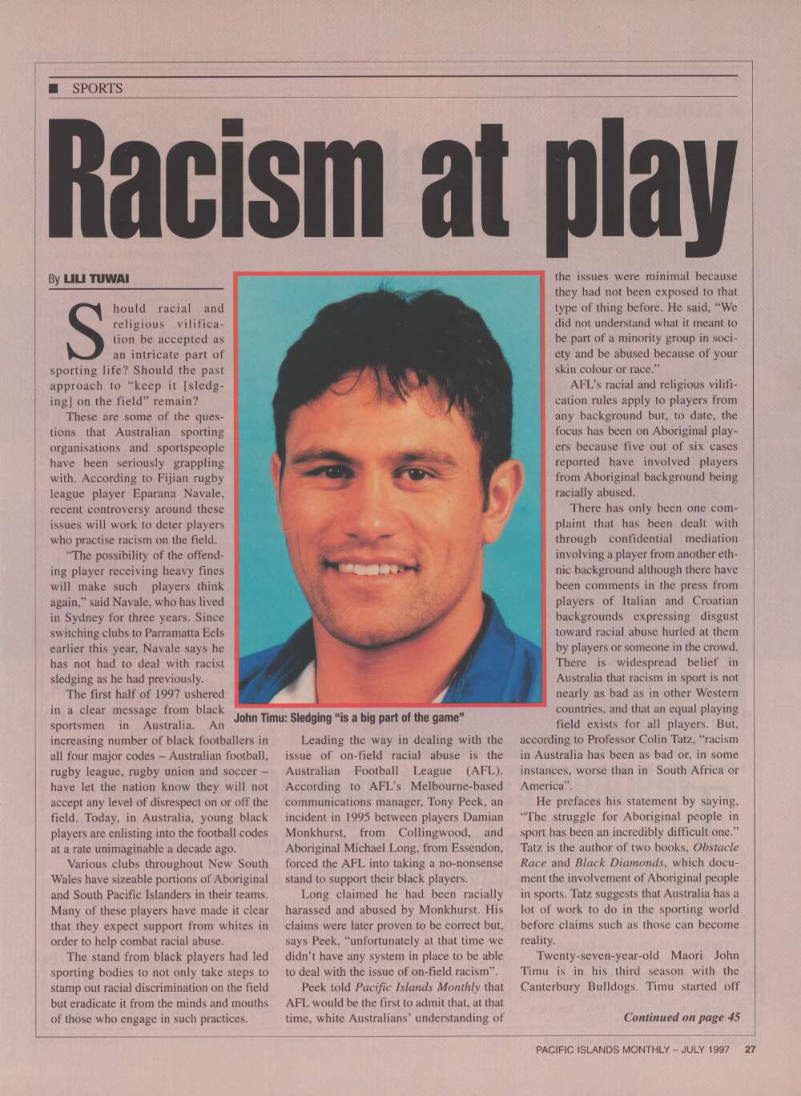
Twenty-seven-year-old Maori John Timu is in his third season with the Canterbury Bulldogs. Timu started off
Continued on page 45
John Timu: Sledging “is a big part of the game”
Continued from page 27
playing rugby union for Provincial in Otago and then spent five years with the All Blacks before he made the switch to rugby league.
“A lot can happen in the heat of the moment on a footy field.
For example, in heated situa tions, players can lash out and punch someone - whereas if they were in the street they would be had up for assault. So, there are a lot of things that we really have to put in perspective when we are looking at sports, especially physi cal sports like league and rugby.
“I have been fortunate enough not to be a part of sledging or have been sledged against, but I have seen and heard of circumstances when players have definitely been sledged and it is a big part of the game.”
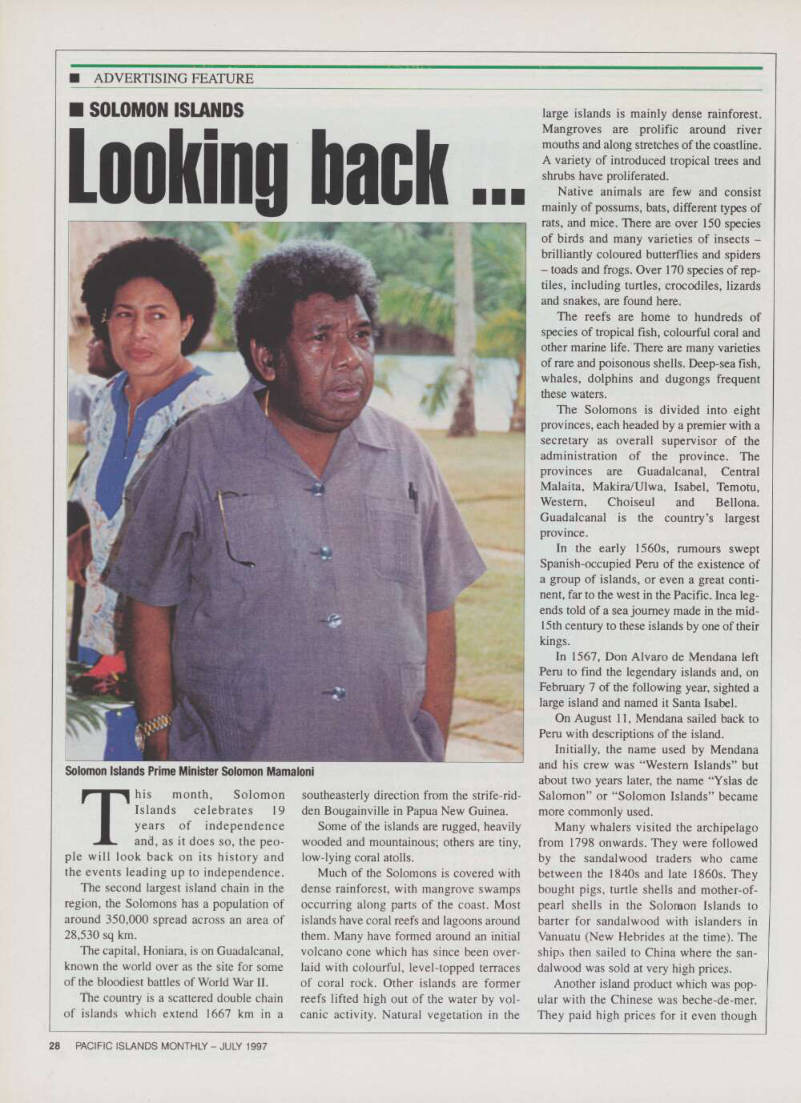
Another very popular Canterbury Bulldogs player is Tongan Solomon Haumono. He states that, while working on a pro fessional level, he has not experi enced racial abuse but admits that
he was subject to it on occasion during games when he was younger. Haumono said that, although he hadn’t personally come across racial sledging at the profes sional level, he knew players who had.
“Some guys use it just to distract the game, but I have always been taught the best strategy is the player’s skill.”
Super League’s Auckland Warrior team mates, Western Samoans Joe Vagana and Tony Toimavav, have strong opinions regarding the use of sledging in a game.
“Sledging has long been part of the game,” says Vagana. “For 80 minutes everybody is really competitive and, at times, it brings the verbal abuse stuff out - but under no circumstances should racial sledging come into it.” Toimavav expressed that he had had limited experience with racial sledg ing. “You get the odd bloke that does make racial comments but usually after having a beer, then everybody gets along with everybody else.”
One Australian Rugby League (ARL) player declares; “I couldn’t really give two hoots about the whole thing.
“It’s just part of the game,” says Sydney
City’s part-Chinese, part-Papua New
Guinean halfback, Adrian Lam. Lam said
that he often experienced racial abuse on the field but was prepared to ignore it.
Gold Coast Chargers Aboriginal halfback Wesley Patten made international head lines earlier this year when he successfully sued the NSW Police Department for $A25,000 (SUS 17,600) after being called a “coon” by police on a national television programme. Patten says he would accept some forms of sledging during a game but would definitely not accept racial abuse.
In a letter circulated throughout AFL clubs in April, Wayne Jackson, the chief executive officer, stated: “While the terms of our racial and religious vilification rule - as recommended to us by such organisa tions as the Human Rights Commission and Equal Opportunity Commission of Victoria - require confidential mediation to be part of the process, it would appear that a small minority of players has not heeded the message. Put simply, on-field racial abuse is not acceptable and we urge all players, coaches and clubs to under stand our position on this matter.
“In the broader community and work place, abusing someone on the basis of his race or religion is against the law. More importantly, it is against the Australian
ideal of a ‘fair go’ for everyone. We believe football can play a major role in educating all sections of the
community, with particular empha
sis on the children of Australia, and that racial abuse has no place in our
society.”
Tatz believes that if the Australian population had a better understanding of Australia’s com
plex history, it might help shape
some of the ignorant attitudes that exist. “You listen to some of these people and you would think that
Aboriginal people have always
being playing Aussie rules and
rugby league. Basically, Aboriginal
people began to play rugby league in the late 50s and early 60s.
Really, the avalanche of players only begins in the 80s and 905.”
Toimavav said he was not too clear about the colonial history of Aboriginal Australia but stressed that if Aboriginals were being harassed, then that was serious. He added that as a Pacific Islander in this country “I am a bit removed from what has actually been going on”. “Sports is good for those who
make it,” expresses Tatz. Drawing a paral lel with the Michael Jordan phenomenon, he said: “There has been a study done - for every 100,000 black kids that think that sports is the avenue to social mobility, one makes it.
“There is one Tiger Woods and maybe a dozen Michael Jordans and footballers, basketballers and so on. If you really look at the incredible numbers who try to go that route, you see what kind of a trap sport is for African-Americans or indigenous Australians who believe that the sports world is the way to succeed.
“For everyone that makes it, there are several thousands that don’t. Sport is a way for social mobility, for success - a couple of dozen at the very top, but that is about it.”
Racism within sports is something that can be beaten down by the individuals who are the victims, says West Indian Keith Connor, the head coach for the NSW Institute of Sports.
“If you continue to let people get to you with racist taunts, they will continue to use it. But if you get up and do what you are supposed to do out on the field, you will not be disadvantaged.” ■
Solomon Haumono ... “The best strategy is the player’s skill”