We're not anti-US,
pp. 24-26 · Read in the full issue
Relations
We're not anti-US, says Marshalls
Story and photos by GIFF JOHNSON
It could hardly have hap pened at a worse time for the Marshall Islands. The appearance at the end of March of a New York Times feature headlined “Resentment in the South Seas; Yankee, go home. Send cash”, had Marshalls officials scrambling to assuage Washington and avoid a political backlash that could hurt the Marshalls in the final four years of the Compact of Free Association treaty with the United States. Foreign
Minister Phillip Muller was angered by
the latest New York Times story depicting Marshall Islanders as anti-American but, at an interview, he downplayed the impact it would have on relations with the US.
The article, by Tokyo bureau chief Nicholas Kristof, reported a conversation in a Majuro bar between Kristof and President Imata Kabua and other Marshall Islands leaders, who were said to be drunk (See PIM May, 1997).
The article, the second by the Times in a two-week period in March reporting on the same interview, appeared at a sensi-
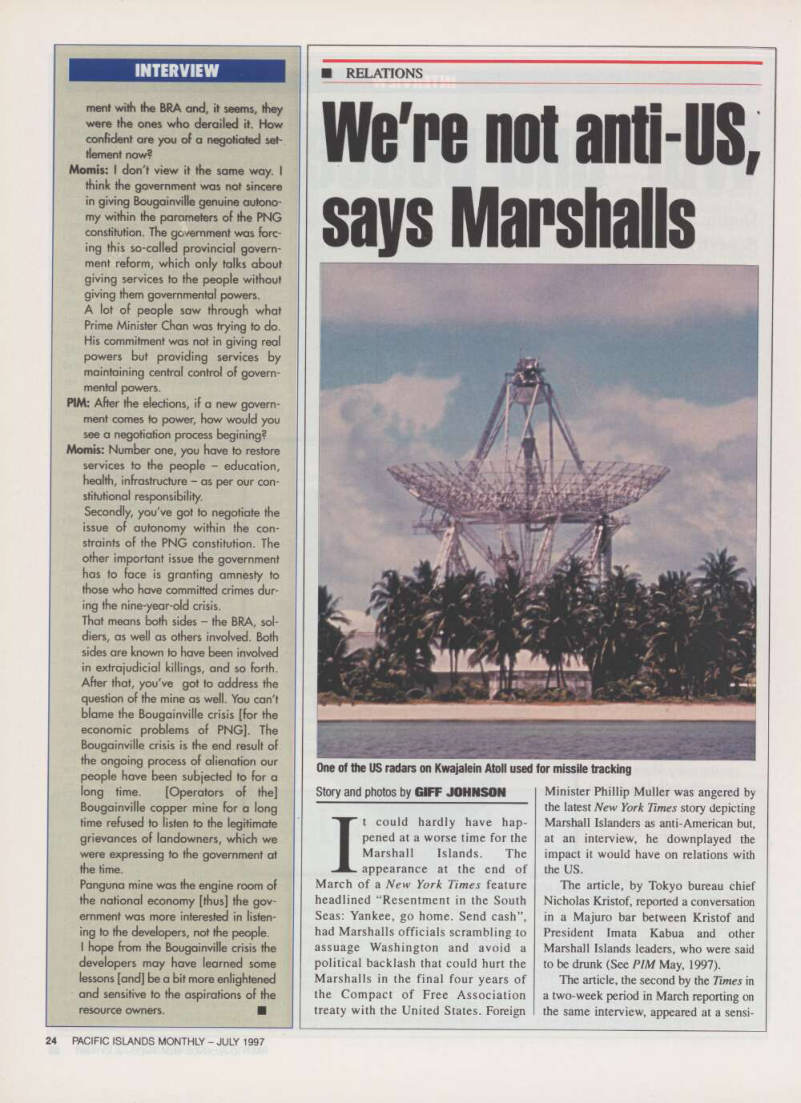
One of the US radars on Kwajalein Atoll used for missile tracking
tive time as the Marshall Islands attempts to get discussions started with the US about future aid commitments.
The Marshalls is increasingly depen dent on declining foreign aid. And the end of the Compact in 2001, ending 15 years of guaranteed funding that to date has totalled about SUSBOO million, looms large against the difficult economic situation on the islands.
In the story, Kabua said he didn’t like the compact and that it should be renegoti ated. A senator in his company is quoted as repeating, “I don’t like America.” Kristof makes the sweeping statement that “the United States is broadly resented” (in the Marshall Islands) and observes that,
“something went badly wrong, for usually
it is possible to be resented without paying $ 1 billion for the privilege”.
It is a conclusion about the Marshallese that irks former ambassador to Washington
Wilfred Kendall, now a senator in the Nitijela (Parliament). “Prom my experi ence in the US capital, I know how much damage the New York Times article has done to the Marshall Islands and its rela tions with the US,” said Kendall, who rep resented the Marshalls in the US for more than nine years.
It gives ammunition to opponents of aid to the Marshalls in the Congress, as well as many governments that are lobbying the US to increase aid to their countries, he said. “All responsible people here should react negatively to this story,” he said.
“Clearly, those involved in the story and the author do not represent our views.”
He termed the anti-American comments of Marshallese leaders “irresponsible”. But the foreign minister shrugged if off as overblown media editorialising. “The pres ident was only restating what we’ve said in the past,” Muller said. “He just said it in a
different way, but his message is we need to renegotiate the document. The Compact of Free Association (treaty) is not a perfect document and both sides need to sit down and dis cuss what’s worked and what hasn’t. But, he added, “the bot tom line is we value that rela tionship with the United States”.
He emphasised, how ever, that it must be based on mutual respect and benefits. “It cannot be a treaty where only one side gets what it wants and the other waits and waits,”
Muller said.
He said the Marshalls was concerned that some US obligations were not being met.
Specifically, he said that: • $lB million (for economic development) is owed to the Marshalls under the compact.
“After 10 years we’re still ask ing, ‘When will it be avail able?’” • Nuclear test compensation funds are virtually “depleted and there are thousands of per sonal injury and land claims Still pending”. •• Kwajaiein landowners contin ue to complain about second class' treatment and double stan dards iin pay scales for
Marshallese and American workers at the army missile testing base. “These issues are frustrating relations,” Muller said.
Commenting on the Times reference to an anonymous senator who is quoted as say ing “I don’t like America”, Muller said: “It’s a free country and any citizen is free to express itheir views. But that does not mean they are speaking for the govern ment.”
Muller wonders why the New York Times published two articles very similar in nature about the Marshalls.
He said that, personally, wondered if the Times writer “was here to report on us or to try and embarrass us” and that he was frus trated by reporters who came into the Marhalls not knowing the history of the islands and its long relationship with America.
“They refer to money under the Compact as ‘foreign aid’ but it’s not,”
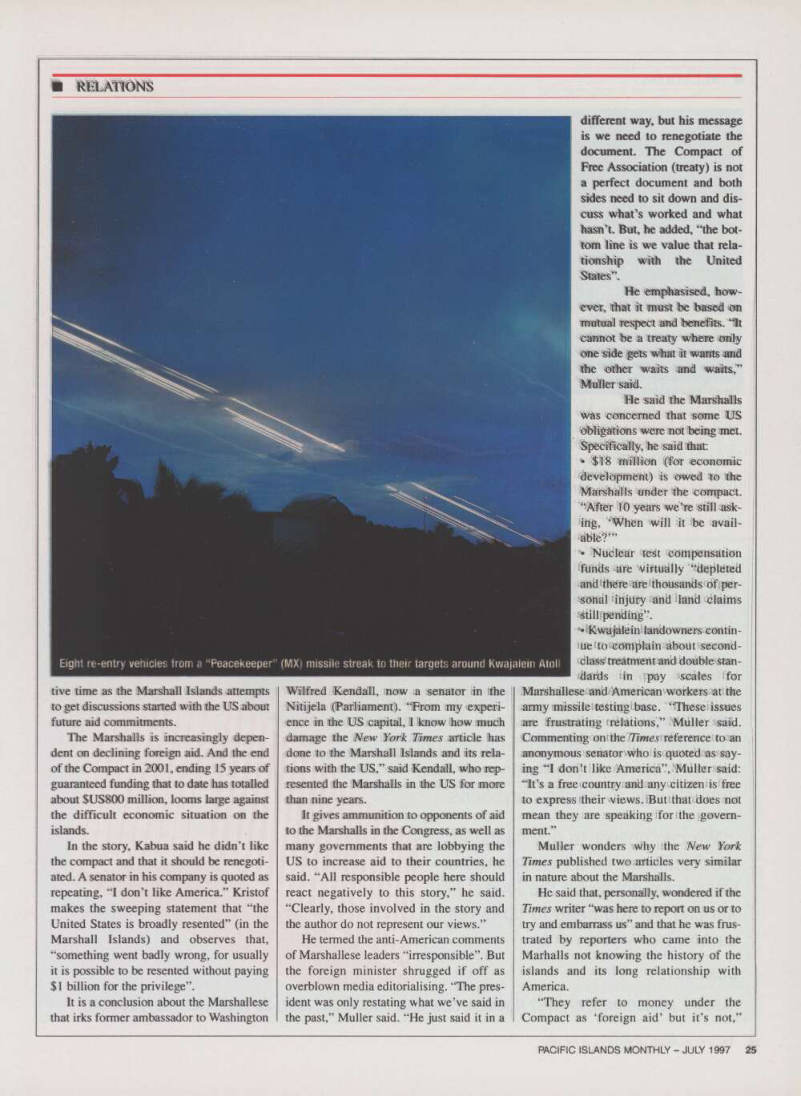
Eight re-entry vehicles from a “Peacekeeper” (MX) missile streak to their targets around Kwajalein Atoll
Muller said. “The money was paid for leases at the Kwajalein missile range, and for moral and legal obligations to the peo ple (of the Marshall Islands).
“Two friends can disagree. We don’t always see eye to eye but, at the end of the day, the relationship is good for us and good for them. We want to reassure our
friends in Washington that we attach value to our relationship.”
Kendall doesn’t believe it will be that easy to repair the damage. The anti-US comments play right into the hands of peo ple in Washington who want to cut back funding to the Marshall Islands, Kendall said. “There are a lot of new faces on the
Hill who have no historical ties to the Marshalls,” he said. “These type of com ments give them ammunition against the Marshall Islands. It can really hurt us.”
It will take time to defuse the resent ment in Washington to the story, he said.
“There’s a lot of work to do to get our image back,” he said. ■
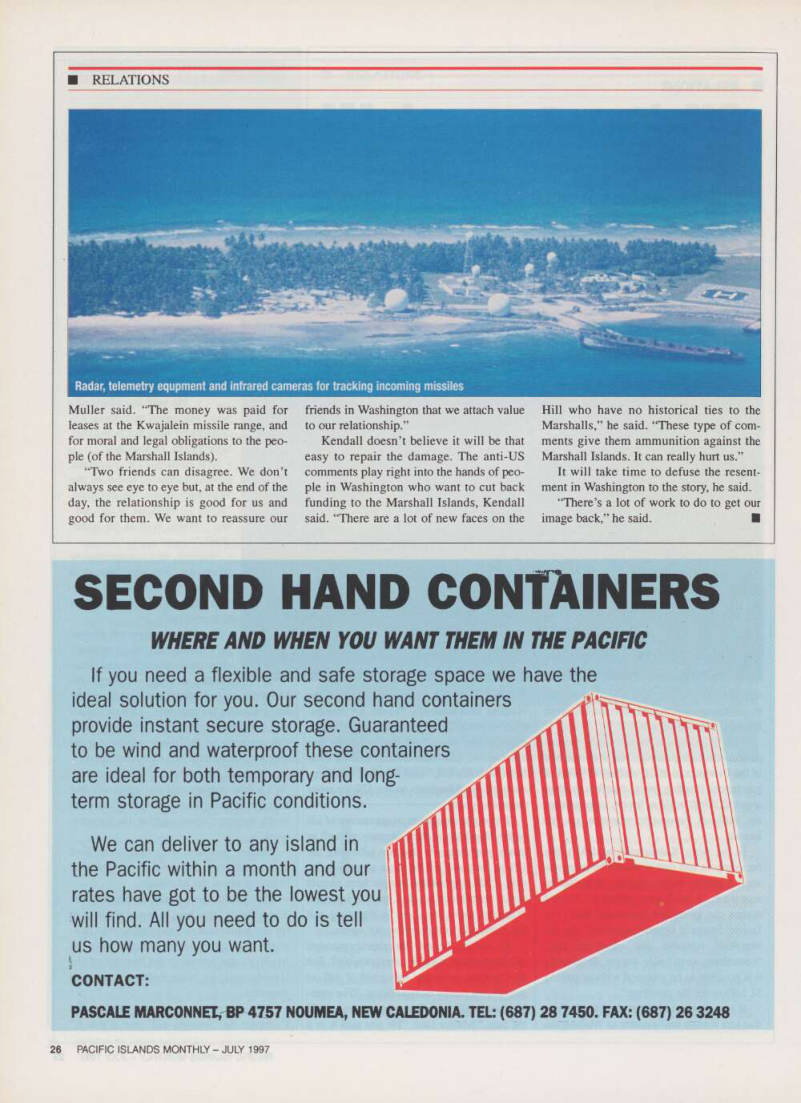
Radar, telemetry equpment and infrared cameras for tracking incoming missiles