War and peace
pp. 23-24 · Read in the full issue
Interview
During a visit to Papua New Guinea last month, Kalinga Seneviratne spoke to John Momis, the regional member of parliament for Bougainville, who was kidnapped by the BRA. Momis suggests devolution of powers as a solution to the crisis. The following is an edited version of the interview recorded two weeks before his kidnap ping. When this issue went to press, Momis had not been released
PIM: How do you see the impact of the Bougainville conflict on national politics here?
Momis: It is having a detrimental impact on national politics because some leaders, in their zeal to once and for all solve the Bougainville crisis, are falling easy prey to temp tations of using force and unethical means of resolving the crisis by engaging Sandline mercenaries, for example, and by using the military option. The Bougainville crisis has its root causes in alienation, effects of government policies, CRA's Bougainville copper mine activities and their policies, and the general trend in this country today where people's resources, including human resources, are taken for granted as being cheap whereas our constitution specifically calls upon us to treasure our resources and to use certain strategies based on justice, respect and equity
to develop our resources so that the people of PNG, including resource owners, must be seen to be involved in the decision-making in developing our resources. Our constitution specifically talks about doing certain things to pre vent such crises from arising. The best way of pre-empting such crises with
respect to resource development, law and order and other human aspirations and needs in the country is to involve the people. If you don't allow them to be effectively and meaningfully involved, you are planting the seeds of dissension and rebellion.
PIM: The Bougainville crisis started with
landowners not being happy with what they were getting out of mining opera tions, didn't it? Now, it has become a big military issue. Looking back on the last 10 years can you say what went wrong?
Momis: From the very beginning, the gov ernment did not take the people's rights as legitimate owners of these resources seriously. They saw the land and the resources as commodities; that the gov ernment could generate revenue from for the country. This is wrong because the resource owners are the people.
There is a very strong bond between the people and the land. So, they should not be alienated. People must be the centre of development, they should be involved.
PIM: S ince you are resource rich, if
Bougainville is to secede, can you have a viable economy?
Momis: Bougainville could easily have a viable economy therefore we can be independent. But cur rent circumstances will not allow Bougainville to become political ly independent. First of all, the PNG constitution does not pro vide for Bougainville to secede.
Secondly, the United Nations policy will not allow it. The only ways Bougainville can become independent are by fighting and winning the war or for the PNG government to voluntarily allow
Bougainville to become indepen
dent. Both situations are not fea sible, 1 don't think.
PIM: How do you see your role in national politics here?
Momis: I'm the leader of the Melanesian Alliance. One of the platforms of our party is to empower people through devo lution of government powers and responsibilites - through decen tralisation.
We believe it is quite possible through negotation - for
Bougainville to get autonomy as much autonomy as is possible - with in the parameters of the PNG constitu tion; that is, giving them freedom and powers to manage their own affairs, but not secede. This is feasible within the PNG constitution.
PIM: When Sir Julius Chan became prime minister he tried to negotiate a settle
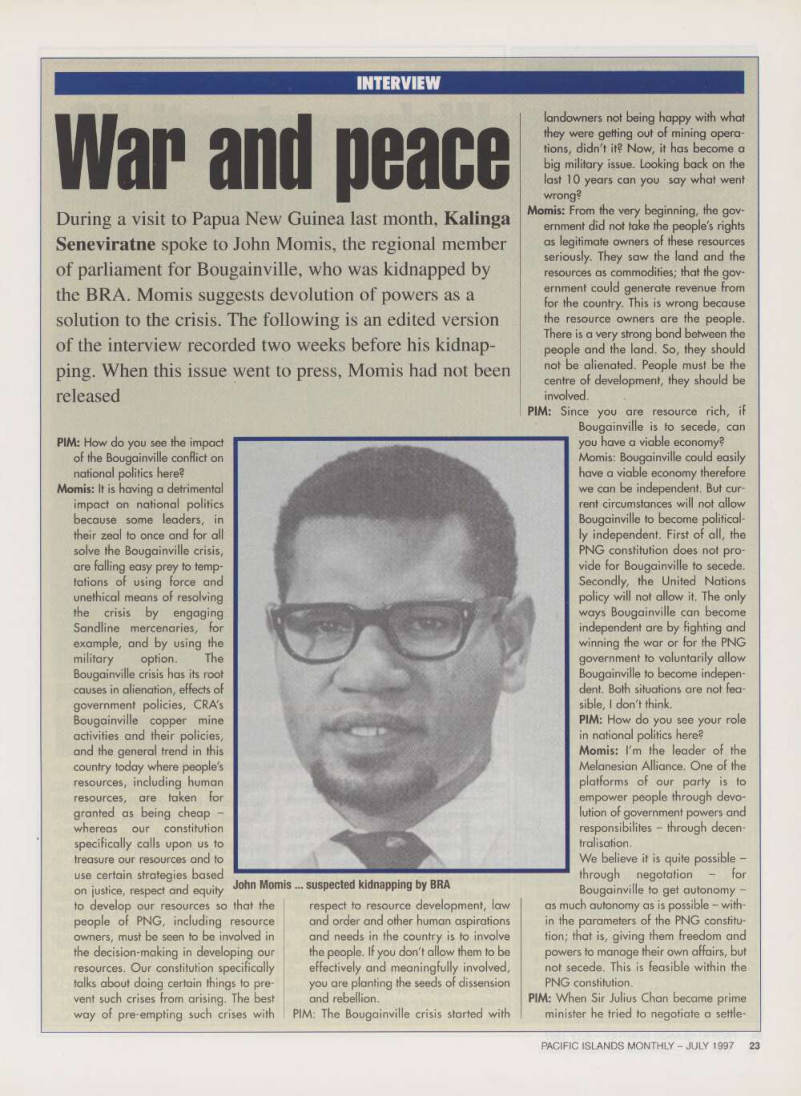
John Momis... suspected kidnapping by BRA
ment with the BRA and, it seems, they were the ones who derailed it. How confident are you of a negotiated set tlement now?
Momis: I don't view it the same way. I think the government was not sincere in giving Bougainville genuine autono my within the parameters of the PNG constitution. The government was forc ing this so-called provincial govern ment reform, which only talks about giving services to the people without giving them governmental powers.
A lot of people saw through what Prime Minister Chan was trying to do.
His commitment was not in giving real powers but providing services by maintaining central control of govern mental powers.
PIM: After the elections, if a new govern ment comes to power, how would you see a negotiation process begining?
Momis: Number one, you have to restore services to the people - education, health, infrastructure - as per our con stitutional responsibility.
Secondly, you've got to negotiate the issue of autonomy within the con straints of the PNG constitution. The other important issue the government has to face is granting amnesty to those who have committed crimes dur ing the nine-year-old crisis.
That means both sides - the BRA, sol diers, as well as others involved. Both sides are known to have been involved in extrajudicial killings, and so forth.
After that, you've got to address the question of the mine as well. You can't blame the Bougainville crisis [for the economic problems of PNG], The Bougainville crisis is the end result of the ongoing process of alienation our people have been subjected to for a long time. [Operators of the] Bougainville copper mine for a long time refused to listen to the legitimate grievances of landowners, which we were expressing to the government at the time.
Panguna mine was the engine room of the national economy [thus] the gov ernment was more interested in listen ing to the developers, not the people.
I hope from the Bougainville crisis the developers may have learned some lessons [and] be a bit more enlightened and sensitive to the aspirations of the resource owners. ■