Fair wages and human rights
pp. 20-22 · Read in the full issue

Labour
Fair wages and human rights far Marianas workers
By Susan Prokop
In the strongest statement ever issued by a US presi dent about labour and immi gration conditions in the Northern Mariana Islands [CNMI], President Bill Clinton sent a letter on May 30, 1997 to Governor Froilan Tenorio stating his intent to apply US immigration and minimum wage laws to the commonwealth.
As reasons for asking Congress to change CNMI’s laws, Clinton’s letter cites labour practices in the islands “inconsistent with our country’s values”, the “plainly inadequate” minimum wage, “persistent incidents of improper treat ment of alien workers” and continued failure of CNMI officials to rectify the
problems.
Clinton’s letter follows the April introduction into the US House of Representatives by congressman George Miller of the Insular Fair Wage and Human Rights Act. The act would bring
CNMI’s minimum wage up to the US minimum wage level ($5.15 beginning September 1, 1997) by 1999. It would also prohibit textile products manufac tured in CNMI from bearing a “made in the USA” label unless workers are paid at least the new minimum wage and the company abides by US fair labour, health add safety standards. The act would also
apply tougher US immigration laws on
Cnmi.
Miller, a Democrat, is the senior member of the minority party on the Resources Committee, which has juris diction over CNMI and has been an out spoken opponent of sweatshops on US soil. The measure has been endorsed by several church, labour and human rights groups, including the Asian Pacific Labour Alliance, the National Asian Pacific American Legal Consortium, Asia Pacific Center for Justice and Peace, the US Catholic Conference, and Human Rights Watch.
At a press conference announcing his bill, Miller released a report detailing cir
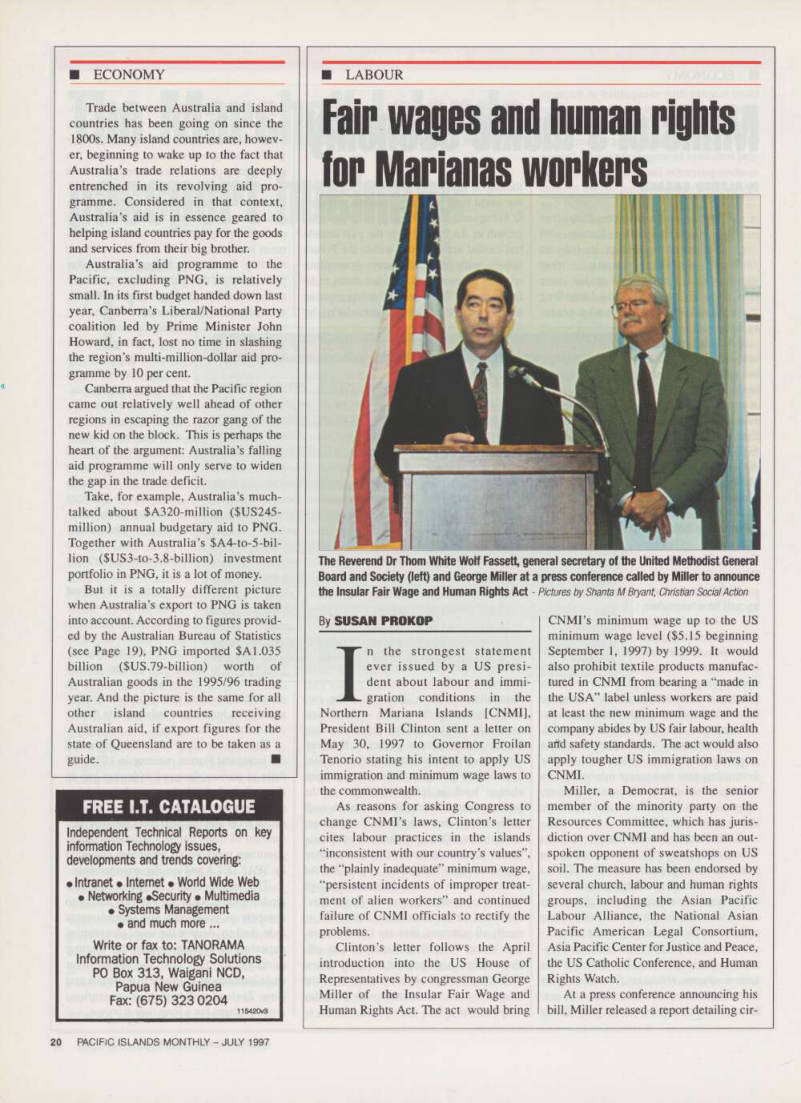
The Reverend Dr Thom White Wolf Fassett, general secretary of the United Methodist General Board and Society (left) and George Miller at a press conference called by Miller to announce the Insular Fair Wage and Human Rights Act - Pictures by Shanta M Bryant, Christian Social Action
cumstances in which workers from the Philippines, China, Micronesia and else where in the Pacific are brought to CNMI often under false pretences - and paid as little as 68 cents an hour for farm labour.
Miller stated, “These workers are not free, and are not given the same opportunities and protections every other worker in the US or its territories is provided.” Noting that companies operating in CNMI can use the “Made in the USA” label on products, Miller observed: “American manufacturers know that the ‘Made in the USA’ label sig nifies compliance with basic worker pro tection laws and human rights guarantees.
But in the CNMI, that label is used to con
ceal systematic exploitation.”
When it became a US commonwealth in 1975, CNMI was exempted from US mini mum wage laws and was allowed to set its own immigration policy. Over the years, CNMI authorities used these exceptions to US law to import cheap foreign labour to work for low wages in local private indus tries.
Today, foreign workers constitute half the population and three quarters of the workforce. Meanwhile, the indigenous population suffers double-digit unemploy ment as people compete for limited gov ernment positions out of reluctance to take poorly paid jobs in the private sector.
Mikel Schwab, an assistant US attorney in Guam, asserts that these immigrants con tribute to the CNMI economy and should enjoy the rights and protections accorded to anyone living under the US flag. Yet, because of their alien status, they have no political power on the islands and are hounded and threatened whenever they attempt to organise for better working con ditions or seek redress for crimes commit-
ted against them by their employers.
High-ranking CNMI officials contend that many of the incidents of abuse that have been reported happened long ago and have been addressed. The CNMI govern ment has also spent SUSI million on a pub lic relations campaign aimed at the tradi tionally pro-business Republican majority in the US House of Representatives. Thus far, no Republicans have signed on to sup port Miller’s legislation. Hope for success in Congress may rest with the other con gressional player, the US Senate, which passed a CNMI minimum wage bill two years ago only to see it blocked by the house. In the meantime, human rights
advocates and US officials in the region continue to fight the exploitation of immi grants in CNMI with some success, albeit sometimes temporary.
The US federal prosecutor’s office in CNMI won back wages for Filipino teach ers in a suit against the public school sys tem only to see the teachers deported by the government the following year.
Meanwhile, the US Department of Labour won a SUS 12-million judgment against international conglomerate chief Willie Tan, whose garment factories in CNMI have been among the most frequent viola tors of worker rights.
And there have been individual victo ries in overcoming CNMI’s harsher reali ties. Dr Eddie del Rosario, a physician in Guam, relates the story of Isabel (not her real name), hired in the Philippines to wait ress in a restaurant in Rota.
Arriving in CNMI, she was forced into prostitution by her employer and became pregnant. Her infant son, Kyle, developed a heart defect. She went to Saipan to seek medical help in the US but no hospital would send her with her son because of her alien status.
Working with other human rights activists, Dr del Rosario managed to obtain a humanitarian visa for Isabel and Kyle to get care in Honolulu. Kyle’s life was saved and Isabel met and married an American businessman. Although he prefers to see improvements sooner, Dr del Rosario believes Kyle should go back to CNMI someday and run for governor so that he might end the abuses and corruption once and for all.
Dr del Rosario says it would be “a per fect example of divine justice if that comes to pass”. ■
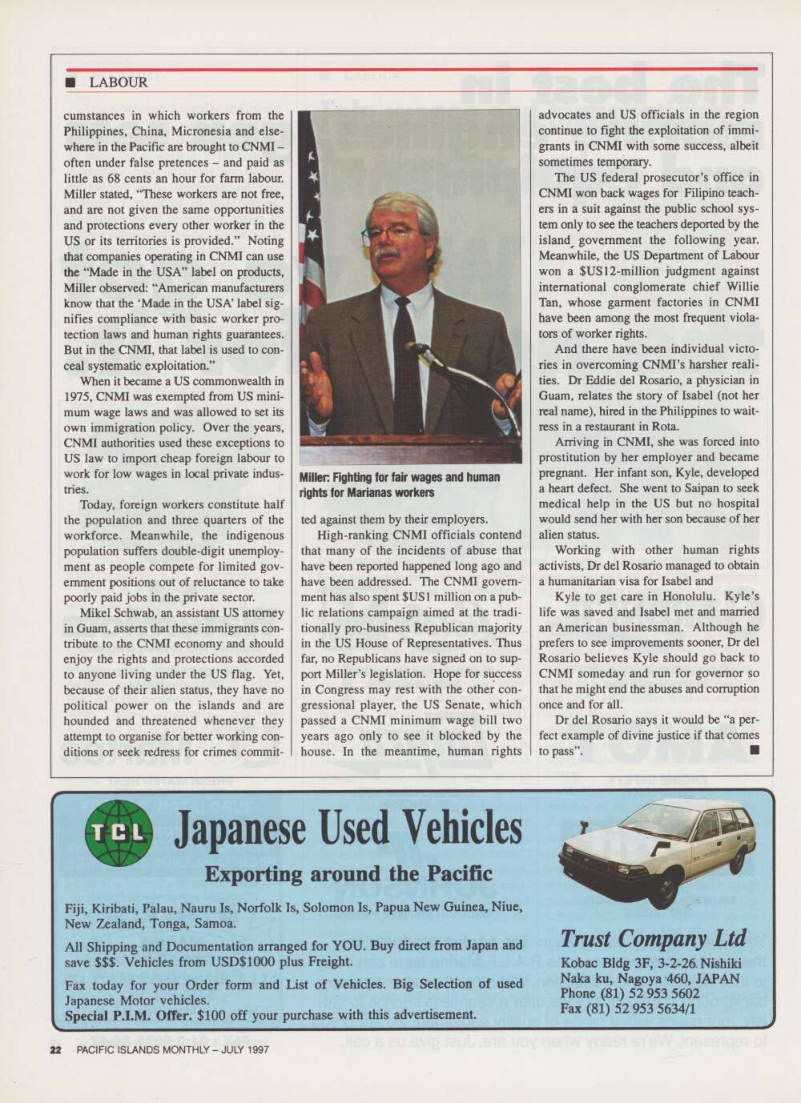
Miller: Fighting for fair wages and human rights for Marianas workers