Ministers tackle economy
pp. 19-20 · Read in the full issue
Economy
By Alfred Sasako
Senior ministers from the South Pacific Forum will meet in Cairns in July to discuss, among other things, trade - the single major issue that served as a catalyst to launching the regional bloc a quarter of a centu
ry ago.
The July 10-11
meeting is expected to
be attended by eco nomic ministers from Australia, Cook Islands, Federated States of Micronesia, Fiji, Kiribati, Nauru, New Zealand, Niue, Palau, Papua New Guinea, the Republic of the Marshall Islands, Solomon Islands, Tonga, Tuvalu, Vanuatu and Western Samoa.
Under close scruti ny will be what makes for sustainable eco nomic development activities which are based on prudent, eco nomic management.
good governance, and which strengthen
links with existing and potential joint-ven
ture partner investors from Australia.
Australia is hosting the two-day meeting in response to a decision by the South Pacific Forum last year that senior ministers from the region should meet regularly, particu larly ministers with finance and economic
development portfolios.
South Pacific Forum finance ministers have already met twice and are expected to meet on a regular basis. The Cairns Economic Ministers’ Meeting signifies the importance the region’s political masters attach to economic reforms and subsequent activities which serve to provide an envi ronment conducive to sustainable develop ment in the longer term. It will be the first time economic ministers from the region meet. No doubt, their discussions will cen tre on economic activities or lack of it in
the region and why comparable regions of the world have recorded enviable econom ic successes. Indeed, sluggish economic growth in the Pacific over the past decade has caused some unease within the Forum family, with political leaders demanding answers - answers that do not seem to be forthcoming. The situation has triggered an avalanche of criticism, particlarly by
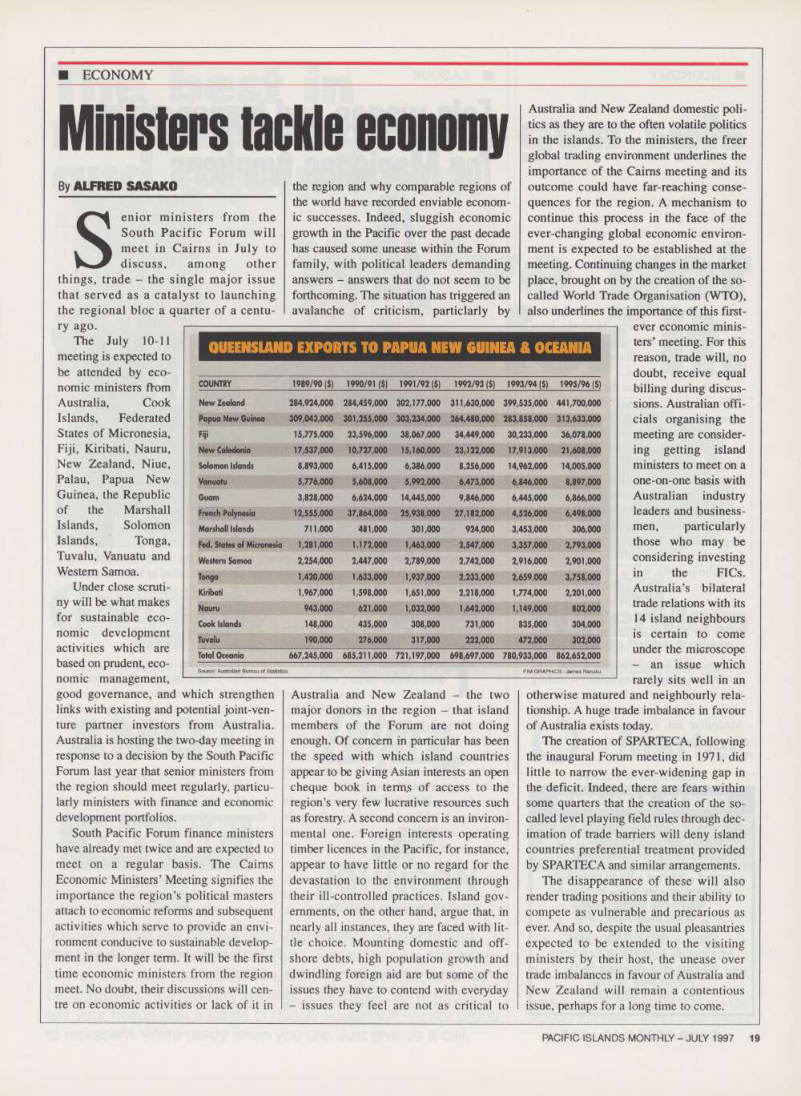
QUEENSLAND EXPOUTS TO PAPUA NEW GUINEA & OCEANIA
Australia and New Zealand - the two major donors in the region - that island members of the Forum are not doing enough. Of concern in particular has been the speed with which island countries appear to be giving Asian interests an open cheque book in terms of access to the region’s very few lucrative resources such as forestry. A second concern is an inviron mental one. Foreign interests operating timber licences in the Pacific, for instance, appear to have little or no regard for the devastation to the environment through their ill-controlled practices. Island gov ernments, on the other hand, argue that, in nearly all instances, they are faced with lit tle choice. Mounting domestic and off
shore debts, high population growth and
dwindling foreign aid are but some of the issues they have to contend with everyday - issues they feel are not as critical to
Australia and New Zealand domestic poli tics as they are to the often volatile politics in the islands. To the ministers, the freer global trading environment underlines the importance of the Cairns meeting and its outcome could have far-reaching conse quences for the region. A mechanism to continue this process in the face of the
ever-changing global economic environ
ment is expected to be established at the
meeting. Continuing changes in the market
place, brought on by the creation of the so called World Trade Organisation (WTO), also underlines the importance of this first
ever economic minis ters’ meeting. For this reason, trade will, no doubt, receive equal
billing during discus
sions. Australian offi cials organising the meeting are consider ing getting island ministers to meet on a one-on-one basis with
Australian industry
leaders and business
men, particularly
those who may be
considering investing
in the FICs.
Australia’s bilateral trade relations with its 14 island neighbours is certain to come under the microscope - an issue which rarely sits well in an
otherwise matured and neighbourly rela tionship. A huge trade imbalance in favour of Australia exists today.
The creation of SPARTECA, following the inaugural Forum meeting in 1971, did little to narrow the ever-widening gap in the deficit. Indeed, there are fears within some quarters that the creation of the so called level playing field rules through dec imation of trade barriers will deny island countries preferential treatment provided by SPARTECA and similar arrangements.
The disappearance of these will also render trading positions and their ability to compete as vulnerable and precarious as ever. And so, despite the usual pleasantries expected to be extended to the visiting ministers by their host, the unease over trade imbalances in favour of Australia and New Zealand will remain a contentious issue, perhaps for a long time to come.
Country
1989/90 ($) 1990/91 ($) 1991/92 ($) 1992/93 ($) 1993/94($) 1995/96($) New Zealand 284,924,000 284,459,000 302,177,000 311,630,000 399,535,000 441,700,000 Papua New Guinea 309,043,000 301,255,000 303,234,000 264,480,000 283,858,000 313,633,000 Fiji 15,775,000 23,596,000 38,067,000 34/449,000 30,233,000 36,078,000 New Caledonia 17,537,000 10,727,000 15,160,000 23,122,000 17,913,000 21,608,000 Solomon islands 8,893,000 6,415,000 6,386,000 8,256,000 14,962,000 14,005,000 Vanuatu 5,776,000 5,608,000 5,992,000 6,473,000 6,846,000 8,897,000 Guam 3,828,000 6,624,000 14,445,000 9,846,000 6,445,000 6,866,000 French Polynesia 12,555,000 37,864,000 25,938,000 27,182,000 4,526,000 6,498,000 Marshall Islands 711,000 481,000 301,000 924,000 3,453,000 306,000 Fed. States of Micronesia 1,281,000 1,172,000 1,463,000 2,547,000 3,357,000 2,793,000 Western Samoa 2,254,000 2,447,000 2,789,000 2,742,000 2,916,000 2,901,000 Tonga 1,420,000 1,633,000 1,937,000 2,233,000 2,659,000 3,758,000 Kiribati 1,967,000 1,598,000 1,651,000 2,218,000 1,774,000 2,201,000 Nauru 943,000 621,000 1,032,000 1,642,000 1,149,000 802,000 Cook Islands 148,000 435,000 308,000 731,000 835,000 304,000 Tuvalu 190,000 276,000 317,000 222,000 472,000 302,000 Total Oceania 667,245,000 685,211,000 721,197,000 698,697,000 780,933,000 862,652,000 Source: Australian Bureau of Statistics PIM GRAPHICS : James Ranuku
Trade between Australia and island countries has been going on since the 1800 s. Many island countries are, howev er, beginning to wake up to the fact that Australia’s trade relations are deeply entrenched in its revolving aid pro gramme. Considered in that context, Australia’s aid is in essence geared to helping island countries pay for the goods and services from their big brother.
Australia’s aid programme to the Pacific, excluding PNG, is relatively small. In its first budget handed down last year, Canberra’s Liberal/National Party coalition led by Prime Minister John Howard, in fact, lost no time in slashing the region’s multi-million-dollar aid pro gramme by 10 per cent.
Canberra argued that the Pacific region came out relatively well ahead of other regions in escaping the razor gang of the new kid on the block. This is perhaps the heart of the argument: Australia’s falling aid programme will only serve to widen the gap in the trade deficit.
Take, for example, Australia’s much talked about SA32O-million (SUS24S - annual budgetary aid to PNG.
Together with Australia’s SA4-to-5-bil lion (SUS3-to-3.8-billion) investment portfolio in PNG, it is a lot of money.
But it is a totally different picture when Australia’s export to PNG is taken into account. According to figures provid ed by the Australian Bureau of Statistics (see Page 19), PNG imported $A 1.035 billion (SUS.79-billion) worth of Australian goods in the 1995/96 trading year. And the picture is the same for all other island countries receiving Australian aid, if export figures for the state of Queensland are to be taken as a
guide. ■