Lan's lament
pp. 50-51 · Read in the full issue
By Atama Raganivatu
Manu Samoa captain Pat Lam must have
been experiencing
mixed feelings when he recently boarded a plane at Auckland airport for England and a lucractive contract with the Newcastle club.
Doubtless, he would be anticipating with relish the opportunity to become involved in the burgeoning and highly rewarding European professional rugby circuit, but there must also have been a tinge of regret at leaving New Zealand without making an impact on the local scene which equated to his talent.
After playing a starring role in Western Samoa’s glorious World Cup campaign in 1991 Lam, then just 23, seemed destined to become one of the greatest loose forwards Kiwi rugby had produced.
Lam gained selection for Manu Samoa’s World Cup squad after only two seasons of first-class rugby with the awesomely strong Auckland outfit.
His senior international career could not possibly have had a better start - a Man-of-the-Match performance in Western Samoa’s never-to-be-forgotten win over Wales at Cardiff’s National Stadium. Subsequent perfomances in October, 1991 were only slightly less impressive and when, at the tourna ment’s end, a World XV was selected, Lam found himself named their number eight.
Upon returning to Auckland, his birthplace, Lam, decided that the time was now ripe for him to push for All Black honours and the fame and fortune obtained therewith. But his All Black career was both brief and disastrous.
Making his debut against Sydney on the 1992 Australian tour, he lasted just 30 minutes against Sydney before leav-
ing the field with broken ribs. New Zealand suffered the biggest loss in their long and glorious history, 17-40, and Lam was not called upon again by the Kiwis. Nor did Auckland regard him as indispensable. Lam had to be content with long sessions on the Auks’ reserves bench.
A narrow escape during a major earth
quake while holidaying at California early
in 1993 appeared to adversely affect his form too. However, Western Samoa wel comed him with open arms when, in 1994 , Lam decided to return to their fold. Lam proved during the 1995 World Cup that
very few loose forwards could match him for mobility, speed, ball-handling skill and tackling ability.
In South Africa, he displayed another
talent-inspiring captaincy. Taking over the
skipper’s role from the inimitable Peter Fatialofa early in the tournament, Lam suc ceeded in obtaining 100 per cent commit ment from each of his charges as Manu Samoa again confounded the critics by reaching the quarter-final. Lam and Fatialofa are like chalk and cheese.
Fatialofa prided himself on being “one of the boys”. Lam, fresh faced, intense on
the field, more introverted and occasional ly accused of being a little aloof, constant ly cajoles his team into greater effort.
After being led by a favourite uncle, the Samoans found themselves captained by a long-lost cousin. It is testimony to Lam’s gifts in communications and persuasive ness, which were honed during his time as a student at Auckland Teachers’ College and as an educator for F.A.D.E. (a govern ment-funded anti drugs organisation), that he quickly filled the shoes of Fatialofa, who is nine years his senior.
Lam’s leadership capabilities were cited by Manu Samoa coach Bryan Williams as a vital ingredient in the success of last year’s British tour too.
Lam is now certainly well entrenched on the international scene. Yet, ironically, his standing in New Zealand has diminished over the past two years.
Realising that first team appearances would be severely restricted if he stayed with Auckland, Lam moved to neighbour ing North Harbour in 1995. Despite hav ing a star-studded lineup, Harbour rarely rose above mediocrity during his time with them. Last season’s inaugural Super 12 tournament offered the promise of a golden opportunity for Lam to re-establish himself when he was recruited by Canterbury Crusaders. Alas, an injury sidelined him for the entire campaign.
This year, he was not amongst the 125 players offered Super 12 professional con tracts by the New Zealand Rugby Football Union. When, shortly after this rebuff, Newcastle made their generous offer, Lam felt that he - a married man with two chil dren - really had no alternative but to sign.
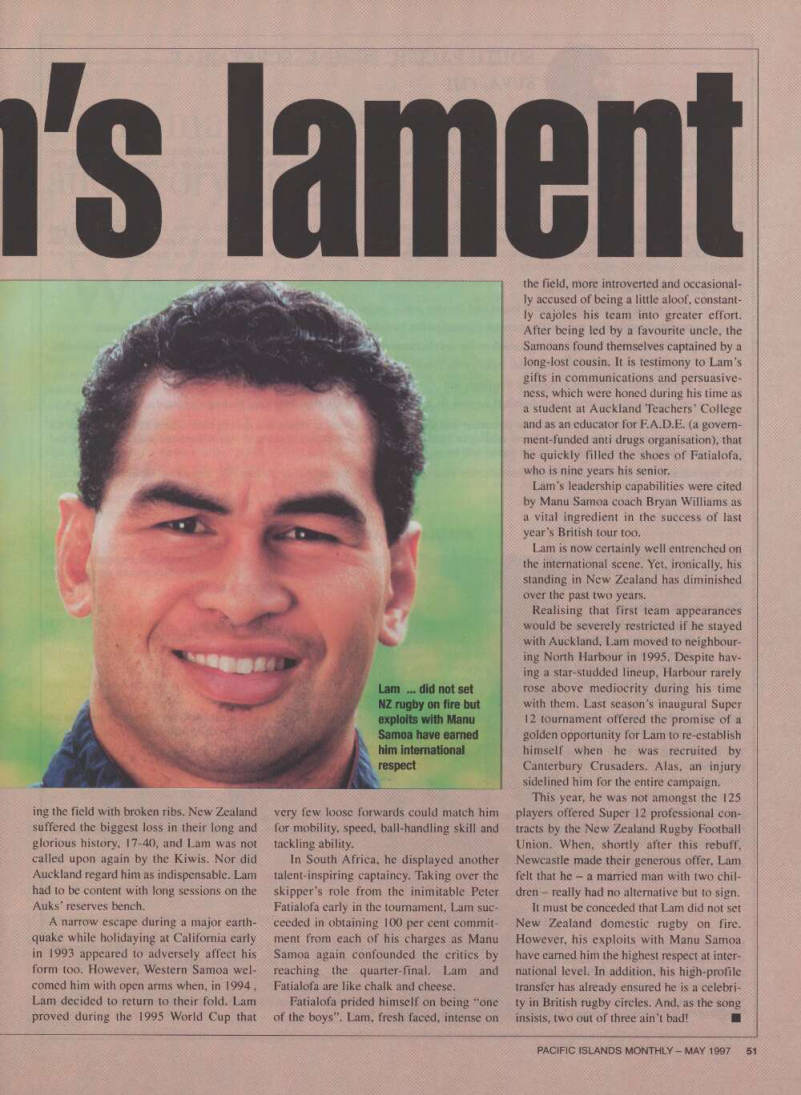
It must be conceded that Lam did not set New Zealand domestic rugby on fire.
However, his exploits with Manu Samoa have earned him the highest respect at inter national level. In addition, his high-profile transfer has already ensured he is a celebri ty in British rugby circles. And, as the song insists, two out of three ain’t bad! ■
Lam ... did not set NZ rugby on fire but exploits with Manu Samoa have earned him international respect