A king regains
pp. 49-50 · Read in the full issue
Sports
A king regains his crown
By Atama Raganivatu
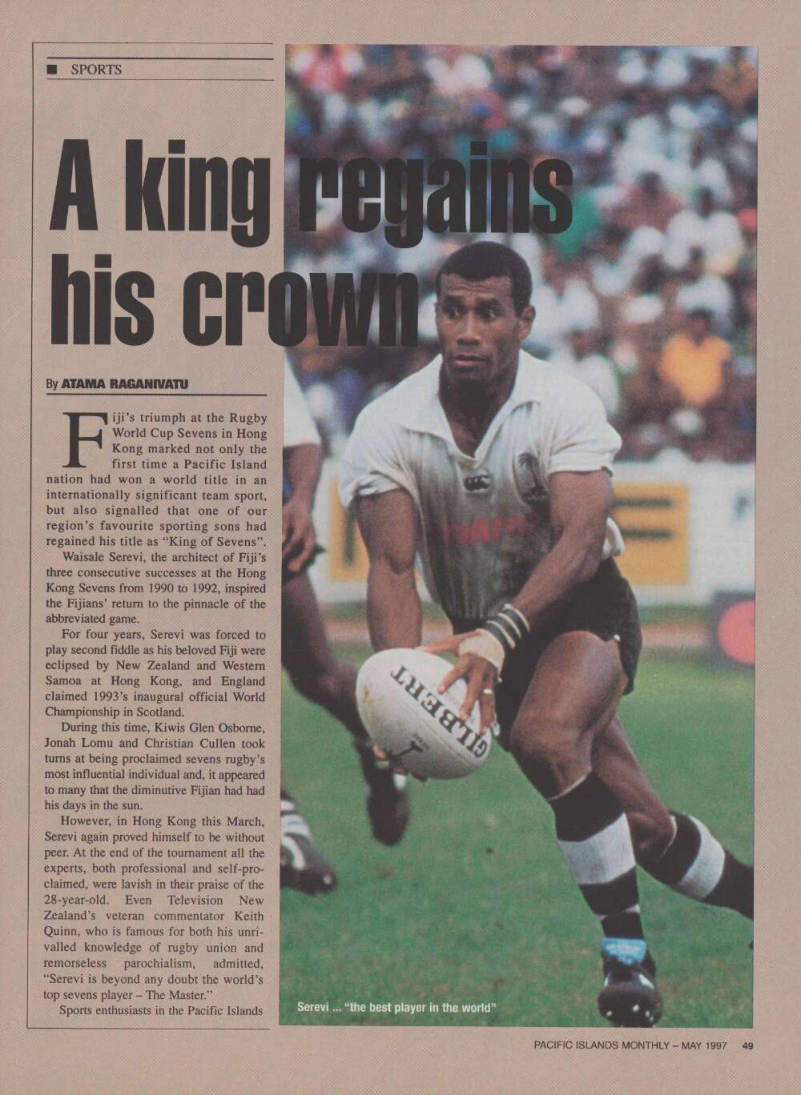
Fiji’s triumph at the Rugby World Cup Sevens in Hong Kong marked not only the first time a Pacific Island nation had won a world title in an internationally significant team sport, but also signalled that one of our region’s favourite sporting sons had regained his title as “King of Sevens”.
Waisale Serevi, the architect of Fiji’s three consecutive successes at the Hong Kong Sevens from 1990 to 1992, inspired the Fijians’ return to the pinnacle of the abbreviated game.
For four years, Serevi was forced to play second fiddle as his beloved Fiji were eclipsed by New Zealand and Western Samoa at Hong Kong, and England claimed 1993’s inaugural official World Championship in Scotland.
During this time, Kiwis Glen Osborne, Jonah Lomu and Christian Cullen took turns at being proclaimed sevens rugby’s most influential individual and, it appeared to many that the diminutive Fijian had had his days in the sun.
However, in Hong Kong this March, Serevi again proved himself to be without peer. At the end of the tournament all the experts, both professional and self-pro claimed, were lavish in their praise of the 28-year-old. Even Television New Zealand’s veteran commentator Keith Quinn, who is famous for both his unri valled knowledge of rugby union and remorseless parochialism, admitted, “Serevi is beyond any doubt the world’s top sevens player - The Master.”
Sports enthusiasts in the Pacific Islands
Serevi ... “the best player in the world”
A king regains bis crown
can take particular pride in Serevi’s achievements, for he is a rare breed someone who achieved world fame with out leaving this region.
Christened Waisale Tikoisolomoni Serevi, he was born in Suva but spent most of the first eight years of his life at Qarani, a village situated on the island of Gau in the outlying Lomaiviti Group.
The Serevi family then moved to Nasinu, a Suva suburb, and young Waisale’s first experiences of rugby came when playing improvised games with friends there. Invariably, a plastic bottle was substituted for the ball they were too poor to buy.
At Lelean Memorial School, Serevi had access to real balls and basic coach ing. He played with distinction for the school’s first XV at halfback - a position, curiously, that was discarded almost immediately upon the completion of his education. Serevi made his first class rugby debut just over a year after leaving LMS, being 17 when drafted into the Rewa district representative side’s line up. Less than three seasons of senior grade experience were under his belt as Fiji called him up for international duty. 1989 saw Serevi grace the Hong Kong Sevens for the first time and it was love between the two at first sight. Fiji did not win that year (New Zealand pipped them 12-10 in the semi final) but, such was the impact made by the precocious debutant, who from the start adopted his team’s “playmaker” role, he gained the player of the tournament award - a rare achieve ment for a member of a losing side.
Much to the delight of his quickly acquired army of admirers, Serevi proved himself to be a totally irresistible force 12 months later.
Fiji hammered the Kiwis 22-10 in a memorable final and their gifted pivot became the first and, to date, only man to take the player of the tournament acco lade for a second successive time. His 1990 Fiji Sportsman of the Year trophy
was equally predictable.
During the next two years, he consoli dated his position as the maestro of inter national sevens rugby as the team now known as the “traditional enemy”, New Zealand, succumbed in both Hong Kong finals, 18-14 in 1991 and 22-6 in 1992.
The latter win prompted the presti gious British publication the Rothmans Rugby Almanac to name him amongst
their five Players of the Year, while Clem Thomas, the revered Welsh rugby journal ist, declared Serevi “the best player in the world”.
Fiji’s dominance of sevens ended in 1993 when Western Samoa secured the Perpetual Cup with a shock 14-12 win over the holders. Then, New Zealand emulated the Fijian feat of a hat trick of successes in Hong Kong.
By this time, Serevi had become known to the vast majority of the world’s rugby fans purely as a sevens player for virtually all his 15-a-side activity was confined to the Japanese club champi onship.
He signed a contract with Mitsubishi Motors in 1992 and, since then, his com mitments to them have severely limited appearances for the Fiji XV. But, Serevi was very nearly lost to rugby union alto gether.
In June, 1993 he signed a three-year contract with the Brisbane based rugby league club South Queensland Crushers for what now seems like a pitifully low figure - US$l6O,OOO. This brought gasps of astonishment from his numerous devo tees, who envisaged him taking horren dous batterings in Australian rugby league, which is noted, first and foremost, for the brutishness and intensity of its tackling (often executed by ‘posses’ of three players).
Just 1.76 metres tall and weighing 80 kilograms, no mountains remain for him to conquer in sevens rugby and, surely, his greatest aspiration now must be make an impression in the 15-man game corre sponding to his talents.
There are several theories why Serevi has not made his presence fully felt in conventional rugby. The likeliest are the inferiority of the players around him and the fact he is constantly being switched between fullback, wing and first five eighth and not allowed to settle in one position.
But, his greatest gifts - speed, flair, elusiveness, doggedness and ability to read the game superbly - are prime assets in the 15-man game too.
Recently introduced International Rugby Board regulations give the Fiji Rugby Football Union the right to call him back from Japan for international duty whenever they wish, Serevi has an excellent opportunity to prove he is more than just a sevens specialist - and that would be this King’s crowning achievement. ■