and Ivory singing duo
pp. 53-54 · Read in the full issue
Music
Fishy market for Ebony and Ivory singing duo
By Liu Tuwai
What would lead some one to hold a CD launch at a venue where fish odour per meates the air? Why would anyone then proceed to tell several hundred invited media and guests that the CD and music video features two female media personalities who cannot sing?
And how can a reviewer then make sense out of the obvious nonsense?
Giving her explanation, Australia’s pop ular ABC television news reader, Indira Naidoo, told the crowd how she and Helen Razer, presenter on the Triple J Youth Network became recording stars. “Helen rang me up one day, and said: ‘Why don’t we record a version of Ebony and Ivory together?’ She laughed and con
firmed: ‘Obviously, you are black. I’m pale white. It would visually be very funny, and the fact that both of us can’t sing would be pretty hilarious.’ So we hope you get the joke,” repeated Indira to the audience.
The Fish Markets Auction Auditorium was chosen symboli cally to parody the notorious fish and chip shop owner, the federal member for Oxley, Pauline Hanson. Commenting on the activities of Sydney’s Pyrmont Fish Market, ABC Music promo tions manager, Fiona Wiley, made reference several times to “this wonderful multicultural venue” during the introduction speech.
Wiley said this cover version of the Stevie Wonder/Paul McCartney song was launched as a satirical response to the recent race debate. A bonus, however, was the simultaneous release of Face the Facts, a publication put out by the Human Rights and Equal Opportunity Commission, which challenges some of the
myths and stereotypes held about immi
grants, refugees and indigenous
Australians.
Zita Antonios, the Federal Race Discrimination commissioner, spoke briefly about the level of misinformation that had led to recent “public acts of racial hatred”.
Mick Dodson, the Aboriginal and Torres Strait Islander Social Justice commission er, was the honoured speaker for the event.
He told the crowd: “Humour cuts through rhetoric, misinformation and prejudice. It is often devastating in its simplicity. The best humour seeks to challenge us to think about how we view the world and to con sider the many assumptions we hold as true, particularly about people from other cultures.”
Dodson had begun his speech by
expressing he hoped that the irony of the fish market venue had not been lost on anyone present. He said: “I think irony is a completely different kettle of fish from humour, so I’m going to attempt not to con tinue down the line of irony. I am here to talk about the role of humour in the midst of intolerance.”
Dodson reasoned that humour was one of the most potent weapons a community could use to highlight and disarm racial prejudice, particularly when based on solid facts.
Throughout his speech he told several jokes with a hard edge. One example was: “Pik Botha [asked] Gareth Evans at one stage, when he was foreign minister, if Aborigines had the right to vote and Evans replied, ‘Yes, if they live to be 18.’” The audience was unsure whether it was appro priate to laugh or not.
Dodson went on to explain, “For many Aboriginal people the laughing in the midst of intolerance, laughing in the midst of Australia’s social confusion, joking about the very racism that oppresses your people is a way for us of understanding the nation’s demons and of dealing with the
related sadness and grief that is too much part of our everyday life.”
Indira Naidoo’s family migrated
to Australia from South Africa when she was young because of the apartheid system. She told an astonished audience, “I can hon estly say in all the time I have lived in this country, Australia, it has been the most harmonious, tolerant place to live”. Naidoo claimed that she had not experi enced any serious racism or dis crimination prior to the past three months when the country became embroiled in the race debate generated by Hanson.
During this period her family
and friends had suffered racial and verbal abuse, she said.
Naidoo had received hate mail.
She reasoned, “It just shows you what a serious issue that [race] has become.”
What was very evident to some of the indigenous attendants was how race and class often deter mine the ways that people of colour are arbitrarily included and excluded within the very
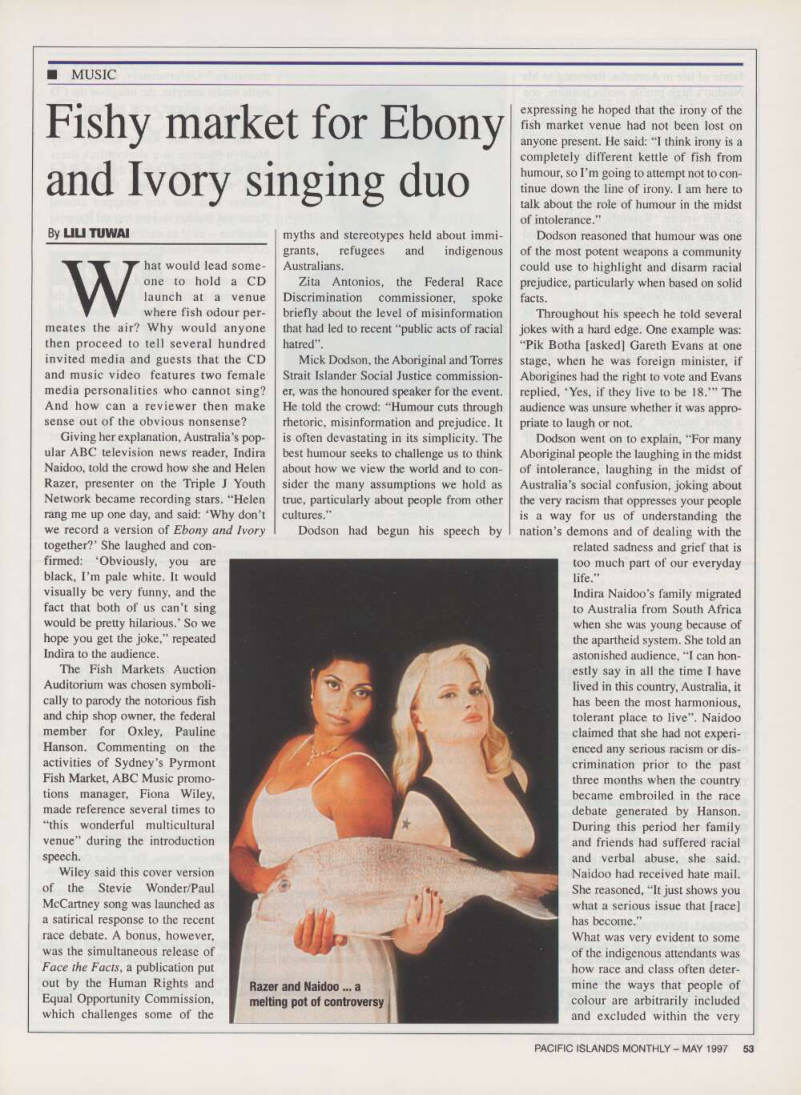
Razer and Naidoo ... a melting pot of controversy j
fabric of life in Australia. Referring to Ms Naidoo’s high-profile media position, one critic said: “There is irony in the experi ence of discrimination that Indira spoke about. If she was Aboriginal she would understand that racism has been serious in this country for over 200 years.”
Helen Razer’s comment on the CD sleeve also caused a few raised eyebrows.
She has written; “Recently, it would appear that some of our country folk have turned their virulent, irrational attentions to so called New Australians. What’s up? As if we need to add racism to the vast catalogue of global stinkiness.”
Reacting to Razer’s naivete, an Australian journalist said, “No, we do not need to add racism, it has been here long enough, we need to address it as a nation”.
A bizarre twist to the launch was that one week earlier Razer had pleaded guilty in a Sydney court to growing marijuana in a spare bedroom. She was given a three year good behaviour bond. Gold Coast MP and Triple J critic John Bradford called on ABC management to sack Razer. Bradford claimed Razer was not “fit and proper” to broadcast to young people because of her drug conviction.
The Ebony and Ivory press release reads: “If music soothes the savage beast then perhaps the best way to slay the drag on of bigotry is by the careful musical part nering of two of this country’s most well known - and diverse - female social com
mentators.” Unfortunately, according to some media analysts, the image on the CD does little to subvert racist and sexist rep resentations.
The cover has Razer looking very Marilyn Monroe in a slinky black dress with her arms folded across the front of her body. Next to her (stuck like glue) is Naidoo with one arm wrapped around Razer and Naidoo leaning toward Razer in adoration - as if to embrace Razer in her coldness and whiteness.
In a country with so few positive images of ‘otherness’, “it may have been appropriate to think more clearly about the image on the cover of the CD - even if it is in the pursuit of humour” has been the con
sensus of public opinions.
Does Dodson’s comment that “some times humour may reveal the pure absurdi ty of intolerance and the nonsensical aspect of racism” apply also to the CD?
Remarking on something that Mark Twain had once written, Dodson said, “The secret source of humour is not joy but sorrow.”
Dodson maintained that some of the best jokes he had heard only worked because their source was in the tragedy of real life, the depravity and the horror. ■
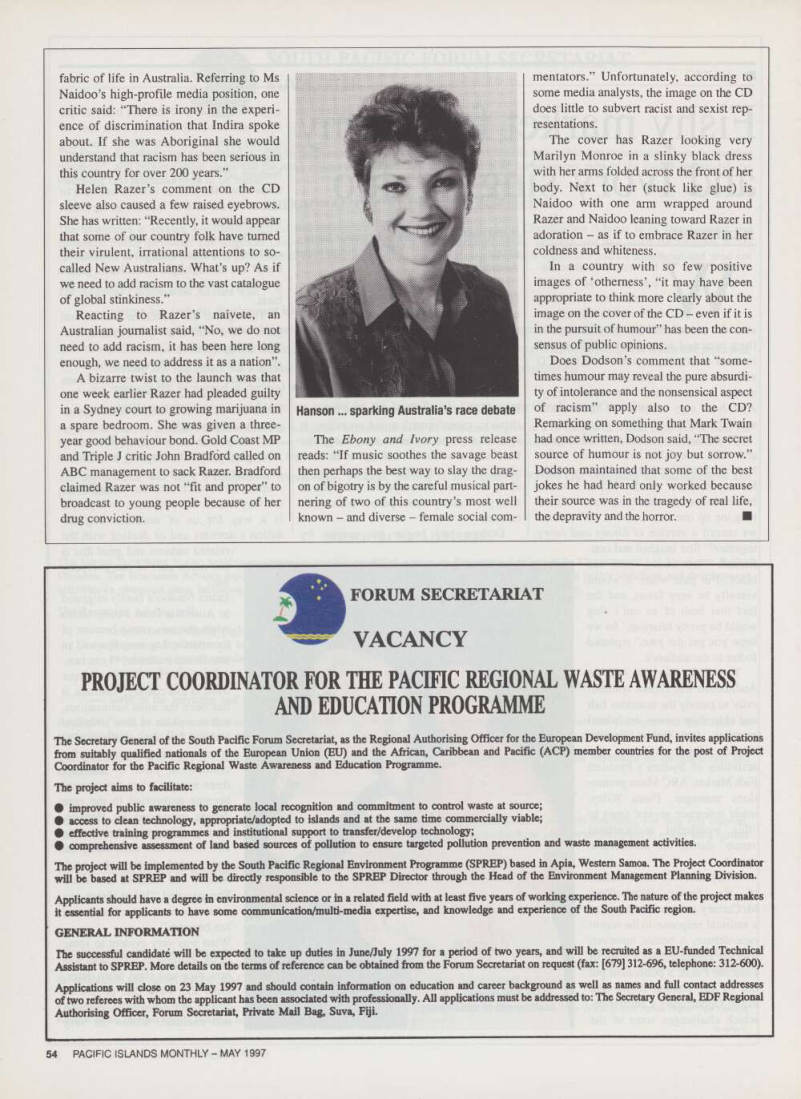
Hanson ... sparking Australia’s race debate