economic rebalancing
pp. 35-36 · Read in the full issue
Untapped Kanaky tourist potential holds key to economic rebalancing
Nickel wealth may be what is ticking the New Caledonian economy and keeping the French in the Pacific, but the tourism poten tial in the traditional Kanak areas of the North Province and Loyalty Island is an untapped economic potential which holds the key to balancing the economic scales in the French colony.
In the last decade, New Caledonia has attracted about 120,000 tourists a year and another 50,000-60,000 cruise passengers.
Most visitors have come from Japan, Australia and New Zealand. Because of the high cost of living in the country, tourism industry sources admit that it has been dif ficult to attract tourists from other parts of
the region.
As one industry source said, in the past, New Caledonia had promoted itself as a part of Europe and a part of the French in
this region. “We know this asset is appreci ated, especially with Japanese tourists,” he said.
Thus, most of the tourist development has taken place in Noumea and other parts of the South Province where the French settlers live. But all this is going to change now, with the entry of the North and Loyalty Island provincial administrations into the tourist industry. They are chan nelling funds through two Kanak-owned companies into tourist ventures around the country.
The North Province-supported nickel mining company, SMSP, through its parent company, SOFINOR, is at the forefront of these moves. It has been plugging some of its nickel profts to SOFINOR which, in turn, has set up Compagnie D’lnvestissements Touristiques (CIT) to buy into hotels and build new resorts.
Under CIT is a whole range of subsidiary
companies which are slowly establishing themselves in the tourist industry here.
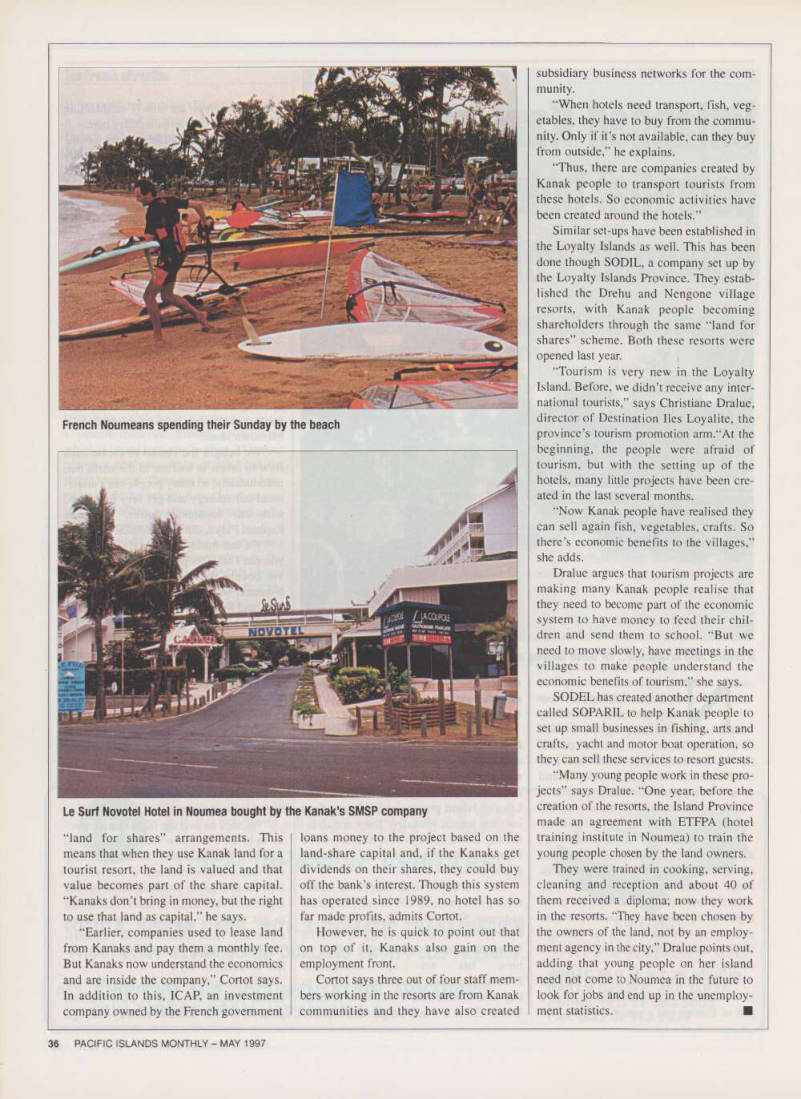
CIT has brought into three of the biggest hotels in Noumea - it is currently just 12 shares short of 50 per cent owner ship of the Novotel Le Surf hotel, owns four per cent of the only five-star hotel in New Caledonia, Le Meredien, and has bought into the Ibis hotel. The three hotels together have half the room capacity in the country. These purchases have upset the leader of the RPCR, Jacques Lafluer, who argues the Kanak-owned companies should concentrate their investments in their own
provinces.
When SOFINOR bought into Le Surf, which included Noumea’s only casino at the time, Lafluer, as president of the South Province, issued regulations to restrict the opening hours of the casino. Since then another casino has been established at Le Meredien Hotel.
“We bought the casino to create cash flow to invest in tourism in the north but, unfortunately, so many people can’t under stand our strategy and get very frightened with our economic power,” observes Raphael Pidjot, director of SMSP.
“We can build hotels in the north, but you can’t take people directly to the bush.
We bought the casino and the hotel in Noumea, so people arrive here for a few days and then we take them to the north,” he adds.
SOFINOR has invested SUS2O million into a Club Med and Malabou Beach resort in the far north of the country. They have also invested another SUSB million in the Nengone Village and Drehu Village resorts in the Loyalty Islands.
“CIT is a major investor in tourism and hotels in New Caledonia,” says Gerald Cortot, director-general of CIT, but he complains that a lack of good airline ser vices to New Caledonia is a major draw back for the industry.
“We need an average 60 per cent capac ity to break even; now we are less 15,000 visitors a year to do that,” he adds, pointing out that a major problem is many New Caledonians go on overseas holidays dur ing school vacations and it’s very difficult to get flights in and out of the country, especially from December to February.
“During the same period, hotels here are half booked,” he says.
Cortot explains that the way they get Kanak people involved in their tourism projects in the north is intially through
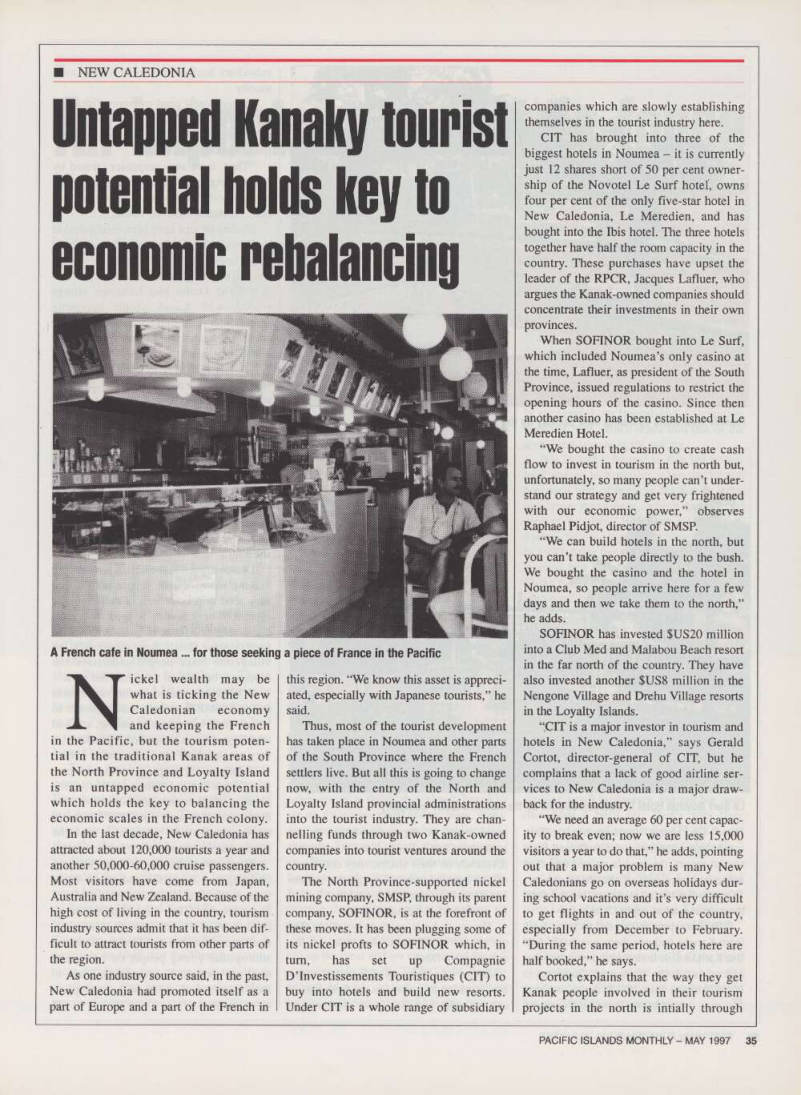
A French cafe in Noumea ... for those seeking a piece of France in the Pacific
“land for shares” arrangements. This means that when they use Kanak land for a tourist resort, the land is valued and that value becomes part of the share capital.
“Kanaks don’t bring in money, but the right to use that land as capital,” he says.
“Earlier, companies used to lease land from Kanaks and pay them a monthly fee.
But Kanaks now understand the economics and are inside the company,” Cortot says.
In addition to this, ICAP, an investment company owned by the French government
loans money to the project based on the land-share capital and, if the Kanaks get dividends on their shares, they could buy off the bank’s interest. Though this system has operated since 1989, no hotel has so far made profits, admits Cortot.
However, he is quick to point out that on top of it, Kanaks also gain on the
employment front.
Cortot says three out of four staff mem bers working in the resorts are from Kanak communities and they have also created
subsidiary business networks for the com
munity.
“When hotels need transport, fish, veg etables, they have to buy from the commu nity. Only if it’s not available, can they buy from outside,” he explains.
“Thus, there are companies created by Kanak people to transport tourists from these hotels. So economic activities have been created around the hotels.”
Similar set-ups have been established in the Loyalty Islands as well. This has been done though SODIL, a company set up by the Loyalty Islands Province. They estab lished the Drehu and Nengone village resorts, with Kanak people becoming shareholders through the same “land for shares” scheme. Both these resorts were opened last year.
“Tourism is very new in the Loyalty Island. Before, we didn’t receive any inter national tourists,” says Christiane Dralue, director of Destination lies Loyalite, the province’s tourism promotion arm.“At the beginning, the people were afraid of tourism, but with the setting up of the hotels, many little projects have been cre ated in the last several months.
“Now Kanak people have realised they can sell again fish, vegetables, crafts. So there’s economic benefits to the villages,” she adds.
Dralue argues that tourism projects are making many Kanak people realise that they need to become part of the economic system to have money to feed their chil dren and send them to school. “But we need to move slowly, have meetings in the villages to make people understand the economic benefits of tourism,” she says.
SODEL has created another department called SOPARIL to help Kanak people to set up small businesses in fishing, arts and crafts, yacht and motor boat operation, so they can sell these services to resort guests.
“Many young people work in these pro jects” says Dralue. “One year, before the creation of the resorts, the Island Province made an agreement with ETFPA (hotel training institute in Noumea) to train the young people chosen by the land owners.
They were trained in cooking, serving, cleaning and reception and about 40 of them received a diploma; now they work in the resorts. “They have been chosen by the owners of the land, not by an employ ment agency in the city,” Dralue points out, adding that young people on her island need not come to Noumea in the future to look for jobs and end up in the unemploy ment statistics. ■
French Noumeans spending their Sunday by the beach
Le Surf Novotel Hotel in Noumea bought by the Kanak’s SMSP company