The French
pp. 33-34 · Read in the full issue
attraction
Nickel wealth in the Pacific
Many players in the New Caledonian independence strug gle are well aware that the nickel wealth and the poli tics of independence cannot be seperated. But those on the French side do not necessarily agree.
The pro-independence grassroots activists, who believe the French have been pouring subsidies into New Caledonia, since the Matignon Accord was signed in 1988, to buy off the Kanaks, will be quick to point out that this is the result of nickel wealth return ing to their country.
Thus, the leadership of the FLNKS believe that if they grab control of the nickel industry here, they have all but won the indepedence struggle.
“Our struggle is a political struggle to achieve our independence, but we know that political independence must be built on economic rules. I think nickel mines are important in this process,” FLNKS leader Rock Wamyton said in an inter view with Pacific Islands Monthly. “We know political independence without economic development creates a real problem.” Through the Kanak-owned mining company, Societe Miniere du Sud Pacifique (SMSP), this is what the FLNKS has set out to achieve.
Nickel is an important strategic min eral for the industrialised world, which is used in the production of stainless steel.
With demand for such products as kitchenware increasing rapidly in fast growing South-East Asia, the future of the nickel industry looks bright.
“We expect the demand for stainless steel will grow around the world,” says Raphael Pidjot, director of SMSP. “We
have big plans to develop the north; to produce nickel here, not just export the ore.”
According to various estimates, this Pacific Island territory of roughly 18,000 square km holds between 25 and 40 per cent of the world’s known reserves of nickel. These deposits are expected to last well into the 21st century. New Caledonia is today the world’s third biggest producer of nickel behind Canada and Russia. It exported 50,000 tonnes in 1995, 60 per cent of which went to Japan, 36 per cent to Ausralia and four per cent to the United States.
The industry provides some 3000 jobs and contributes to between seven and 10 per cent of the territory’s gross domestic
product (GDP).
As Jean Charles Ardin, the director of the French government’s Mines and Energy Service of New Caledonia, says, “If you speak of industry, sure there’s only one industry in New Caledonia and that is nickel mining.”
But Ardin is not that optimistic about the future. He says a new era of competi tion is beginning in the nickel industry with several new mines being opened in Australia, Indonesia and South America.
Thus, it may be difficult to maintain their number three position in the world.
The politics of independence, howev er, is giving the nickel industry here a new push, with three new mines to be opened in the country within the next few years. The two mining giants here are aligned with the two major political forces in New Caledonia.
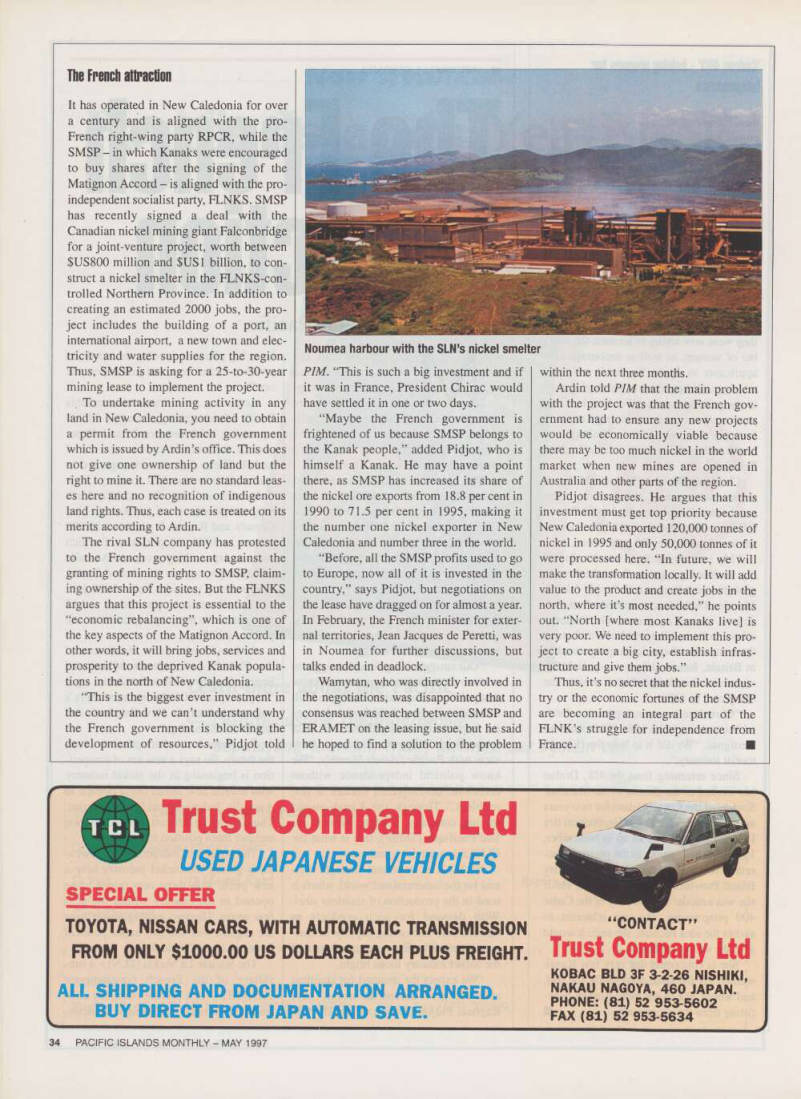
The Societe Le Nickel (SLN) - a sub sidiary of the French conglomerate ERAMET - is a private company con trolled by French government agencies.
The French attraction
It has operated in New Caledonia for over a century and is aligned with the pro- French right-wing party RPCR, while the SMSP - in which Kanaks were encouraged to buy shares after the signing of the Matignon Accord - is aligned with the pro independent socialist party, FLNKS. SMSP has recently signed a deal with the Canadian nickel mining giant Falconbridge for a joint-venture project, worth between SUSBOO million and SUSI billion, to con struct a nickel smelter in the FLNKS-con trolled Northern Province. In addition to creating an estimated 2000 jobs, the pro ject includes the building of a port, an international airport, a new town and elec tricity and water supplies for the region.
Thus, SMSP is asking for a 25-to-30-year
mining lease to implement the project.
To undertake mining activity in any land in New Caledonia, you need to obtain a permit from the French government which is issued by Ardin’s office. This does not give one ownership of land but the right to mine it. There are no standard leas es here and no recognition of indigenous land rights. Thus, each case is treated on its merits according to Ardin.
The rival SLN company has protested to the French government against the granting of mining rights to SMSP, claim ing ownership of the sites. But the FLNKS argues that this project is essential to the “economic rebalancing”, which is one of the key aspects of the Matignon Accord. In other words, it will bring jobs, services and
prosperity to the deprived Kanak popula
tions in the north of New Caledonia.
“This is the biggest ever investment in the country and we can’t understand why the French government is blocking the development of resources,” Pidjot told
PIM. “This is such a big investment and if it was in France, President Chirac would have settled it in one or two days.
“Maybe the French government is frightened of us because SMSP belongs to the Kanak people,” added Pidjot, who is himself a Kanak. He may have a point there, as SMSP has increased its share of the nickel ore exports from 18.8 per cent in 1990 to 71.5 per cent in 1995, making it the number one nickel exporter in New Caledonia and number three in the world.
“Before, all the SMSP profits used to go to Europe, now all of it is invested in the
country,” says Pidjot, but negotiations on
the lease have dragged on for almost a year.
In February, the French minister for exter nal territories, Jean Jacques de Peretti, was in Noumea for further discussions, but talks ended in deadlock.
Wamytan, who was directly involved in the negotiations, was disappointed that no consensus was reached between SMSP and ERAMET on the leasing issue, but He said he hoped to find a solution to the problem
within the next three months.
Ardin told PIM that the main problem with the project was that the French gov ernment had to ensure any new projects would be economically viable because there may be too much nickel in the world market when new mines are opened in Australia and other parts of the region.
Pidjot disagrees. He argues that this investment must get top priority because New Caledonia exported 120,000 tonnes of nickel in 1995 and only 50,000 tonnes of it were processed here. “In future, we will make the transformation locally. It will add value to the product and create jobs in the north, where it’s most needed,” he points out. “North [where most Kanaks live] is very poor. We need to implement this pro ject to create a big city, establish infras tructure and give them jobs.”
Thus, it’s no secret that the nickel indus try or the economic fortunes of the SMSP are becoming an integral part of the FLNK’s struggle for independence from France. ■
Noumea harbour with the SLN’s nickel smelter