helping prepare
pp. 30-33 · Read in the full issue


'Cadres 400' helping prepare for independence
The main pillar of the Matignon Accord is to rebalance the economic scales in New Caledonia over the 10-year period leading up to the independence vote in 1998; that is to make more economic opportunities available to Kanak people living in the Northern and Loyalty Island provinces. While Kanaky investments into the nickle and tourism sector were a major plank of it, for that to make a real impact on the upward mobility of Kanak people, they need to run and manage the enterprises thus created.
To assist in this process, the Cadres 400 programme was set up in 1989 to send to France 400 New Caledonians - mainly Kanaks - for higher education and training. The objective is to train as many Melanesians (Kanaks) as possible between ages 18 and 40 for senior management level. This scheme is jointly funded by the French government and the territory government of New Caledonia, with 80 per cent of the funding coming from France.
Up to July 31, 1996, 300 people had gone to France on these scholarships. Out of them, 162 have successfully completed their studies while another 110 are still there; 141 of these grad uates have already returned and are employed here.
“We give first preference to Melanesians because the aim is to contribute to the rebalance of responsibilities for the territo ry. Though the percentages were not decided at the beginning, about 75 per cent of those who have gone have been Melanesians, while there have also been Whites, Polynesians and mixed-race students,” says Catherine Bertignac, technical counsellor of Mission Formation, the government body which administers the Cadre 400 programme. She explained that when people came to their office expressing interest in the pro gramme, they first tested their proficiency for further studies,
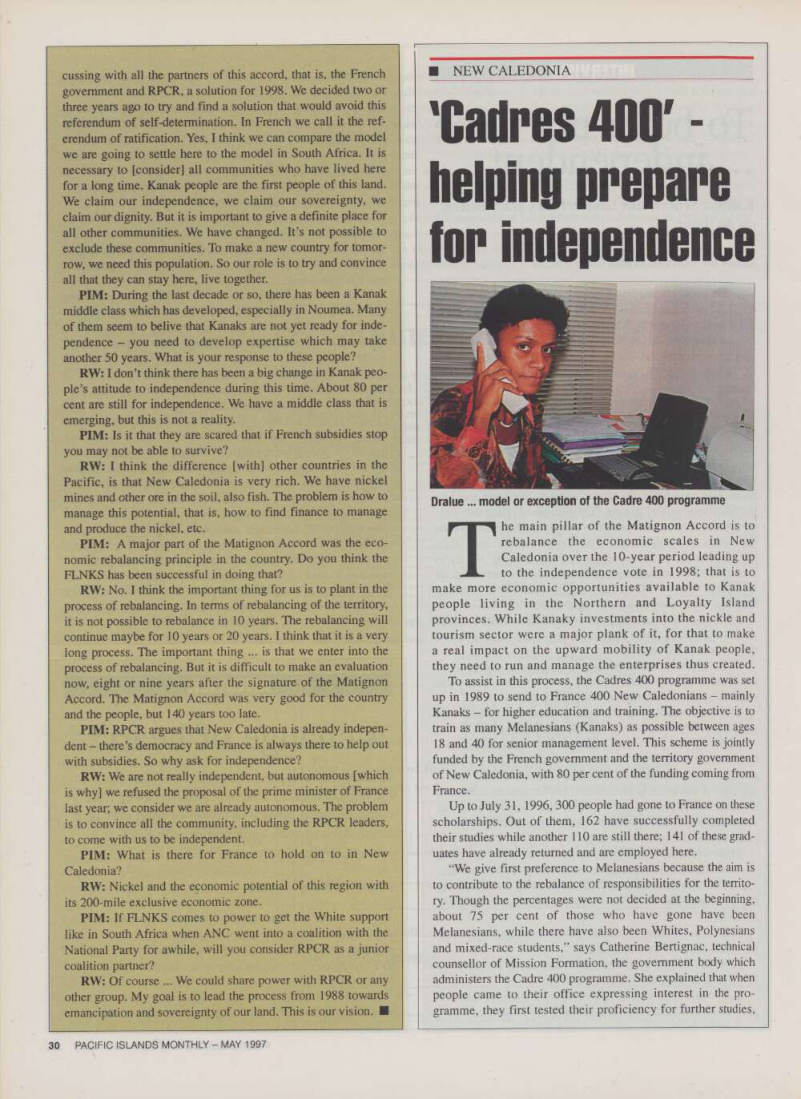
Draiue ... model or exception of the Cadre 400 programme
'Cadres 400' - helping prepare (or independence
then found out what field they wanted to pursue studies in and tried to match them with the needs of the country, especially that of the Melanesian community.
“They must choose a field of study where they will have an opportunity to work here, once they come back,” says Bertignac, adding that during their studies in France the students have access to a counsellor, and before they come back her office writes to potential employers and tries to arrange a job.
She said that about 80 per cent of scholarship-holders had been men and they were now trying to increase the num ber of women, as well as encourage new applicants to apply for fields of study which would help them to get employment in the private sector. “[For the] last two years we have tried to encourage students to apply for industrial technology and health and social science courses,” added Bertignac.
Christiane Dralue, a 29-year-old Kanak woman who is now the director of the newly established Loyalty Island Tourist Office in Noumea, is one of the success stories of the Cadre 400 programme.
“My parents are poor farmers; for all my studies I got grants from the French government,” Dralue told Pacific Islands Monthly. Dralue has completed a four-year degree course at a reputable business school in Paris, after which she undertook three months of special language studies in Britain, followed by a one-year MBA course in the United States, which she completed in 1994.
“Christiane was an exception, we fund ed her to do an MBA in the US,” observed Bertignac. “We did it to help the (Kanak) tourist industry.”
Since returning from the US, Dralue has worked as the director of the Maritime Society of the Loyalty Island for two years and became the director of Destination lies Loyalite when it was set up in November, 1996. She also works as the personal sec retary for the president of the Loyalty Island Province. When asked by PIM if she was a model success story of the Cadre 400 programme, she was reluctant to accept the idea because, she said, it would give the wrong picture.
She is concerned that very few Kanak women got the same opportunity she had, and would like to see more women bene fitting from the programme. ■