An Important economic force
p. 37 · Read in the full issue
Vietnamese play crucial part
Vietnamese have been liv ing in New Caledonia for as long as the French, who colonised the country. The first Vietnamese arrived on board the ship Cheribon in March 1891 from Hai Phong in the then French-ruled Indo-China. There were 791 men and 50 women, the men being mainly convicts being exported to the Pacific. Only 41 of the men had signed the contract to freely come to New Caledonia to work.
Thus, the first Vietnamese migrants came to New Caledonia at a time when the French needed cheap labour to mine nickel and develop agriculture. The early workers came on five-year contracts and, even though the working conditions were exploitative and sometimes brutal, many extended their contracts for a further five years before being forced to go back.
Between 1891 and the 19405, waves of Vietnamese migrant workers came to New Caledonia, sometimes about 500 a year. It was only in 1945 that the French govern ment decided to give permanent residence to all those who were on contract. New waves of migrants had come from Vietnam
following the French defeat in Indo-China in 1954 and the Amercan defeat in Vietnam in 1975. Many of them were Catholics.
Today, there are some 4000 Vietnamese living in New Caledonia, most of them in Noumea. According to the Vietnamese Association of New Caledonia (VANC), there are at least another 4000 New Caledonians who have Vietnamese blood through inter-marriage. After the Vietnamese were released from contract labour in 1945 and allowed to freely circu late in the country, many of them went into business. They first went into food busi ness with Kanak people. From working as salespersons in shops, they slowly began to set up their own small shops. Now, many own supermarkets, even car dealerships, shipping lines and export-import business es. There are many Vietnamese family businesses which own the whole process from the growing of vegetables to trans porting them to the market to selling to customers.
“We never got government help in set ing up business and we never asked for it,” a spokesman for the VANC told Pacific Islands Monthly, adding, “we are proud to be New Caledonians rooted in this country.
We don’t want to get involved in politics but we’re happy politicians are now talk ing to each other.”
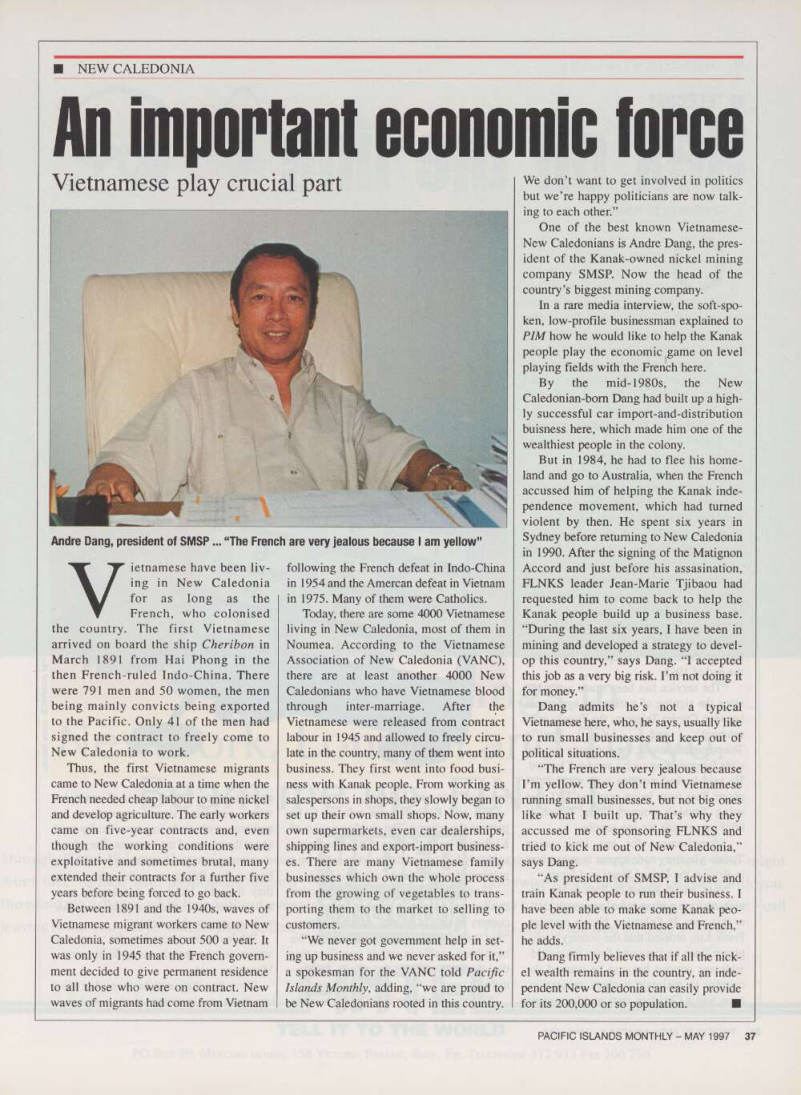
One of the best known Vietnamese- New Caledonians is Andre Dang, the pres ident of the Kanak-owned nickel mining company SMSP. Now the head of the
country’s biggest mining company.
In a rare media interview, the soft-spo ken, low-profile businessman explained to PIM how he would like to help the Kanak people play the economic game on level playing fields with the French here.
By the mid-1980s, the New Caledonian-bom Dang had built up a high ly successful car import-and-distribution buisness here, which made him one of the wealthiest people in the colony.
But in 1984, he had to flee his home land and go to Australia, when the French accussed him of helping the Kanak inde pendence movement, which had turned violent by then. He spent six years in Sydney before returning to New Caledonia in 1990. After the signing of the Matignon Accord and just before his assasination, FLNKS leader Jean-Marie Tjibaou had requested him to come back to help the Kanak people build up a business base.
“During the last six years, I have been in mining and developed a strategy to devel op this country,” says Dang. “I accepted this job as a very big risk. I’m not doing it for money.”
Dang admits he’s not a typical Vietnamese here, who, he says, usually like to run small businesses and keep out of
political situations.
“The French are very jealous because I’m yellow. They don’t mind Vietnamese running small businesses, but not big ones like what I built up. That’s why they accussed me of sponsoring FLNKS and tried to kick me out of New Caledonia,” says Dang.
“As president of SMSP, I advise and train Kanak people to run their business. I have been able to make some Kanak peo ple level with the Vietnamese and French,” he adds.
Dang firmly believes that if all the nick el wealth remains in the country, an inde pendent New Caledonia can easily provide for its 200,000 or so population. ■
Andre Dang, president of SMSP ... “The French are very jealous because lam yellow”