Mercenaries,
pp. 55-56 · Read in the full issue
Opinion
Mercenaries, PNG and Aussie aid
Australia’s foreign minister, Alexander Downer, was right when he described the decision by Papua New Guinea’s prime minister, Sir Julius Chan, to use mercenaries on Bougainville as “disastrous”.
It is more than disastrous. It has again halted aid and basic supplies getting to people who, after nine years of war, are more desperate than ever and it is likely to further derail the peace process which has been steadily building among ordi nary citizens.
If the surgical strikes to assassinate key seccessionist leaders and/or release the five PNG Defence Force hostages being held by the Bougainville Revolutionary Army (for which the mer cenaries appear to have been hired) go ahead, PNG will seriously alienate its allies in the region and create repercus sions amongst its major aid donors bigger than anything seen to date.
In his first response. Sir Julius argued that the 40 mercenaries, supplied by the British-registered Sandline International, which is a subsidiary of the notorious Executive Outcomes (the largest supplier of private armies to African trouble spots), were in PNG in a training capaci ty to upgrade the PNGDF so that it was “physically and psychologically” pre pared to fight.
Hard to believe, when Sandline had approached hospitals in Queensland seek ing facilities for treating their badly wounded operatives in emergency situa tions. The hospital refused to help and Sir Julius soon admitted that he was planning to use the mercenaries in Bougainville but, he said, not in frontline positions.
Initially, it appeared the Australian government had been taken by surprise by the revelations of the region’s first experience with mercenaries.
The news was broken by Mary-Louise O’Callaghan in The Australian just days after a visit by Downer to PNG, during which the public face was one of business as usual. In fact. Downer went to pains to trumpet a new SA4-million (SUS 2.9 mil
lion) humanitarian package for Bougainville, which, with the permission of Port Moresby, would for the first time allow a large aid package to be delivered by non-govemment organisations and for some of that aid to be delivered to people living in BRA-controlled areas.
In private during that visit. Downer was already making the Australian gov ernment’s position clear. Downer had been receiving intelligence briefings about the situation for at least the few weeks leading up to his trip.
If he had any doubts, when his plane landed in Port Moresby, it touched down between the two Russian transport planes which had brought the Sandline opera tives and their equipment into the country.
Downer called a meeting attended by the high commissioners for Britain and New Zealand and the United States charge d’affairs at which he briefed them and asked them to express their own con cerns to PNG.
After his meeting with Sir Julius, Downer briefed the Australian prime min ister, John Howard, who then rang Sir Julius to reinforce his concern at what were, in discussions, still only being described as “rumours”.
Once the story broke, Howard made his opposition clear, telling parliament the use of mercenaries was “absolutely and completely unacceptable” to Australia.
A meeting of Australia’s new peak security committee, the National Security Committee, was called and, under Howard’s chairmanship, went through all the options for handling the issue.
Afterwards, Downer took an extraor dinary step, one which indicates the depth of concern in Canberra, by refusing to rule out the possibility of cancelling Australia’s entire SA32O-million (SUS2SI -million) aid allocation to PNG.
While that is highly unlikely, unless there is some terrible conflagration on Bougainville, it is clear that some serious questions need to be asked about Australia’s defence aid to PNG.
Since independence, Australia’s tax payers have spent nearly half a billion dollars on the PNGDF. It is Australia’s
biggest defence aid allocation and its least successful.
Early in the war on Bougainville, Australia poured in huge amounts of aid and much of it, such as the three iroquois helicopters which were given with the condition that they were not to be used in an offensive capacity, have caused noth ing but trouble, most of all for innocent
Bougainvilleans.
Since the early 19905, Australia has taken the position that there can be no military solution to the Bougainville cri sis and that peace efforts are the only way forward.
These may not be easy but it is a stance which has been proven by events.
When the PNGDF has gone for all-out war, as it did in mid-1996 with Operation High Speed 11, it has met only humiliating defeat and prompted more skirmishes which have led to deaths on both sides.
Not only that, but the military approach leads hostility towards all Bougainvilleans such that, in 1996, Amnesty International reported that the PNGDF was responsible for 44 unlawful killings or disappearances on the island.
When the defence force plays a role in reconstruction, as it did under Sir Julius’ peace plan during 1994-95, it is more dis ciplined and peace efforts move forward.
As a result of Australia’s concern about PNGDF actions on Bougainville, its defence aid to PNG has gone down from a peak of around SA2O-SA2S mil lion (SUSI4.2-SUSI7.B million) a year to around SAI2 million (SUSB.S million).
Now, however, it looks as though Howrad may be going to increase that aid again.
After a five-hour meeting with Sir Julius in Sydney last month, the Australian PM said: “We don’t like mer cenaries. We think any reasonable alter native to mercenaries is to be preferred.”
Those “reasonable alternatives” are believed to include extra defence aid, which would be given only if PNG aban dons its plans to use mercenaries on
Bougainville.
At the same time, Australia would increase funding for peace efforts. While the PNG delegation was delighted with the prime ministerial talks, there will be many in Australia, including in the defence establishment, who will be want ing to see some big improvements in the PNGDF structure and discipline if such aid is to go ahead.
Since the war on Bougainville began, the lack of discipline, which leads to human rights abuses has become so bad that it is one of the major factors under mining peace efforts.
The assassination of the then premier of Bougainville, Theodore Miriung, is just one example.
Despite the enormous change in its
Australia
Jemma
Garrett
role, the PNGDF has not had its structure overhauled since independence, more than 20 years ago. Money is not the only answer to the PNGDF’s problems.
The political will to ensure human rights abuses are stamped out and those which do occur are properly dealt with, are much more important, as are measures to ensure that those troops returning from time on Bougainville have the necessary help they need to adjust to life out of a war zone.
Australia also needs to indulge in some self-examination on the mercenary issue if reports in the Bulletin are to be believed.
In the March 4 issue, Laurie Oakes claims that as far back as October last year, a well-known and unsavoury ex- Australian army officer was attempting to recruit Australians for mercenary work on Bougainville, offering as much as $A120,000 ($U585,700).
If intelligence sources are aware of that sort of information, one wonders why they are not able to charge the man under the Crimes (Foreign Incursions and Recruitment) Act and why the issue was not raised with Port Moresby much soon er. ■
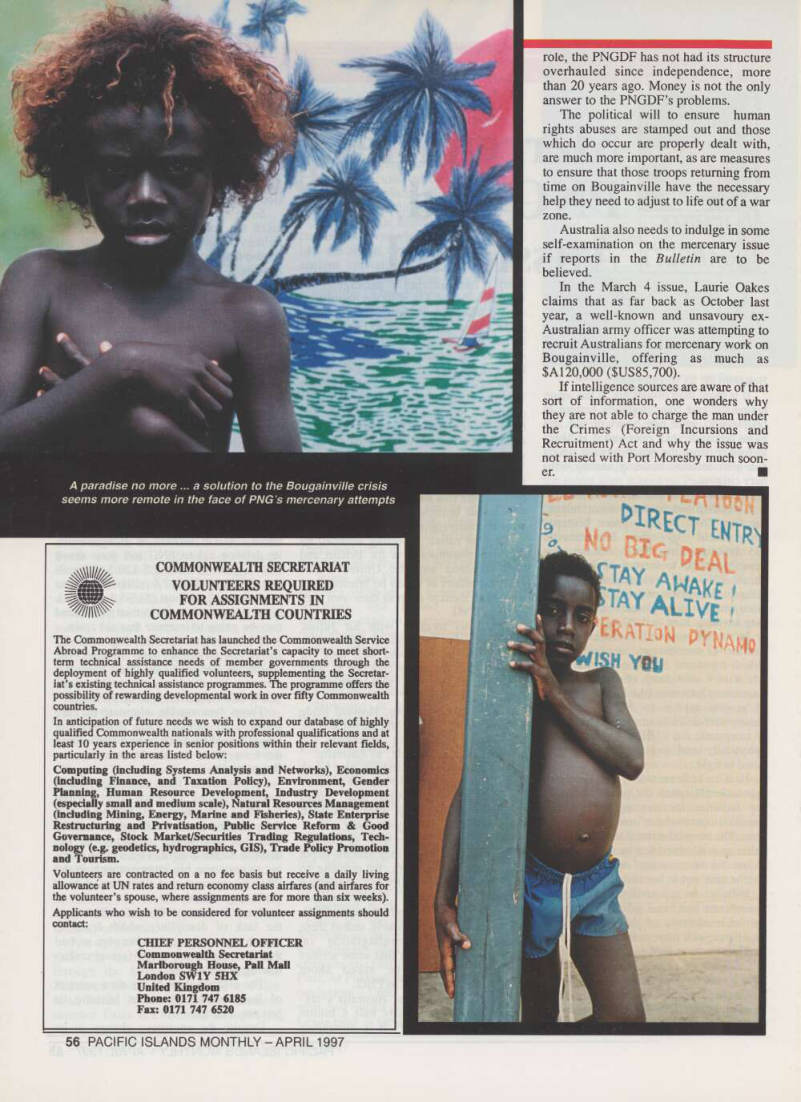
A paradise no more ... a solution to the Bougainville crisis seems more remote in the face of PNG's mercenary attempts