Looking for
p. 54 · Read in the full issue
Yachting
Looking for adventure
BY Sally Andrew
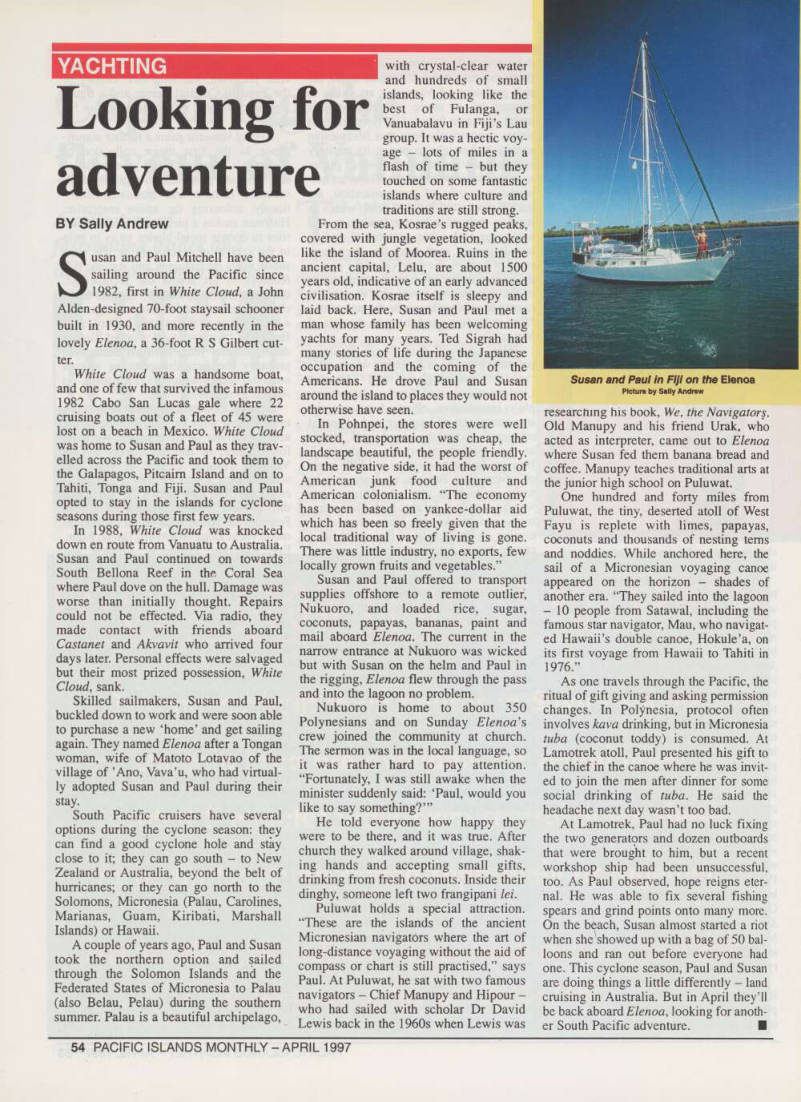
Susan and Paul Mitchell have been sailing around the Pacific since 1982, first in White Cloud, a John Alden-designed 70-foot staysail schooner built in 1930, and more recently in the lovely Elenoa, a 36-foot R S Gilbert cut ter.
White Cloud was a handsome boat, and one of few that survived the infamous 1982 Cabo San Lucas gale where 22 cruising boats out of a fleet of 45 were lost on a beach in Mexico. White Cloud was home to Susan and Paul as they trav elled across the Pacific and took them to the Galapagos, Pitcairn Island and on to Tahiti, Tonga and Fiji. Susan and Paul opted to stay in the islands for cyclone seasons during those first few years.
In 1988, White Cloud was knocked down en route from Vanuatu to Australia.
Susan and Paul continued on towards South Bellona Reef in the Coral Sea where Paul dove on the hull. Damage was worse than initially thought. Repairs could not be effected. Via radio, they made contact with friends aboard Castanet and Akvavit who arrived four days later. Personal effects were salvaged but their most prized possession. White Cloud, sank.
Skilled sailmakers, Susan and Paul, buckled down to work and were soon able to purchase a new ‘home’ and get sailing again. They named Elenoa after a Tongan woman, wife of Matoto Lotavao of the village of ’Ano, Vava’u, who had virtual ly adopted Susan and Paul during their stay.
South Pacific cruisers have several options during the cyclone season: they can find a good cyclone hole and stay close to it; they can go south - to New Zealand or Australia, beyond the belt of hurricanes; or they can go north to the Solomons, Micronesia (Palau, Carolines, Marianas, Guam, Kiribati, Marshall Islands) or Hawaii.
A couple of years ago, Paul and Susan took the northern option and sailed through the Solomon Islands and the Federated States of Micronesia to Palau (also Belau, Pelau) during the southern summer. Palau is a beautiful archipelago,
with crystal-clear water and hundreds of small islands, looking like the best of Fulanga, or Vanuabalavu in Fiji’s Lau group. It was a hectic voy age - lots of miles in a flash of time - but they touched on some fantastic islands where culture and
traditions are still strong.
From the sea, Kosrae’s rugged peaks, covered with jungle vegetation, looked like the island of Moorea. Ruins in the ancient capital, Lelu, are about 1500 years old, indicative of an early advanced civilisation. Kosrae itself is sleepy and laid back. Here, Susan and Paul met a man whose family has been welcoming yachts for many years. Ted Sigrah had many stories of life during the Japanese occupation and the coming of the Americans. He drove Paul and Susan around the island to places they would not otherwise have seen.
In Pohnpei, the stores were well stocked, transportation was cheap, the landscape beautiful, the people friendly.
On the negative side, it had the worst of American junk food culture and American colonialism. “The economy has been based on yankee-dollar aid which has been so freely given that the local traditional way of living is gone.
There was little industry, no exports, few locally grown fruits and vegetables.”
Susan and Paul offered to transport supplies offshore to a remote outlier, Nukuoro, and loaded rice, sugar, coconuts, papayas, bananas, paint and mail aboard Elenoa. The current in the narrow entrance at Nukuoro was wicked but with Susan on the helm and Paul in the rigging, Elenoa flew through the pass and into the lagoon no problem.
Nukuoro is home to about 350 Polynesians and on Sunday Elenoa' s crew joined the community at church.
The sermon was in the local language, so it was rather hard to pay attention.
“Fortunately, I was still awake when the minister suddenly said: ‘Paul, would you like to say something?”’
He told everyone how happy they were to be there, and it was true. After church they walked around village, shak ing hands and accepting small gifts, drinking from fresh coconuts. Inside their dinghy, someone left two frangipani lei.
Puluwat holds a special attraction.
“These are the islands of the ancient Micronesian navigators where the art of long-distance voyaging without the aid of compass or chart is still practised,” says Paul. At Puluwat, he sat with two famous navigators - Chief Manupy and Hipour who had sailed with scholar Dr David Lewis back in the 1960 s when Lewis was
researching his book, We, the Navigators.
Old Manupy and his friend Urak, who acted as interpreter, came out to Elenoa where Susan fed them banana bread and coffee. Manupy teaches traditional arts at the junior high school on Puluwat.
One hundred and forty miles from Puluwat, the tiny, deserted atoll of West Fayu is replete with limes, papayas, coconuts and thousands of nesting terns and noddies. While anchored here, the sail of a Micronesian voyaging canoe appeared on the horizon - shades of another era. “They sailed into the lagoon - 10 people from Satawal, including the famous star navigator, Mau, who navigat ed Hawaii’s double canoe, Hokule’a, on its first voyage from Hawaii to Tahiti in 1976.”
As one travels through the Pacific, the ritual of gift giving and asking permission
changes. In Polynesia, protocol often
involves kava drinking, but in Micronesia tuba (coconut toddy) is consumed. At Lamotrek atoll, Paul presented his gift to the chief in the canoe where he was invit ed to join the men after dinner for some social drinking of tuba. He said the headache next day wasn’t too bad.
At Lamotrek, Paul had no luck fixing the two generates and dozen outboards that were brought to him, but a recent workshop ship had been unsuccessful, too. As Paul observed, hope reigns eter nal. He was able to fix several fishing spears and grind points onto many more.
On the beach, Susan almost started a riot when she'showed up with a bag of 50 bal loons and ran out before everyone had one. This cyclone season, Paul and Susan are doing things a little differently - land cruising in Australia. But in April they’ll be back aboard Elenoa , looking for anoth er South Pacific adventure. ■
Susan and Paul in Fiji on the Elenoa Picture by Sally Andrew