Capturing the
pp. 52-53 · Read in the full issue

Literature
Capturing the flavour of Vanuatu
A collection of fascinating asides and little gems of information
By Nicolas Rothwell
Tall Ambrym slit-drums with star
ing disc-eyes, fine-woven mats
from Pentecost, Malakulan
‘ Ramboramp ’ funerary effigies, bright
painted, with curled pig-tusks and over modelled skulls, black Banks Islands grade sculptures of tree-fern, their mouths seeming to whisper mesages of power the archipelago of Vanuatu, that Y-shaped sprawl of 83 islands and 100 languages, has given the world a dazzling variety of artistic styles and traditions, which are at long last being assessed and recognised in a landmark international exhibition.
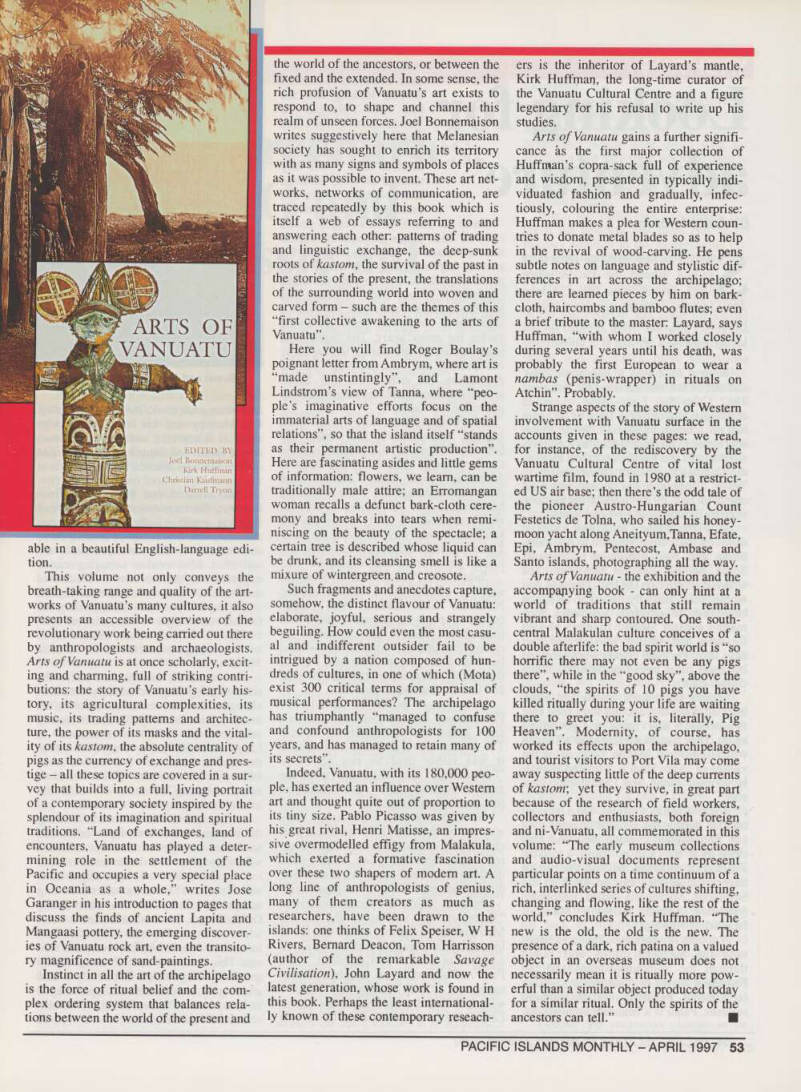
Arts of Vanuatu, which opened in Port Vila’s elegant new museum last year and moved on to Noumea, in New Caledonia, will be on display in 1997 in two of the great ethnographic centres of Europe: Basel, in Switzerland, and the French capital, Paris. Accompanying the exhibi tion is an imporatnt catalogue, now avail-
19th-century photograph by J W Lindt of Vanuatu slit gongs
able in a beautiful English-language edi tion.
This volume not only conveys the breath-taking range and quality of the art works of Vanuatu’s many cultures, it also presents an accessible overview of the revolutionary work being carried out there by anthropologists and archaeologists.
Arts of Vanuatu is at once scholarly, excit ing and charming, full of striking contri butions: the story of Vanuatu’s early his tory, its agricultural complexities, its music, its trading patterns and architec ture, the power of its masks and the vital ity of its kastom, the absolute centrality of pigs as the currency of exchange and pres tige - all these topics are covered in a sur vey that builds into a full, living portrait of a contemporary society inspired by the splendour of its imagination and spiritual traditions. “Land of exchanges, land of encounters, Vanuatu has played a deter mining role in the settlement of the Pacific and occupies a very special place in Oceania as a whole,” writes Jose Garanger in his introduction to pages that discuss the finds of ancient Lapita and Mangaasi pottery, the emerging discover ies of Vanuatu rock art, even the transito ry magnificence of sand-paintings.
Instinct in all the art of the archipelago is the force of ritual belief and the com plex ordering system that balances rela tions between the world of the present and
the world of the ancestors, or between the fixed and the extended. In some sense, the rich profusion of Vanuatu’s art exists to respond to, to shape and channel this realm of unseen forces. Joel Bonnemaison writes suggestively here that Melanesian society has sought to enrich its territory with as many signs and symbols of places as it was possible to invent. These art net works, networks of communication, are traced repeatedly by this book which is itself a web of essays referring to and answering each other: patterns of trading and linguistic exchange, the deep-sunk roots of kastom, the survival of the past in the stories of the present, the translations of the surrounding world into woven and caived form - such are the themes of this “first collective awakening to the arts of Vanuatu”.
Here you will find Roger Boulay’s poignant letter from Ambrym, where art is “made unstintingly”, and Lament Lindstrom’s view of Tanna, where “peo ple’s imaginative efforts focus on the immaterial arts of language and of spatial relations”, so that the island itself “stands as their permanent artistic production”.
Here are fascinating asides and little gems of information: flowers, we leam, can be traditionally male attire; an Erromangan woman recalls a defunct bark-cloth cere mony and breaks into tears when remi niscing on the beauty of the spectacle; a certain tree is described whose liquid can be drunk, and its cleansing smell is like a mixure of wintergreen, and creosote.
Such fragments and anecdotes capture, somehow, the distinct flavour of Vanuatu: elaborate, joyful, serious and strangely beguiling. How could even the most casu al and indifferent outsider fail to be intrigued by a nation composed of hun dreds of cultures, in one of which (Mota) exist 300 critical terms for appraisal of musical performances? The archipelago has triumphantly “managed to confuse and confound anthropologists for 100 years, and has managed to retain many of its secrets”.
Indeed, Vanuatu, with its 180,000 peo ple, has exerted an influence over Western art and thought quite out of proportion to its tiny size. Pablo Picasso was given by his great rival, Henri Matisse, an impres sive overmodelled effigy from Malakula, which exerted a formative fascination over these two shapers of modem art. A long line of anthropologists of genius, many of them creators as much as researchers, have been drawn to the islands: one thinks of Felix Speiser, W H Rivers, Bernard Deacon, Tom Harrisson (author of the remarkable Savage Civilisation ), John Layard and now the latest generation, whose work is found in this book. Perhaps the least international ly known of these contemporary reseach
ers is the inheritor of Layard’s mantle, Kirk Huffman, the long-time curator of the Vanuatu Cultural Centre and a figure legendary for his refusal to write up his studies.
Arts of Vanuatu gains a further signifi cance as the first major collection of Huffman’s copra-sack full of experience and wisdom, presented in typically indi viduated fashion and gradually, infec tiously, colouring the entire enterprise: Huffman makes a plea for Western coun tries to donate metal blades so as to help in the revival of wood-carving. He pens subtle notes on language and stylistic dif ferences in art across the archipelago; there are learned pieces by him on bark cloth, haircombs and bamboo flutes; even a brief tribute to the master: Layard, says Huffman, “with whom I worked closely during several years until his death, was probably the first European to wear a nambas (penis-wrapper) in rituals on Atchin”. Probably.
Strange aspects of the story of Western involvement with Vanuatu surface in the accounts given in these pages; we read, for instance, of the rediscovery by the Vanuatu Cultural Centre of vital lost wartime film, found in 1980 at a restrict ed US air base; then there’s the odd tale of the pioneer Austro-Hungarian Count Festetics de Tolna, who sailed his honey moon yacht along Aneityum,Tanna, Efate, Epi, Ambrym, Pentecost, Ambase and Santo islands, photographing all the way.
Arts of Vanuatu - the exhibition and the accompanying book - can only hint at a world of traditions that still remain vibrant and sharp contoured. One south central Malakulan culture conceives of a double afterlife: the bad spirit world is “so horrific there may not even be any pigs there”, while in the “good sky”, above the clouds, “the spirits of 10 pigs you have killed ritually during your life are waiting there to greet you; it is, literally. Pig Heaven”. Modernity, of course, has worked its effects upon the archipelago, and tourist visitors to Port Vila may come away suspecting little of the deep currents of kastonv, yet they survive, in great part because of the research of field workers, collectors and enthusiasts, both foreign and ni-Vanuatu, all commemorated in this volume: “The early museum collections and audio-visual documents represent particular points on a time continuum of a rich, interlinked series of cultures shifting, changing and flowing, like the rest of the world,” concludes Kirk Huffman. “The new is the old, the old is the new. The presence of a dark, rich patina on a valued object in an overseas museum does not necessarily mean it is ritually more pow erful than a similar object produced today for a similar ritual. Only the spirits of the ancestors can tell.” ■