Ingots for Inga
p. 51 · Read in the full issue
Sport
By Atama Raganivatu
Va’aiga Tuigamala’s bank manager was not the only one to smile when the Samoan superstar struck gold by becoming the first rugby player to feature in a £l-million transfer. Manu Samoa fans also had reason to rejoice, for the move from rugby league’s Wigan to the Newcastle Rugby Union Club means that the legendary “Inga the Winger” will be free to appear for their side in all future internationals.
The personal financial aspects of Tuigamala’s five-year contract were not announced. However, it its believed that Newcastle have doubled the salary he received at Wigan. If this is true, he will receive over SUSI million in total.
Few will begrudge Tuigamala his wealth, for his is an inspiring story of tri umph over adversity.
Bom in the village of Faleasiu, the ninth of 14 children, his family was just able to eke out an existence by growing bananas, pawpaws, cotton and yams on their plantation. Poverty, though, did not drive Va’aiga Tuigamala senior and his wife, Fa’atauala, along with four of their children, to migrate to New Zealand.
It was during a cyclone in 1973 that the elder Va’aiga determined the family would move to a place with a kinder cli mate. He settled in Invercargill, New Zealand’s southernmost city, where rela tives resided, and must have wondered if he had swapped a frying pan for a fire.
At least a fire would have been hot!
After eight months, failing to come to terms with the unaccustomed cold of Southland while working in a sawmill, Va’aiga senior relocated to Auckland’s warmer climes and found a job as a facto ry storeman.
Here, the full family was reassembled.
Invercargill did at least provide young Va’aiga with his first rugby memory.
While there, he witnessed a group of youngsters playing an impromptu game in the family front yard with a rolled-up sock the substitute for a ball. He recalls having no wish to join in and cricket was then the one sport which held any interest for him.
Only after the Tuigamalas had been set tled in Auckland for two years did Va’aiga catch the rugby bug and become a mem ber of the Kelston under-10 side. Playing barefoot and using orange peel as a mouthguard, his road to fame and fortune
started in a distinctly unglamorous man ner.
Boxing also appealed to him and, for awhile, it seemed the better option. Those witnessing his efforts on the rugby pitch at the time believed he lacked the dedication necessary to make any real impact in that game. Then came the moment which changed Tuigamala’s life.
In 1970, when he was just 11, his father died of a heart attack, leaving Fa’atauala to raise 14 children alone. A very different Va’aiga emerged from the shock - a much more determined and mature young man, and this manifested itself fnost obviously in his drive to suc ceed at rugby.
And success certainly did come his way as the gaunt youngster transformed himself into one of international rugby union’s strongest, fastest and most author itative players.
Milestones passed during Tuigamala’s progression included first appearances for the New Zealand Secondary Schools XV (in 1986), the national under-19 selection (1987), New Zealand Colts and the all conquering Auckland senior provincial team (both 1988). 1989 saw his All Blacks debut. However, he had to wait a further two years before being called up for Test match duty - against the United States at the World Cup in England.
By late 1993, Tuigamala had become the greatest cult hero ever produced by New Zealand rugby. On the pitch, he was the creator and scorer of tries par excel lence. No All Blacks fans who witnessed them will ever forget his touchdown against the Rest of the World in 1992, when six would-be tacklers were left in his wake, or the way he presented the ball for a teammate to score the match-clinch ing try against world champions Australia the following year despite having four opponents clinging vainly to him.
Off the field, Tuigamala transgressed rugby. Affectionately known to one and all as “Inga the Winger”, he was the favourite of everybody, from the auto graph-hunting schoolboy to the advertis ing executive seeking an instantly recog nisable and popular personality to endorse products. The affable and guileless devot ed family man with the ever-broad smile projected exactly the right picture desired of the modem player by the image-con scious New Zealand Rugby Football Union. It was, therefore, a major blow to the Kiwis’ national game when, in January 1994, Tuigamala joined the Wigan Rugby League Club in England.
He made no bones about it. Money, purely and simply, induced Tuigamala’s switch. Despite his fame and achieve ments, earnings for him in what was then still basically an amateur sport were limit ed. When signing the contract offered by Wigan, he secured the financial futures of himself and his family. He had made 39 appearances for the All Blacks, 19 of them in Tests.
Although changing his country, his sport and his playing position (Wigan pre ferred him as a centre rather than a winger), Tuigamala continued to thrive and won every honour available with “The Riversiders”.
Rugby union’s ditching of amateurism in 1995 opened the door back into that sport for Tuigamala and, during the fol lowing year, he participated in both codes; making guest appearances on loan from Wigan for the famous London club Wasps and playing a major role in Manu Samoa’s historic 40-25 rout of Ireland. He had also represented Western Samoa a year earlier in rugby league’s Centenary World Cup.
Ireland’s destruction whetted Tuigamala’s appetite for more internation al rugby and the prospect of being free to pull on Manu Samoa’s jersey whenever called upon (he insisted that a clause be added to his contract releasing him for all internationals) made the link-up with Newcastle all the more attractive.
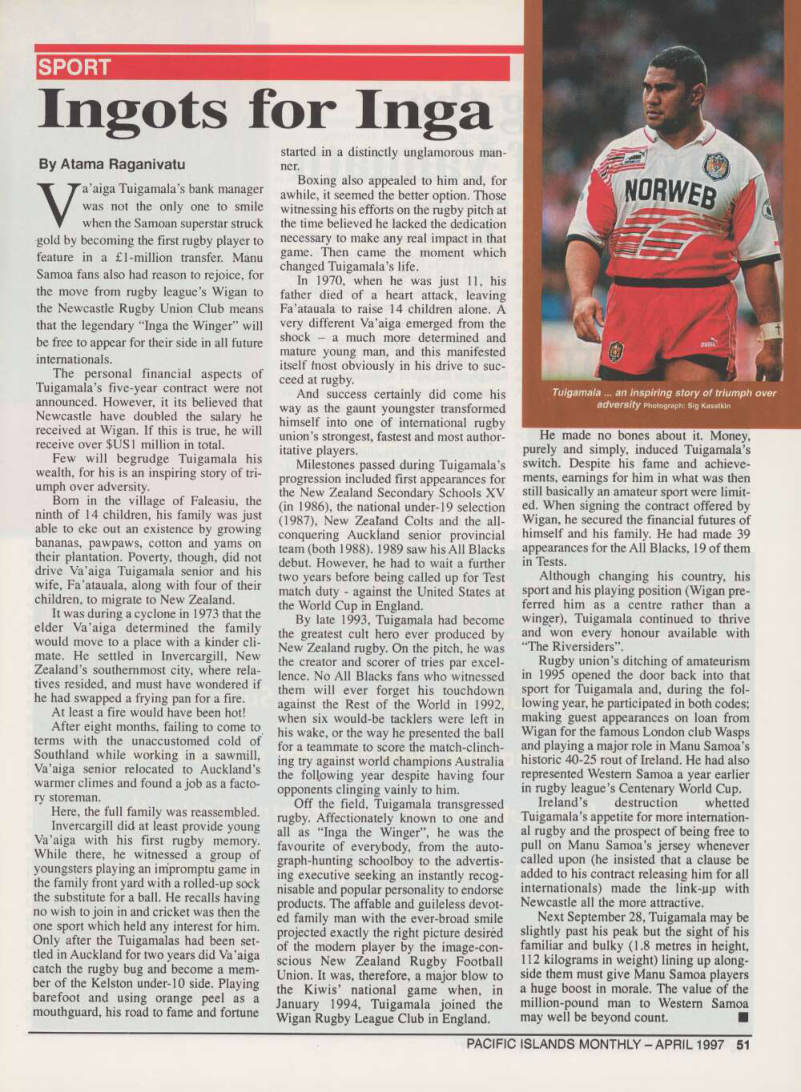
Next September 28, Tuigamala may be slightly past his peak but the sight of his familiar and bulky (1.8 metres in height, 112 kilograms in weight) lining up along side them must give Manu Samoa players a huge boost in morale. The value of the million-pound man to Western Samoa may well be beyond count, ■
Tuigamala ... an inspiring story of triumph over adversity Photograph: Sig Kasatkin