The race issue
p. 57 · Read in the full issue
no longer in black and white
Twenty-five years have passed since New Zealand set up a Race Relations Office, charged with pro moting racial harmony in this multicultur al nation.
A quarter of a century later, the chal lenge is like rust - “It never sleeps,” race relations conciliator Rajen Prasad told parliament recently in his annual report for last year.
How are we doing after all this time?
Well, nobody actually knows.
As Prasad pointed out, we have no way
of measuring the country’s performance
in race relations.
There is no set of indicators by which to judge whether we have good relations between the races or not.
More importantly, he said, New Zealand has no agreed national agenda or strategy for race relations and one is sore
ly needed.
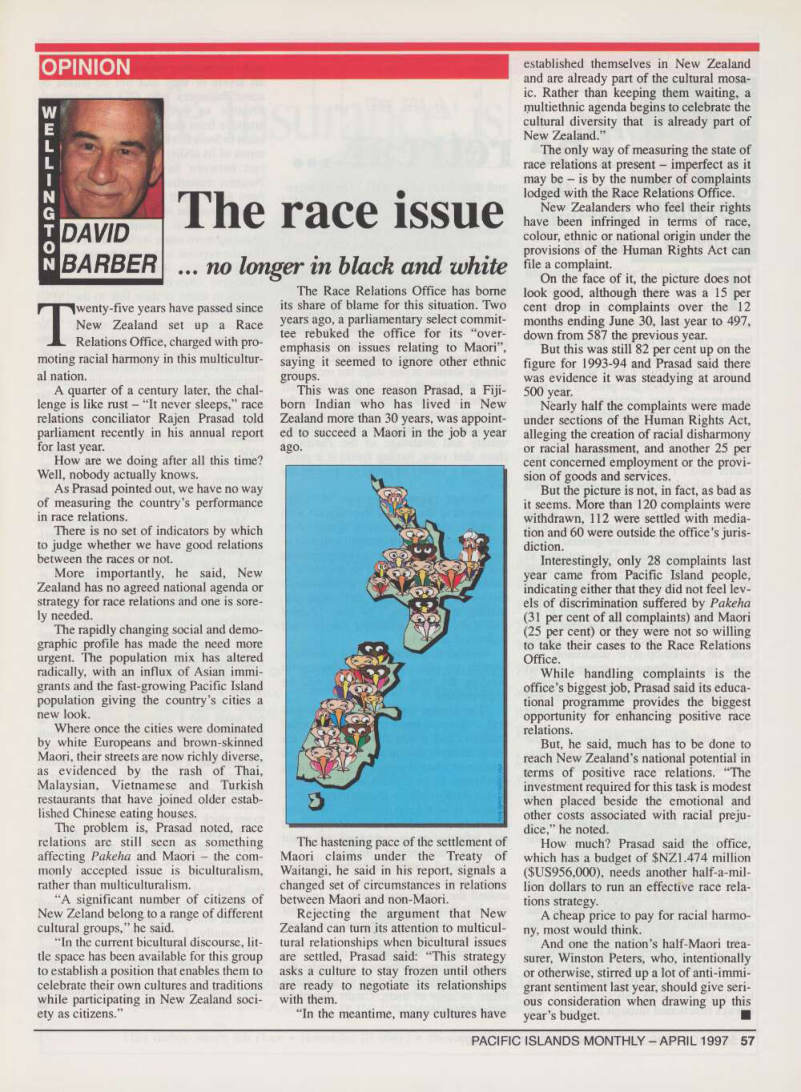
The rapidly changing social and demo graphic profile has made the need more urgent. The population mix has altered radically, with an influx of Asian immi grants and the fast-growing Pacific Island population giving the country’s cities a new look.
Where once the cities were dominated by white Europeans and brown-skinned Maori, their streets are now richly diverse, as evidenced by the rash of Thai, Malaysian, Vietnamese and Turkish restaurants that have joined older estab lished Chinese eating houses.
The problem is, Prasad noted, race relations are still seen as something affecting Pakeha and Maori - the com monly accepted issue is biculturalism, rather than multiculturalism.
“A significant number of citizens of New Zeland belong to a range of different cultural groups,” he said.
“In the current bicultural discourse, lit tle space has been available for this group to establish a position that enables them to celebrate their own cultures and traditions while participating in New Zealand soci ety as citizens.”
The Race Relations Office has borne its share of blame for this situation. Two years ago, a parliamentary select commit tee rebuked the office for its “over emphasis on issues relating to Maori”, saying it seemed to ignore other ethnic groups.
This was one reason Prasad, a Fiji born Indian who has lived in New Zealand more than 30 years, was appoint ed to succeed a Maori in the job a year ago.
The hastening pace of the settlement of Maori claims under the Treaty of Waitangi, he said in his report, signals a changed set of circumstances in relations between Maori and non-Maori.
Rejecting the argument that New Zealand can turn its attention to multicul tural relationships when bicultural issues are settled, Prasad said: “This strategy asks a culture to stay frozen until others
are ready to negotiate its relationships
with them.
“In the meantime, many cultures have
established themselves in New Zealand and are already part of the cultural mosa ic. Rather than keeping them waiting, a multiethnic agenda begins to celebrate the cultural diversity that is already part of New Zealand.”
The only way of measuring the state of race relations at present - imperfect as it may be - is by the number of complaints lodged with the Race Relations Office.
New Zealanders who feel their rights have been infringed in terms of race, colour, ethnic or national origin under the provisions of the Human Rights Act can file a complaint.
On the face of it, the picture does not look good, although there was a 15 per cent drop in complaints over the 12 months ending June 30, last year to 497, down from 587 the previous year.
But this was still 82 per cent up on the figure for 1993-94 and Prasad said there was evidence it was steadying at around 500 year.
Nearly half the complaints were made under sections of the Human Rights Act, alleging the creation of racial disharmony or racial harassment, and another 25 per cent concerned employment or the provi sion of goods and services.
But the picture is not, in fact, as bad as it seems. More than 120 complaints were withdrawn, 112 were settled with media tion and 60 were outside the office’s juris diction.
Interestingly, only 28 complaints last year came from Pacific Island people, indicating either that they did not feel lev els of discrimination suffered by Pakeha (31 per cent of all complaints) and Maori (25 per cent) or they were not so willing to take their cases to the Race Relations Office.
While handling complaints is the office’s biggest job, Prasad said its educa tional programme provides the biggest opportunity for enhancing positive race relations.
But, he said, much has to be done to reach New Zealand’s national potential in terms of positive race relations. “The investment required for this task is modest when placed beside the emotional and other costs associated with racial preju dice,” he noted.
How much? Prasad said the office, which has a budget of $NZ1.474 million ($U5956,000), needs another half-a-mil lion dollars to run an effective race rela tions strategy.
A cheap price to pay for racial harmo ny, most would think.
And one the nation’s half-Maori trea surer, Winston Peters, who, intentionally or otherwise, stirred up a lot of anti-immi grant sentiment last year, should give seri ous consideration when drawing up this year’s budget. ■