Kava set to calm
pp. 48-49 · Read in the full issue
Business
Kava set to calm Western nerves
Text and photographs by
Kalinga Seneviratne
Kava Kompany, a locally regis tered kava exporting company operated by an American expatri ate businesswoman, is keen to make this traditional Pacific brew a multi-million dollar money spinner for Pacific Island countries.
“At the moment, kava is a hot item in the US. It is getting huge publicity and there’s potentially a 500,000-tonnes-a -year market out there” Roxanna Naylor, director of the Port Vila-based Kava Kompany told Pacific Islands 'Monthly.
But the man who initially'commer cialised this traditional Pacific brew in Vanuatu, local businessman Charles Long Wah, is not sure whether Vanuatu can produce enought kava to satisfy such a market.
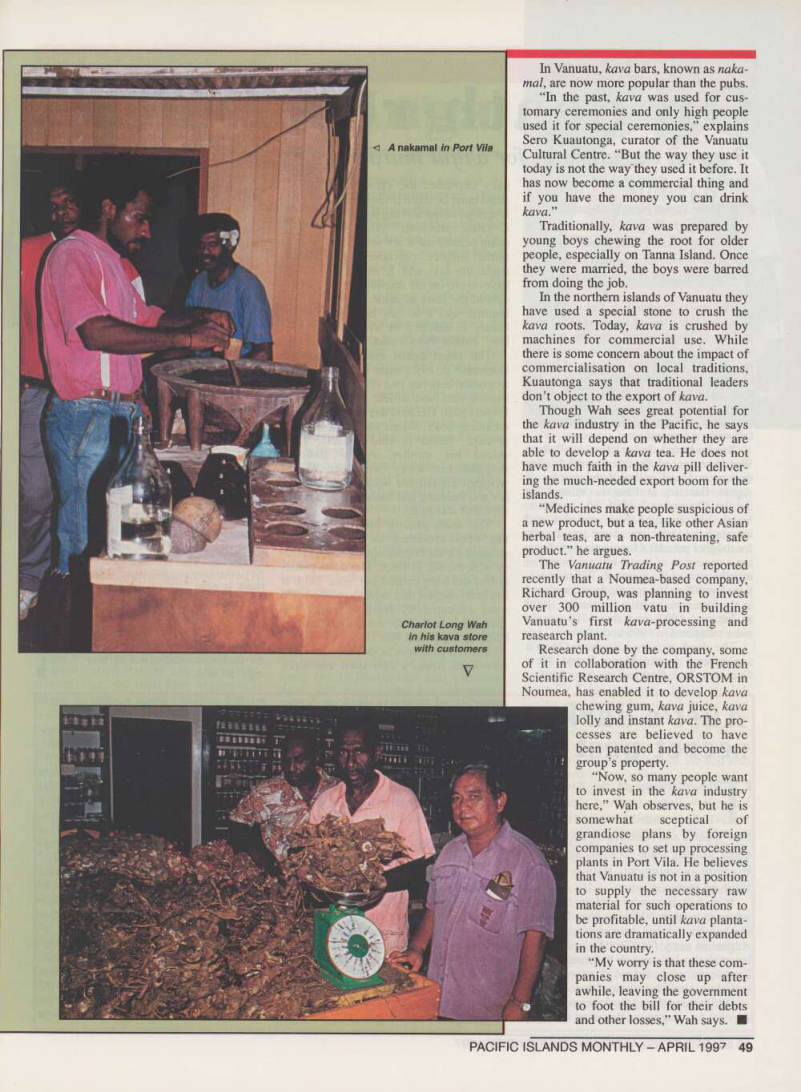
Wah, a Vanuatu citizen of Chinese ancestry, has been instrumental in setting up the kava industry here and has been promoting kava since 1976.
“When I started commercialising it here, all the missionaries in Vanuatu were against me,” he told PIM. “When European missionaries arrived here, they wanted to destroy all the kava plants. So, when I asked all Melanesian ni-Vanuatu people to go back to their traditional drink, instead of (the imported) wine and beer, the missionaries were up in arms. It made headline news here. Now, they sit down with me and drink kava,” said Wah with a chuckle.
Westerners who once wanted to
destroy the kava plants, viewing it as a “devil’s drink”, are today putting its roots under the microscopes in laboratories in the United States, Germany, France and Australia and finding out that the Pacific Islanders were correct in the first place when drunk it could induce tranquility and restfulness in both body and soul.
Thus, capsules, tablets and juices made from kava are now slowly entering markets in the West as stress-relief “dietary-supplement”. There are also plans by German and American compa nies to market stress-relief capsules made of, kava extracts in South-East Asian mar kets, Recent studies have shown that it may help to treat schizophrenia and epilepsy, and acts as a muscle relaxant.
During the past two years, working with a US research laboratory, the Kava Kompany has been able to introduce 10 new products into the US market, sold mainly as dietary supplements.
Among the products in the US market is a drink called Mellow Out sold at SUS9O per litre bottle, which is a blend of kava and a Chinese heart). Kavatrol is a 30-capsule packet sold for under SUS 9, advertised mainly in airline margazines targeting the ‘jet-lag’ market. fdquid Kalm is a syrup where three to four tea spoons are recommended after dinner as stress relief, and Erotikava is a 200 ml bot tle of kava syrup recommended to be taken after dinner preferably in a candle lit room with soft music.
“The US Food and Drug Administration (FDA) is still nervous about kava” says Naylor, explaining the beaurocratic wrangle she had to go through to get her first shipment of kava
from Vanuatu into the US in 1994.
“In true definition, it is a narcotic there. That word sends most health authorities into a spin,” she observes.
When the first kava shipment arrived in the US, the FDA wanted a zero defect level in the product when tested for things like insects, “foreign material”, soil, etc, which is impossible to achieve. Thus, Naylor had to hire lawyers, senators and consultants to overturn the decision. She was also helped by Pacific Island country embassies in Washington which wrote to the FDA in support of kava.
Now that kava is allowed to be imported into the US for use as a dietary supplement, being a new product promot ed in the market for its therapeutic quali ties, it is facing new challenges.
“Dietary supplements have various advertising restrictions - such as you can’t make any wild outlandish claims which has made the industry a little bit nervous,” she says.
“It has held up the release of some of our new products.”
Naylor claims that she and her part ners in the US have plugged in SUS2S million into advertising so far this year.
Naylor also believes that if the US market pontential is realised, the region will not have enough kava to supply it, at the current rates of production. Thus, she argues rather than worry about Intellectual Property Rights (IPR) issues, Pacific Island countries must increase its kava production and regional govern ments, through the South Pacific Commission, must fund a research pro gramme in the region.
Kava is already a big export earner for Pacific Island countries, Vanuatu has increased its export income from kava by six-fold within five years, earning $U5520,000 in 1994.
Wah says he has created a SUS3-mil lion industry here which produced over 6000 tonnes in 1996 and employs some 6000 people in a country whose popula tion is just 145,000. Most of this income is generated locally.
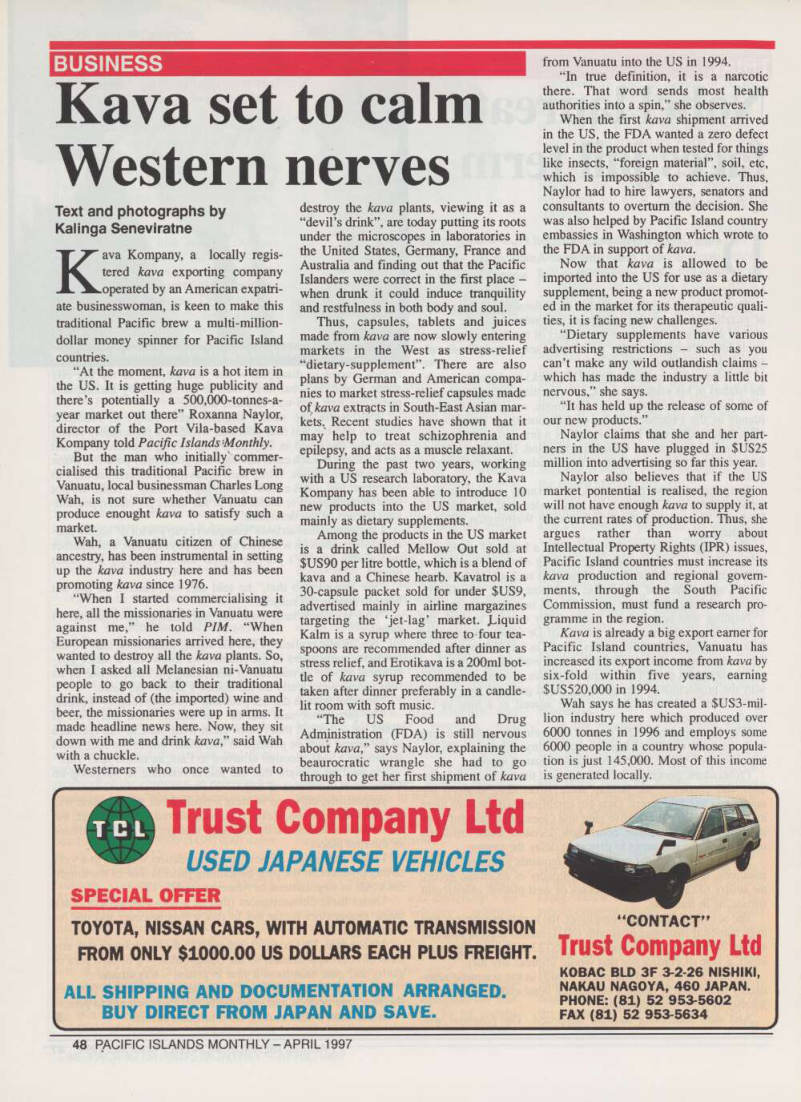
In Vanuatu, kava bars, known as naka mal, are now more popular than the pubs.
“In the past, kava was used for cus tomary ceremonies and only high people used it for special ceremonies,” explains Sero Kuautonga, curator of the Vanuatu Cultural Centre. “But the way they use it today is not the way'they used it before. It has now become a commercial thing and if you have the money you can drink kava .”
Traditionally, kava was prepared by young boys chewing the root for older people, especially on Tanna Island. Once they were married, the boys were barred from doing the job.
In the northern islands of Vanuatu they have used a special stone to crush the kava roots. Today, kava is crushed by machines for commercial use. While there is some concern about the impact of commercialisation on local traditions, Kuautonga says that traditional leaders don’t object to the export of kava.
Though Wah sees great potential for the kava industry in the Pacific, he says that it will depend on whether they are able to develop a kava tea. He does not have much faith in the kava pill deliver ing the much-needed export boom for the islands.
“Medicines make people suspicious of a new product, but a tea, like other Asian herbal teas, are a non-threatening, safe product.” he argues.
The Vanuatu Trading Post reported recently that a Noumea-based company, Richard Group, was planning to invest over 300 million vatu in building Vanuatu’s first £ava-processing and reasearch plant.
Research done by the company, some of it in collaboration with the French Scientific Research Centre, ORSTOM in Noumea, has enabled it to develop kava
chewing gum, kava juice, kava lolly and instant kava. The pro cesses are believed to have been patented and become the group’s property.
“Now, so many people want to invest in the kava industry here,” Wah observes, but he is somewhat sceptical of grandiose plans by foreign companies to set up processing plants in Port Vila. He believes that Vanuatu is not in a position to supply the necessary raw material for such operations to be profitable, until kava planta tions are dramatically expanded in the country.
“My worry is that these com panies may close up after awhile, leaving the government to foot the bill for their debts and other losses,” Wah says. ■
A nakamal in Port Vila
Chariot Long Wah in his kava store with customers