On death row
p. 50 · Read in the full issue
Execution
3 await execution for for wilful murder
Reports by Sam Vulum
Three Papua New Guinean men are being held in jail awaiting their execution by hanging for the rape and wilful murder of a woman in the West New Britain province on December 3, 1995.
The three, Steven Ima Loke, Charles Kona and Greg Vava Kavoa, were the sec ond lot to be sentenced after the reintro duction of the death penalty by parliament in August, 1991. The first was Charles Ombusu from the Northern Province. He was convicted by Justice Tracy Doherty in February, 1995. However, the sentence was later quashed by the supreme court following an appeal.
Kimbe-based judge Justice Robert Woods sentenced the three to death after they were found guilty of the murder of Agnes Banovo at Pangalu village on Sunday, December 3, 1995. The sentence, which has attracted both national and international criticism, came amid calls for tougher penalties for criminals follow ing a sucession of brutal killings in recent months around the country. Police statis tics shows that 158 people were murdered in the four months from September, 1996 to January, 1997, and that 1110 people were murdered in 1995 and 1996.
The death penalty has always been a contentious issue. Many Papua New Guineans, including leaders, have contin
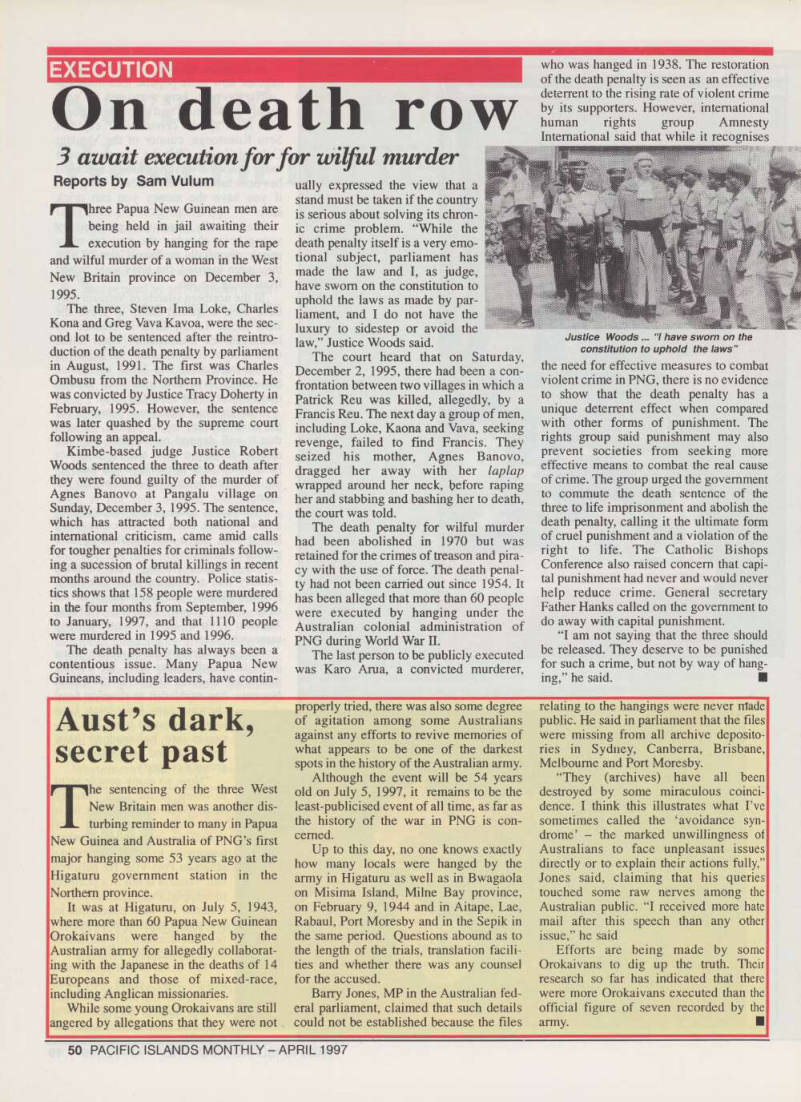
ually expressed the view that a stand must be taken if the country is serious about solving its chron ic crime problem. “While the death penalty itself is a very emo tional subject, parliament has made the law and I, as judge, have sworn on the constitution to uphold the laws as made by par liament, and I do not have the luxury to sidestep or avoid the law,” Justice Woods said.
The court heard that on Saturday, December 2, 1995, there had been a con frontation between two villages in which a Patrick Reu was killed, allegedly, by a Francis Reu. The next day a group of men, including Loke, Kaona and Vava, seeking revenge, failed to find Francis. They seized his mother, Agnes Banovo, dragged her away with her laplap wrapped around her neck, before raping her and stabbing and bashing her to death, the court was told.
The death penalty for wilful murder had been abolished in 1970 but was retained for the crimes of treason and pira cy with the use of force. The death penal ty had not been carried out since 1954. It has been alleged that more than 60 people were executed by hanging under the Australian colonial administration of PNG during World War 11.
The last person to be publicly executed was Karo Arua, a convicted murderer,
who was hanged in 1938. The restoration of the death penalty is seen as an effective deterrent to the rising rate of violent crime by its supporters. However, international human rights group Amnesty International said that while it recognises
u the need for effective measures to combat violent crime in PNG there is no evidence to show that the death jxmalty has a unl 3 ue dete f m effe « whe " compared w,th other forms of punishment. The rights group said punishment may also prevent societies from seeking more effective means to combat the real cause of crime - ' Rle B rou P ur B ed ,he government commute the death sentence of the three to life imprisonment and abolish the death P enalt y> calling it the ultimate form of cruel punishment and a violation of the J>ght to life. The Catholic Bishops Conference also raised concern that cap.tal punishment had never and would never |i el P r f du f crime. General secretary Father Hanks called on the government to do away with capital punishment, * am not sa y m 8 t^at the three should be released. They deserve to be punished for such a crime, but not by way of hang_ mg, he said. ■
Justice Woods... “I have sworn on the constitution to uphold the laws’’