Nobel laureate
p. 47 · Read in the full issue
Trial
Nobel laureate faces jail term
By David North
Daniel Carleton Gajdusek, the Nobel Prize-winning scien tist, will spend some time in an American jail - but not much - for sexual abuse of young boys from Micronesia.
Both Dr Gajdusek’s remarkable breakthroughs in the studies of puzzling diseases and his apparent fondness for the young men of the islands have been the subject of much press attention (including “Nobel laureate in islands sex scandal”, Pacific Islands Monthly June, 96).
Dr Gajdusek (pronounced gah-DOO-sek) made many trips to the islands in his scientific work, often getting into remote areas of Papua New Guinea and the Solomons, as well as to many islands in the Federated States of Micronesia. A bachelor, he often ‘adopted’ young boys, as well as a few girls, and brought them back to his home in suburban Maryland. He helped educate them and many have returned to the islands to play major roles there.
But, according to prosecutors, he sexually abused at least some of them and last year, he was hauled into the courts of Frederick County, Maryland (just outside Washington, DC), to
face charges.
One prospect was that there would be a long and unpleasant trial, with several young witnesses telling of their treatment at the hands of the scientist. If found guilty at such a trial, he would (at 72) spend the rest of his life in prison; more specifically, given his failing health, the rest of his life in a prison hospital.
Nothing was heard about the case for months as both the prosecutor and the numerous friends of Dr Gajdusek prepared their cases and made their moves. Then, in late February came the announcement that the defendant had worked out a plea bar gain (a standard part of the criminal justice process in the US) with the prosecutors - he agreed to plead guilty to two counts against him, and, in return, the state agreed to a nine-to-12month prison senence.
Why the apparently light penalty? Therein lies a tale that runs from the inner circles of Big Science to tiny villages on FSM’s high island of Yap to the mechanisms of justice systems.
Prosecutors, generally, have the easiest time with petty crim inals and crazies - the holdup men, street drug dealers, the rapists and axe murderers; facts are established (if they are there in the first place) with relative ease and cases move straight from indictment to the ultimate courtroom decision. Such criminals usually lack the resources to distort or delay the system.
But in some criminal cases, the defendants have remarkable resources, in terms of money, the sympathy of an ethnic group, the ability to cause fear in witnesses or well-placed, resourceful friends, as in this case.
The scientist’s long-term employer, the highly prestigious and huge National Institutes of Health (NIH) rallied around him and saw to it that he retired with his $U5123,000-a-year pension intact, a vote of confidence that would impress any jury.
Further, at the time of his arrest, friends in the scientific com munity immediately raised a substantial bond and got him out of jail shortly after his indictment.
And then something unusual happened. The potential wit-
nesses started to disappear - not ‘rubbed oiit’ as the big city gangs would do - but lured back to the islands by mainlanders providing free, one-way airplane tickets.
Scott Rolle, the state’s attorney (prosecutor) in Frederick County, told me that four potential witnesses, presumably young men who had lived in Gajdusek’s sprawling household, all left the US after, in each case, having been given fully paid-for, plane tickets to the islands. While such behaviour is clearly contrary to Maryland law - it is called “suborning a witness” - Rolle did not have enough proof to indict any of the ticket providers, presum ably friends of the defendant.
I suggested that airlines’ computers carry a lot of highly spe cific information on who flies and who pays the bill, and whether that source couldn’t provide useful leads regarding the ticket
buyers.
“We looked into that,” he told me, but, clearly, he did not want to pursue the subject.
“Did you seek help from the Micronesian government?” I asked.
“No,” Rolle replied. “I had the strong impression that we did not have many allies in the islands; we know that a major gov ernment official, a minister or something [in FSM or one of its four states] was clearly on the doctor’s side of the issue.”
“To what islands did the potential witnesses return?” I asked.
The prosecutor said that he was distant from that level of detail but did recall that two of them went back to Yap (perhaps to the island itself or perhaps to Yap State, one of the four states within the FSM). Another returned to Fais, an island near Yap.
He said he thought that the fourth returned to Mogmog on Ulithi Atoll, northeast of Yap.
Apparently, only one witness remained but whose name was not released. He, too, Rolle said, was offered a plane ticket, but he refused it, and stuck by the story that got the doctor indicted in the first place.
Left with a single witness, the prosecution was not in a very strong position for the plea-bargaining process, one of the tough est kinds of negotiations in American public life.
Under these circumstances (that is, a less-than-perfect case), many prosecutors prefer not to risk a loss in court and opt for
plea bargain.
Meanwhile, Dr Gajdusek apparently did not want to risk any kind of court appearance, so the compromise - a limited plea of guilty and nine months to a year in prison - was struck.
On April 29, a Frederick County judge will decide between the two time periods and send the Nobel Prize winner to prison.
It has been a dark ending for a brilliant career. ■
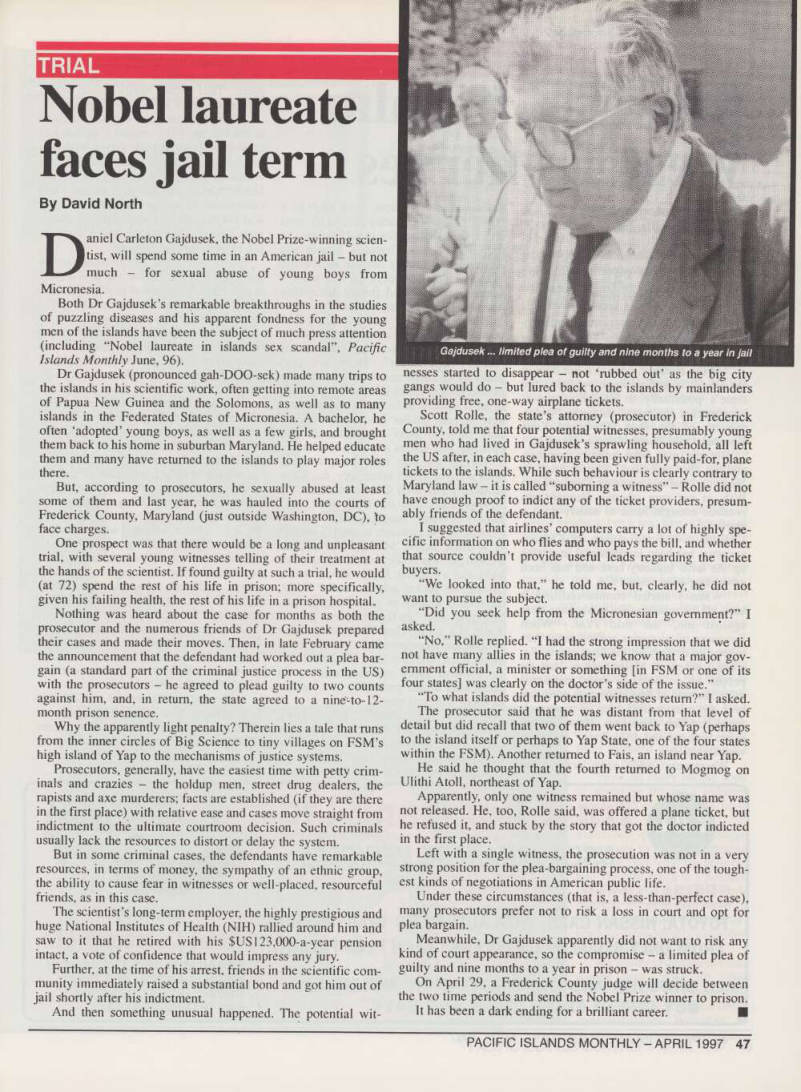
Gajdusek... limited plea of guilty and nine months to a year in Jail