A healthy start
p. 24 · Read in the full issue
Health
The newly formed Pasifika Medical
Association aims to cure to the ailing health status ofNZ’s island community
By Atama Raganivatu
The recent formation of the Pasifika Medical Association may well prove to be a watershed in the endeavours to combat the horrendous health problems currently endured by New Zeland’s Pacific Island community.
The PMA was founded by a group of Auckland-based medi cal practitioners with Pacific Island origins. Its committee con sists of four Samoans and one Tongan. Dr Debbie Ryan, the association’s treasurer, stated that her organisation’s primary objectives were “to provide professional support for our mem bers and to coordinate with relevant authorities and community networks in an effort to improve the health status of Pacific Island people in New Zealand”.
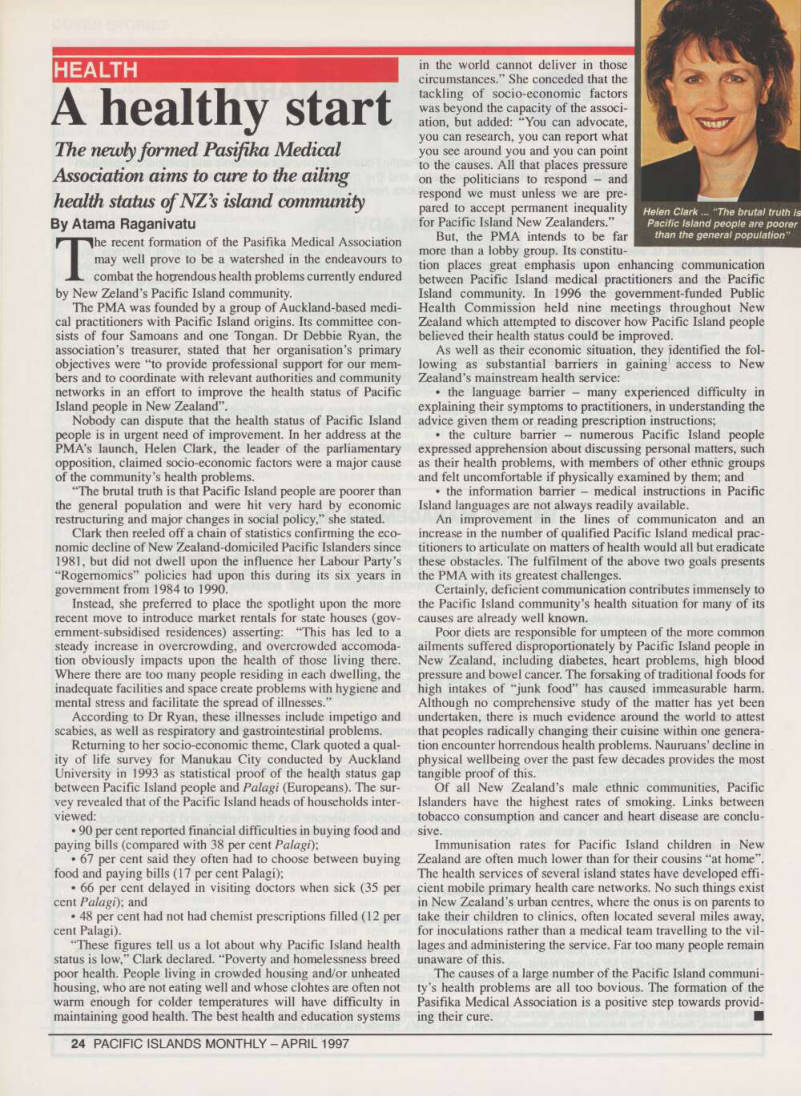
Nobody can dispute that the health status of Pacific Island people is in urgent need of improvement. In her address at the PMA’s launch, Helen Clark, the leader of the parliamentary opposition, claimed socio-economic factors were a major cause of the community’s health problems.
“The brutal truth is that Pacific Island people are poorer than the general population and were hit very hard by economic restructuring and major changes in social policy,” she stated.
Clark then reeled off a chain of statistics confirming the eco nomic decline of New Zealand-domiciled Pacific Islanders since 1981, but did not dwell upon the influence her Labour Party’s “Rogemomics” policies had upon this during its six years in government from 1984 to 1990.
Instead, she preferred to place the spotlight upon the more recent move to introduce market rentals for state houses (gov ernment-subsidised residences) asserting: “This has led to a steady increase in overcrowding, and overcrowded accomoda tion obviously impacts upon the health of those living there.
Where there are too many people residing in each dwelling, the inadequate facilities and space create problems with hygiene and mental stress and facilitate the spread of illnesses.”
According to Dr Ryan, these illnesses include impetigo and scabies, as well as respiratory and gastrointestinal problems.
Returning to her socio-economic theme, Clark quoted a qual ity of life survey for Manukau City conducted by Auckland University in 1993 as statistical proof of the health status gap between Pacific Island people and Palagi (Europeans). The sur vey revealed that of the Pacific Island heads of households inter viewed; • 90 per cent reported financial difficulties in buying food and paying bills (compared with 38 per cent Palagi ); • 67 per cent said they often had to choose between buying food and paying bills (17 per cent Palagi); • 66 per cent delayed in visiting doctors when sick (35 per cent Palagi ); and • 48 per cent had not had chemist prescriptions filled (12 per
cent Palagi).
“These figures tell us a lot about why Pacific Island health status is low,” Clark declared. “Poverty and homelessness breed poor health. People living in crowded housing and/or unheated housing, who are not eating well and whose clohtes are often not warm enough for colder temperatures will have difficulty in maintaining good health. The best health and education systems
in the world cannot deliver in those circumstances.” She conceded that the tackling of socio-economic factors was beyond the capacity of the associ ation, but added: “You can advocate, you can research, you can report what you see around you and you can point to the causes. All that places pressure on the politicians to respond - and respond we must unless we are pre pared to accept permanent inequality for Pacific Island New Zealanders.”
But, the PMA intends to be far more than a lobby group. Its constitu-
tion places great emphasis upon enhancing communication between Pacific Island medical practitioners and the Pacific Island community. In 1996 the government-funded Public Health Commission held nine meetings throughout New Zealand which attempted to discover how Pacific Island people believed their health status could be improved.
As well as their economic situation, they identified the fol lowing as substantial barriers in gaining access to New Zealand’s mainstream health service: • the language barrier - many experienced difficulty in explaining their symptoms to practitioners, in understanding the advice given them or reading prescription instructions; • the culture barrier - numerous Pacific Island people expressed apprehension about discussing personal matters, such as their health problems, with members of other ethnic groups and felt uncomfortable if physically examined by them; and • the information barrier - medical instructions in Pacific Island languages are not always readily available.
An improvement in the lines of communicaton and an increase in the number of qualified Pacific Island medical prac titioners to articulate on matters of health would all but eradicate these obstacles. The fulfilment of the above two goals presents the PMA with its greatest challenges.
Certainly, deficient communication contributes immensely to the Pacific Island community’s health situation for many of its causes are already well known.
Poor diets are responsible for umpteen of the more common ailments suffered disproportionately by Pacific Island people in New Zealand, including diabetes, heart problems, high blood pressure and bowel cancer. The forsaking of traditional foods for high intakes of “junk food” has caused immeasurable harm.
Although no comprehensive study of the matter has yet been undertaken, there is much evidence around the world to attest that peoples radically changing their cuisine within one genera tion encounter horrendous health problems. Nauruans’ decline in physical wellbeing over the past few decades provides the most
tangible proof of this.
Of all New Zealand’s male ethnic communities. Pacific Islanders have the highest rates of smoking. Links between tobacco consumption and cancer and heart disease are conclu sive.
Immunisation rates for Pacific Island children in New Zealand are often much lower than for their cousins “at home”.
The health services of several island states have developed effi cient mobile primary health care networks. No such things exist in New Zealand’s urban centres, where the onus is on parents to take their children to clinics, often located several miles away, for inoculations rather than a medical team travelling to the vil lages and administering the service. Far too many people remain unaware of this.
The causes of a large number of the Pacific Island communi ty’s health problems are all too bovious. The formation of the Pasifika Medical Association is a positive step towards provid ing their cure. ■
Helen Clark... “The brutal truth is Pacific Island people are poorer than the general population”