Spare the rod
pp. 21-22 · Read in the full issue
or lose the child
When is discipline abuse? 6 Traditional 9 disciplinary methods are landing island parents in Australian courts
By Lili Tuwai
Why is there an over-representation of Pacific Island youth in Sydney’s juvenile detention centres? Why are so many Pacific Island children running away from home, opting to live on Sydney’s streets? Are Pacific Island parents’ disciplining methods too harsh - or not harsh enough?
According to Sydney’s Fijian Community Development
Project and Case Work officer, Mere Siganisucu, many Pacific Islanders are still using ‘traditional’ methods to discipline their children at home in Australia. She said some still firmly believe there is no way to discipline other than with sticks or physical means. However, Siganisucu added that the parents’ actions need to be understood.
“I’m certainly not condoning physical punishment, but these parents need information on how to leam other methods of cor recting children. They must understand they are in Australia; therefore, the law does not allow parents to discipline their chil dren in the old ways.”
The programme development officer for Sydney’s Campbelltown Department of Juvenile Justice (DJJ), Samoan Bill Purcell, agrees: “There needs to be closer liaison from our community-based agencies to assist Pacific Island parents to understand that there are certain boundaries that parents cannot go beyond in the way they discipline their children. What may be acceptable back home on our various islands is not acceptable here.”
During an interview with Pacific Islands Monthly, Purcell spoke about the need to raise awareness of the possible legal ramifications of the way in which some Pacific Islanders disci pline their children. He says there is a need for Pacific Island communities to offer and assist parents with education towards alternative ways of disciplining young people.
“In quite a few situations, the way in which we discipline our children is becoming a reason for our children committing crime. They are becoming defiant of the ways they are being brought up and looking at ways to get back at their parents and communities because of the treatment they were given,” alleged Purcell.
There are various lifestyle adjustments that Pacific Island parents face when they migrate to Australia. Many find it hard to come to terms with the fact that they cannot discipline their chil dren in the way that they know. “They find it hard to believe that when they do, the children have the right to take them to court,” says Siganisucu. “I have been dealing with several complicated cases since the beginning of this year.”
Explaining how ignorance of different cultural practices can be costly to all parties concerned, she provided an example: a nine-year-old girl of Fijian background was taken away from her family one week before Christmas because it was alleged that her mother had been beating her.
The child was removed from the home to be cared for by a family unknown to the child and the parents.
Siganisucu claims social workers could have dealt with the case differently. “I felt that a lot of problems would have been
solved if they had come to see me or a community leader in the first place. Because they did not do this, that case ended up in court one month later where I was required to write a back ground-supporting report for this child to be returned to her fam ily. The report helped the magistrate to understand what was really going on. He then recommended that the child be returned to the mother. I don’t know if it was fortunate or unfortunate for this family to have been caught by the Department of
Community Services.”
When they talked to the mother about her disciplinary meth ods, she said: “This is a normal thing that I do to the child all the time. It was not something that I felt was not in order. But the law does not allow it, so it will be stopped.”
The mother refers to the experience as a nightmare and the worst Christmas she ever had.
In Australia, the extended family is often not available, as it is on the islands. If the child is being reprimanded by the father or mother, the child can take refuge in other family members’ homes. That environment does not exist in Australia. Children are at risk of being hit because nothing is alleviating the pressure from parents. In the islands that separation allows a cooling-off period between the parent and child before they come together
again.
Tongan Seini Afeaki, the community liaison officer for the New South Wales Department of Education, conducts informa tion-sharing workshops with Pacific Island parents, she says a lot of Pacific Island parents do not come to terms with the law.
“They need to realise that the kind of discipline we have on the islands is regarded as child abuse in Australia. In many Pacific nations, teachers are expected by parents to discipline their chil
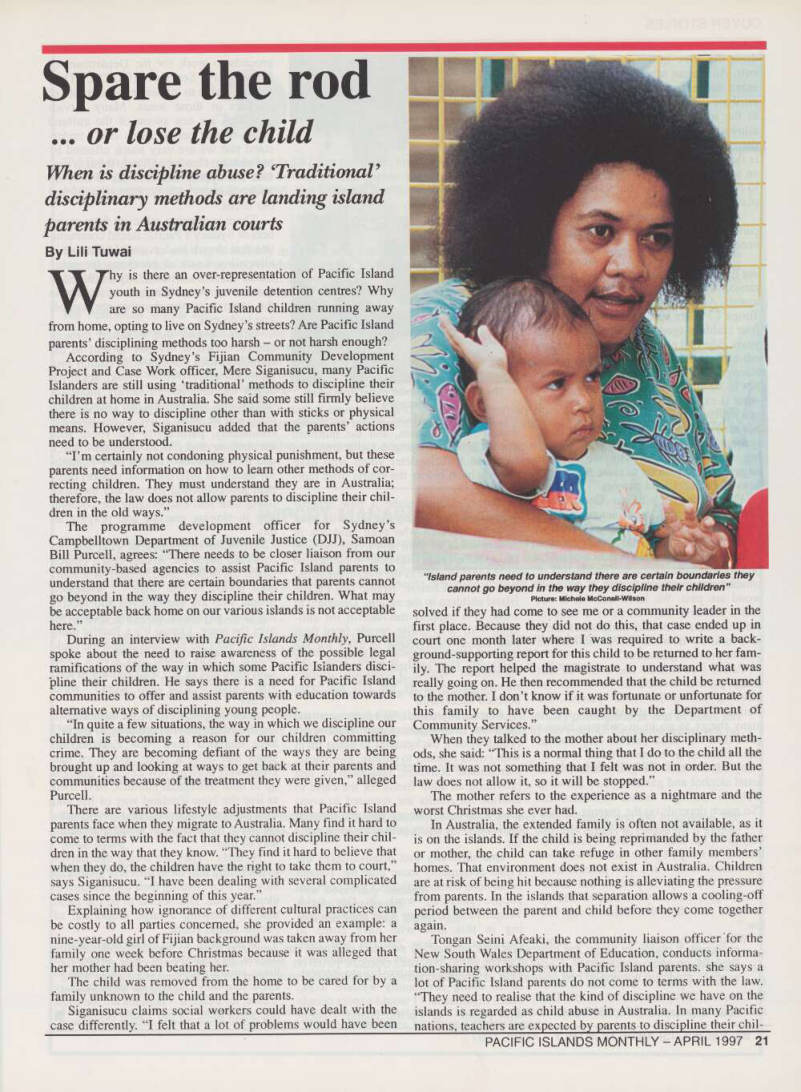
“Island parents need to understand there are certain boundaries they cannot go beyond in the way they discipline their children"
Picture: Michele McConell-Wilson
dren; therefore in the eyes of some par ents, Australian school disciplinary mea sures are extremely weak. Some even attribute their child’s acting out at school to the school system [which, they say,] allows it. When parents send their chil dren to school on the islands, the educator is the person who is also the disciplinari an from Sam to 3pm. These parents need to realise in Australia, the teachers are in place to teach.”
Afeaki believes more discussions with parents about these cultural differences need to be encouraged.
“Parents must accept they are not rais ing their kids in Tonga or Samoa; they are raising them in Sydney, Australia,” she asserts. Afeaki migrated to Australia from Tonga 13 years ago. She is married with four children aged between seven and 13 years. She had already completed tertiary education before leaving Tonga.
Recognising that her education enables her to be more aware of the law and of what is expected of parents, she says: “It is a different story for someone who can not read or understand English, but being ignorant of the law does not justify break ing the law. This is why we need to engage in discussions to raise the aware ness of Pacific Island parents.”
Pastor Itaia Bob of the Cook Island Church, Liverpool, is an active member of the Cook Islands Advisory Council in Sydney. He is also the father of six.
Talking from his own experience of disci plinary measures, he says; “Those days of smacking our children with a piece of wood are past. We know now it is not really the best way. There is a need to communicate with and understand them so you know how they feel - to then be able to provide guidance.”
Pastor Bob said he had observed that many parents seemed to have lost the meaning behind the word “parent”. He claims, “Here in Australia, there are so many things to go to in order to have a good time that some parents forget about their children at home - that’s why so many of our kids are going astray.” He listed alcohol and gambling as a growing problem amongst island communities.
“So much depends on the parents. If they want their children to be productive when they grow up, then they have to look after them. It is not just a question of what we want them to be - it’s how parents have brought them up. If parents put them selves right, then they are able to lead by example and then the children can fol low.”
"What has become obvious to some welfare workers is that many children who are falling into a life of crime do not have access to positive adult role models.
In October, 1996, statistics from the DJJ revealed six per cent of Pacific Islanders
six per cent of Maori were over-repre sented in the system, and the numbers appear to be increasing. So what steps can be taken to help deter youth who have already been before the courts from reof
fending?
Purcell is optimistic a new scheme being implemented by the DJJ will work to assist children who need guidance in certain areas of their lives. The Mentor Programme (TMP) has been implemented by the DJJ to address the over-representa tion of Indo-Chinese, Arabic and Pacific Island children in the system. Designed to work as a support mechanism for chil dren, TMP will utilise people from their own ethnic background to cater for the need identified in a case plan. An
Aboriginal Mentor Programme imple
mented last year by the DJJ has been deemed successful.
Purcell expressed: “We heve seen the need to ... acquire people from their [youth’s] own background to assist them with issues relating to culture, awareness, recreational activities, education or just providing an adult friend for the child to confide in. Adults are required to com
plete a 20-hour training package through
the DJJ before being considered as a men tor.
One difficulty that disadvantages the
Fijian community more than the Tongan
or Samoan communities is a lack of Fijian people pursuing work in this field.
Tongans and Samoans have people work ing in this area who have come to Australia via New Zealand and have already been active in the communities there. There are not many Fijians interest ed in doing community welfare work, states Siganisucu. “I would expect people with Fijian - or Pacific Island - back
grounds to work for the Department of Community Services (DOCS). They would be able to influence the attitudes of workers in those areas. Many service providers are not aware of the cultural needs of our people, they don’t under stand that we are very much affected by our culture. Contact will help them to pro vide the appropriate services if they do understand our cultural backgrounds and our needs.”
There is growing criticism from mem bers of Sydney’s Pacific Island communi ties that church leaders could be active in alleviating financial pressures for many island families. Afeaki says, “When it comes to monopolising the resources in the community, the churches are number one to do that.”
Often, money that is raised through church efforts in Sydney is sent to the islands to help contribute to church pro grammes there. While Afeaki acknowl edges the tradition of family monetary obligations, she reasons that church lead ers could be more active in assisting the community, particularly the youth who are drifting away from both the church and their families. “I think they [church es] should be offering more support other than just collecting money and monopo lising time and encouraging the commu nity in singing practice and praying all day.”
Providing an example of what her con cerns are based on, Afeaki said a church raised $A70,000 ($U552,000) in a four hour period in one night. “I witnessed people who are unemployed and receiv ing dole payments throwing money all over the place. I know it’s a Pacific thing we do, but I do not understand the logic behind it. Why would you give a thou sand there and be left with nothing to feed your children with next week?” sighs Afeaki.
According to Purcell, the majority of Pacific Island children coming to the DJJ have migrated from New Zealand. He states that quite a large portion of that group were bom in New Zealand, brought up in their individual cultures, have tried to live the New Zealand way of life and then at some stage migrated to Australia and have tried to adapt to the Australian way of life.
He adds: “They are seeing themselves as not fitting into these different groups so they are then creating their own culture to identify with. That seems to be the trend that is following a large proportion of Pacific Island youth.
“If anything, I call upon Pacific Island parents to continue to offer support to these young people. They really need to know that they can rely on their families ’cause, let’s face it - families are the most important thing for our young people.” ■
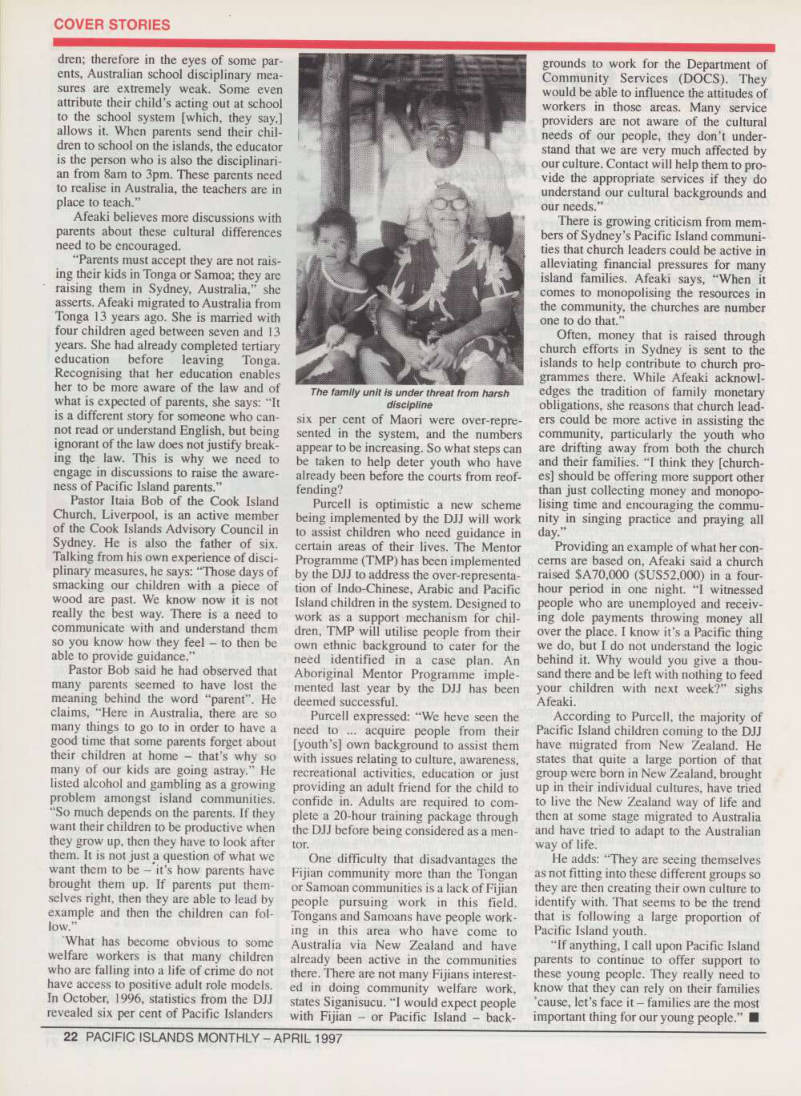
The family unit is under threat from harsh discipline