Streets of no return
pp. 19-20 · Read in the full issue
no return
Rising incidence of child
abuse and parental neglect
are seeing more and more children turn to a life on the streets in Western Samoa Text and photographs
by Chris Peteru
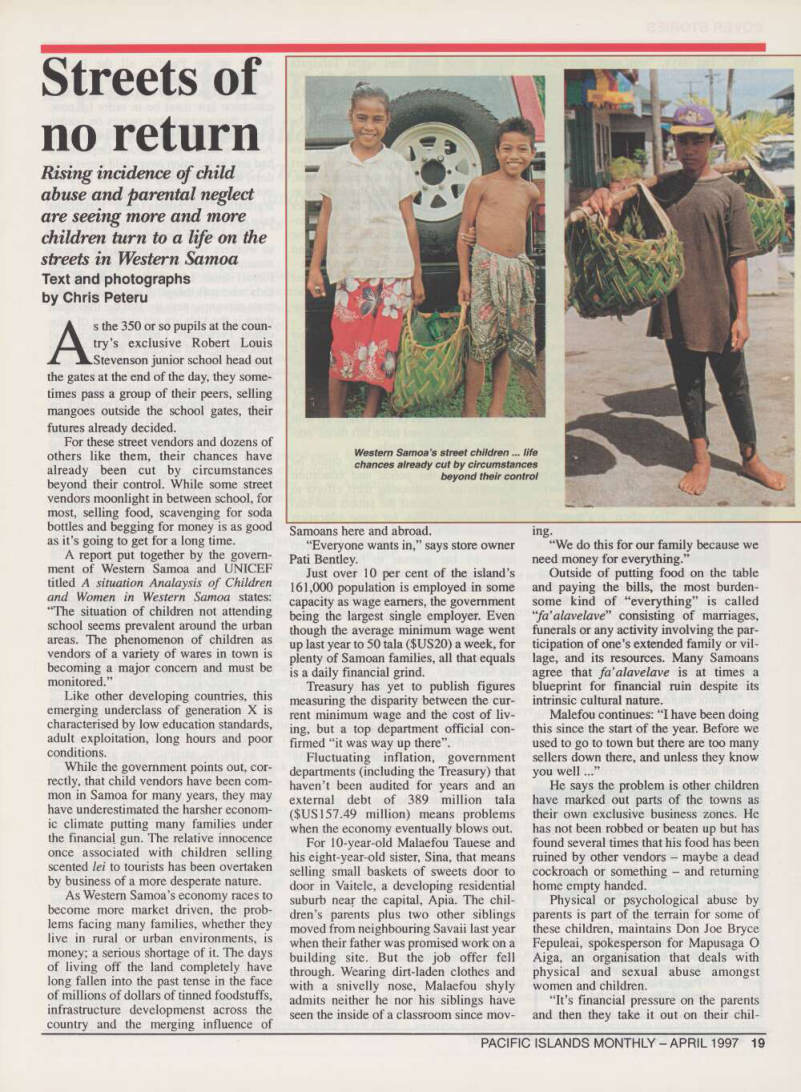
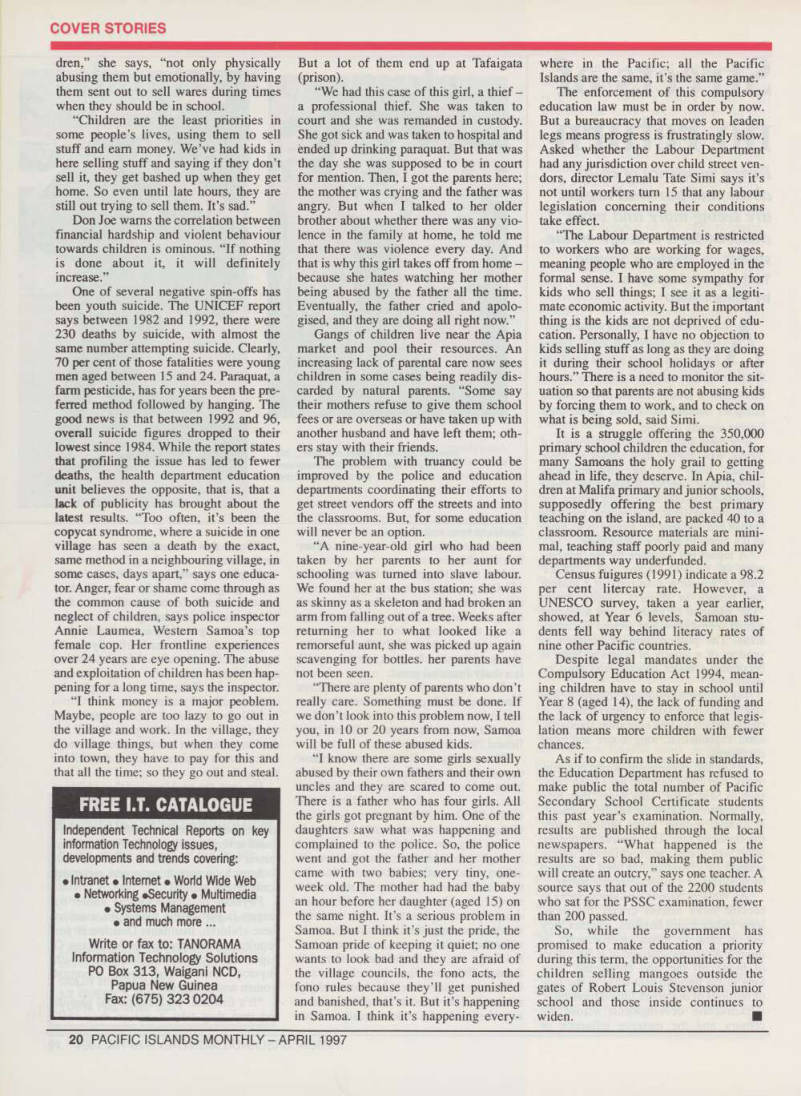
As the 350 or so pupils at the coun try’s exclusive Robert Louis Stevenson junior school head out the gates at the end of the day, they some times pass a group of their peers, selling mangoes outside the school gates, their futures already decided.
For these street vendors and dozens of others like them, their chances have already been cut by circumstances beyond their control. While some street vendors moonlight in between school, for most, selling food, scavenging for soda bottles and begging for money is as good as it’s going to get for a long time.
A report put together by the govern ment of Western Samoa and UNICEF titled A situation Analaysis of Children and Women in Western Samoa states: “The situation of children not attending school seems prevalent around the urban areas. The phenomenon of children as vendors of a variety of wares in town is becoming a major concern and must be monitored.”
Like other developing countries, this emerging underclass of generation X is characterised by low education standards, adult exploitation, long hours and poor conditions.
While the government points out, cor rectly, that child vendors have been com mon in Samoa for many years, they may have underestimated the harsher econom ic climate putting many families under the financial gun. The relative innocence once associated with children selling scented lei to tourists has been overtaken by business of a more desperate nature.
As Western Samoa’s economy races to become more market driven, the prob lems facing many families, whether they live in rural or urban environments, is money; a serious shortage of it. The days of living off the land completely have long fallen into the past tense in the face of millions of dollars of tinned foodstuffs, infrastructure developmenst across the country and the merging influence of
Samoans here and abroad.
“Everyone wants in,” says store owner Pati Bentley.
Just over 10 per cent of the island’s 161,000 population is employed in some capacity as wage earners, the government being die largest single employer. Even though the average minimum wage went up last year to 50 tala (SUS2O) a week, for plenty of Samoan families, all that equals is a daily financial grind.
Treasury has yet to publish figures measuring the disparity between the cur rent minimum wage and the cost of liv ing, but a top department official con firmed “it was way up there”.
Fluctuating inflation, government departments (including the Treasury) that haven’t been audited for years and an external debt of 389 million tala (SUS 157.49 million) means problems when the economy eventually blows out.
For 10-year-old Malaefou Tauese and his eight-year-old sister, Sina, that means selling small baskets of sweets door to door in Vaitele, a developing residential suburb near the capital, Apia. The chil dren’s parents plus two other siblings moved from neighbouring Savaii last year when their father was promised work on a building site. But the job offer fell through. Wearing dirt-laden clothes and with a snivelly nose, Malaefou shyly admits neither he nor his siblings have seen the inside of a classroom since mov
ing.
“We do this for our family because we need money for everything.”
Outside of putting food on the table and paying the bills, the most burden some kind of “everything” is called
“fa alavelave" consisting of marriages,
funerals or any activity involving the par ticipation of one’s extended family or vil lage, and its resources. Many Samoans agree that fa’alavelave is at times a blueprint for financial ruin despite its intrinsic cultural nature.
Malefou continues: “I have been doing this since the start of the year. Before we used to go to town but there are too many sellers down there, and unless they know you we 11...”
He says the problem is other children have marked out parts of the towns as their own exclusive business zones. He has not been robbed or beaten up but has found several times that his food has been ruined by other vendors - maybe a dead cockroach or something - and returning home empty handed.
Physical or psychological abuse by
parents is part of the terrain for some of these children, maintains Don Joe Bryce
Fepuleai, spokesperson for Mapusaga O
Aiga, an organisation that deals with physical and sexual abuse amongst women and children.
“It’s financial pressure on the parents and then they take it out on their chil
Western Samoa’s street children ... life chances already cut by circumstances beyond their control
dren,” she says, “not only physically
abusing them but emotionally, by having
them sent out to sell wares during times when they should be in school.
“Children are the least priorities in some people’s lives, using them to sell stuff and earn money. We’ve had kids in here selling stuff and saying if they don’t sell it, they get bashed up when they get home. So even until late hours, they are still out trying to sell them. It’s sad.”
Don Joe warns the correlation between financial hardship and violent behaviour towards children is ominous. “If nothing is done about it, it will definitely increase.”
One of several negative spin-offs has been youth suicide. The UNICEF report says between 1982 and 1992, there were 230 deaths by suicide, with almost the same number attempting suicide. Clearly, 70 per cent of those fatalities were young men aged between 15 and 24. Paraquat, a farm pesticide, has for years been the pre ferred method followed by hanging. The good news is that between 1992 and 96, overall suicide figures dropped to their lowest since 1984. While the report states that profiling the issue has led to fewer deaths, the health department education unit believes the opposite, that is, that a lack of publicity has brought about the latest results. “Too often, it’s been the copycat syndrome, where a suicide in one village has seen a death by the exact, same method in a neighbouring village, in some cases, days apart,” says one educa tor. Anger, fear or shame come through as the common cause of both suicide and
neglect of children, says police inspector
Annie Laumea, Western Samoa’s top female cop. Her frontline experiences over 24 years are eye opening. The abuse and exploitation of children has been hap pening for a long time, says the inspector.
“I think money is a major peoblem.
Maybe, people are too lazy to go out in the village and work. In the village, they do village things, but when they come into town, they have to pay for this and that all the time; so they go out and steal.
But a lot of them end up at Tafaigata
(prison).
“We had this case of this girl, a thief a professional thief. She was taken to court and she was remanded in custody.
She got sick and was taken to hospital and ended up drinking paraquat. But that was the day she was supposed to be in court for mention. Then, I got the parents here; the mother was crying and the father was angry. But when I talked to her older brother about whether there was any vio lence in the family at home, he told me that there was violence every day. And that is why this girl takes off from home because she hates watching her mother being abused by the father all the time.
Eventually, the father cried and apolo gised, and they are doing all right now.”
Gangs of children live near the Apia market and pool their resources. An increasing lack of parental care now sees children in some cases being readily dis carded by natural parents. “Some say their mothers refuse to give them school fees or are overseas or have taken up with another husband and have left them; oth ers stay with their friends.
The problem with truancy could be improved by the police and education departments coordinating their efforts to get street vendors off the streets and into the classrooms. But, for some education will never be an option.
“A nine-year-old girl who had been taken by her parents to her aunt for schooling was turned into slave labour.
We found her at the bus station; she was as skinny as a skeleton and had broken an arm from falling out of a tree. Weeks after returning her to what looked like a remorseful aunt, she was picked up again scavenging for bottles, her parents have not been seen.
“There are plenty of parents who don’t really care. Something must be done. If we don’t look into this problem now, I tell you, in 10 or 20 years from now, Samoa will be full of these abused kids.
“I know there are some girls sexually abused by their own fathers and their own uncles and they are scared to come out.
There is a father who has four girls. All the girls got pregnant by him. One of the daughters saw what was happening and complained to the police. So, the police went and got the father and her mother came with two babies; very tiny, one week old. The mother had had the baby an hour before her daughter (aged 15) on the same night. It’s a serious problem in Samoa. But I think it’s just the pride, the Samoan pride of keeping it quiet; no one wants to look bad and they are afraid of the village councils, the fono acts, the fono rules because they’ll get punished and banished, that’s it. But it’s happening in Samoa. I think it’s happening every
where in the Pacific; all the Pacific Islands are the same, it’s the same game.”
The enforcement of this compulsory education law must be in order by now.
But a bureaucracy that moves on leaden legs means progress is frustratingly slow.
Asked whether the Labour Department had any jurisdiction over child street ven dors, director Lemalu Tate Simi says it’s not until workers turn 15 that any labour
legislation concerning their conditions
take effect.
“The Labour Department is restricted to workers who are working for wages, meaning people who are employed in the formal sense. I have some sympathy for kids who sell things; I see it as a legiti mate economic activity. But the important thing is the kids are not deprived of edu cation. Personally, I have no objection to kids selling stuff as long as they are doing it during their school holidays or after hours.” There is a need to monitor the sit uation so that parents are not abusing kids by forcing them to work, and to check on what is being sold, said Simi.
It is a struggle offering the 350,000 primary school children the education, for many Samoans the holy grail to getting ahead in life, they deserve. In Apia, chil dren at Malifa primary and junior schools,
supposedly offering the best primary
teaching on the island, are packed 40 to a classroom. Resource materials are mini mal, teaching staff poorly paid and many departments way underfunded.
Census fuigures (1991) indicate a 98.2 per cent litercay rate. However, a UNESCO survey, taken a year earlier, showed, at Year 6 levels, Samoan stu dents fell way behind literacy rates of nine other Pacific countries.
Despite legal mandates under the Compulsory Education Act 1994, mean ing children have to stay in school until Year 8 (aged 14), the lack of funding and the lack of urgency to enforce that legis lation means more children with fewer chances.
As if to confirm the slide in standards, the Education Department has refused to make public the total number of Pacific Secondary School Certificate students this past year’s examination. Normally, results are published through the local newspapers. “What happened is the results are so bad, making them public will create an outcry,” says one teacher. A source says that out of the 2200 students who sat for the PSSC examination, fewer than 200 passed.
So, while the government has promised to make education a priority during this term, the opportunities for the children selling mangoes outside the gates of Robert Louis Stevenson junior school and those inside continues to widen. ■