Pacific
pp. 26-29 · Read in the full issue

Advertising Feature
Tourism in
the
Pacific
Reports by Bernadette Hussein
J!f he tourism market in the South Pacific is picking up and the Tourism Council of the South Pacific is positive that numbers will con tinue to rise.
TCSP chief executive Levani Tuinabua said there was a growth of 4.6 per cent for the third quarter of 1996 and, although the TCSP did not have the figures for the end of the year, they were pretty confident that there wasn’t much of a difference.
“This increase shows the growing awareness of an interest in the South Pacific as a holiday destination,”
Tuinabua said. “I believe we are in a very promising position.”
But what is it that attracts people to the Pacific, or so the argument goes, when other parts of the world are able to provide more in the way of sights, sounds, history and adventure - at relatively cheaper cost?
“We are lucky we still have our pristine environment and our cities and towns are still very clean compared to those coun tries’. In the South Pacific, we’ve still got an opportunity to protect our pristine envi ronment. We’ve still got an opportunity to keep our cities clean.”
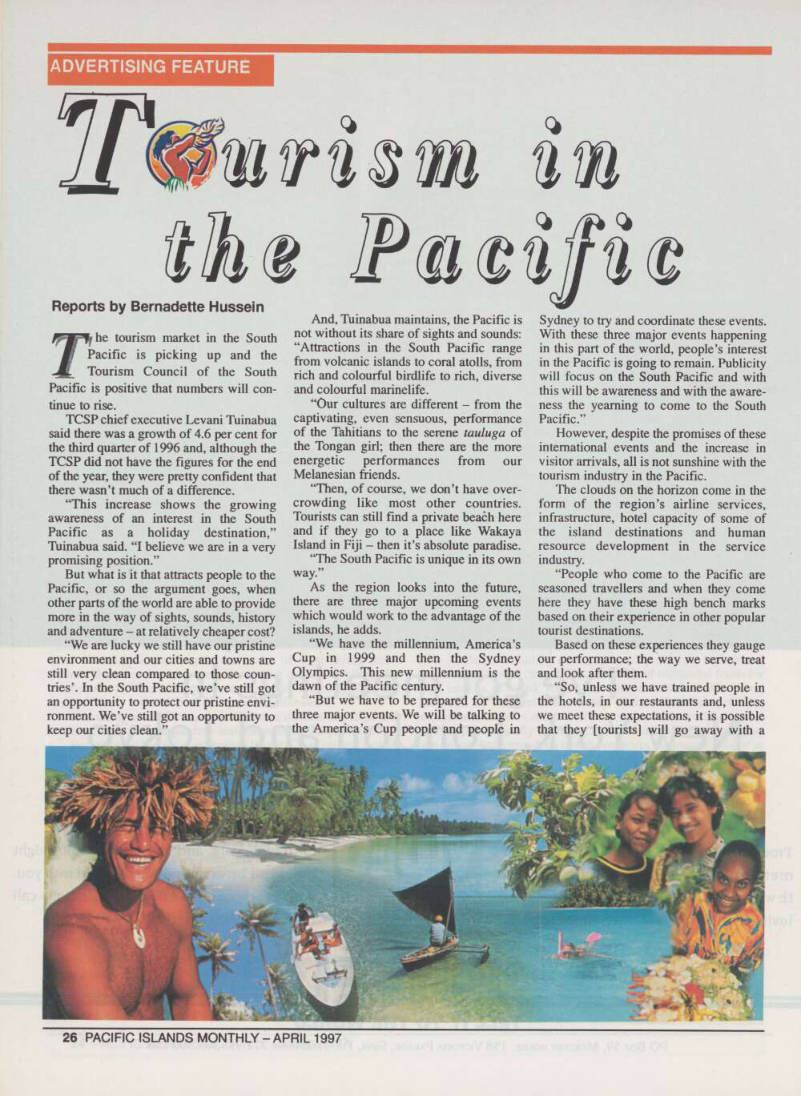
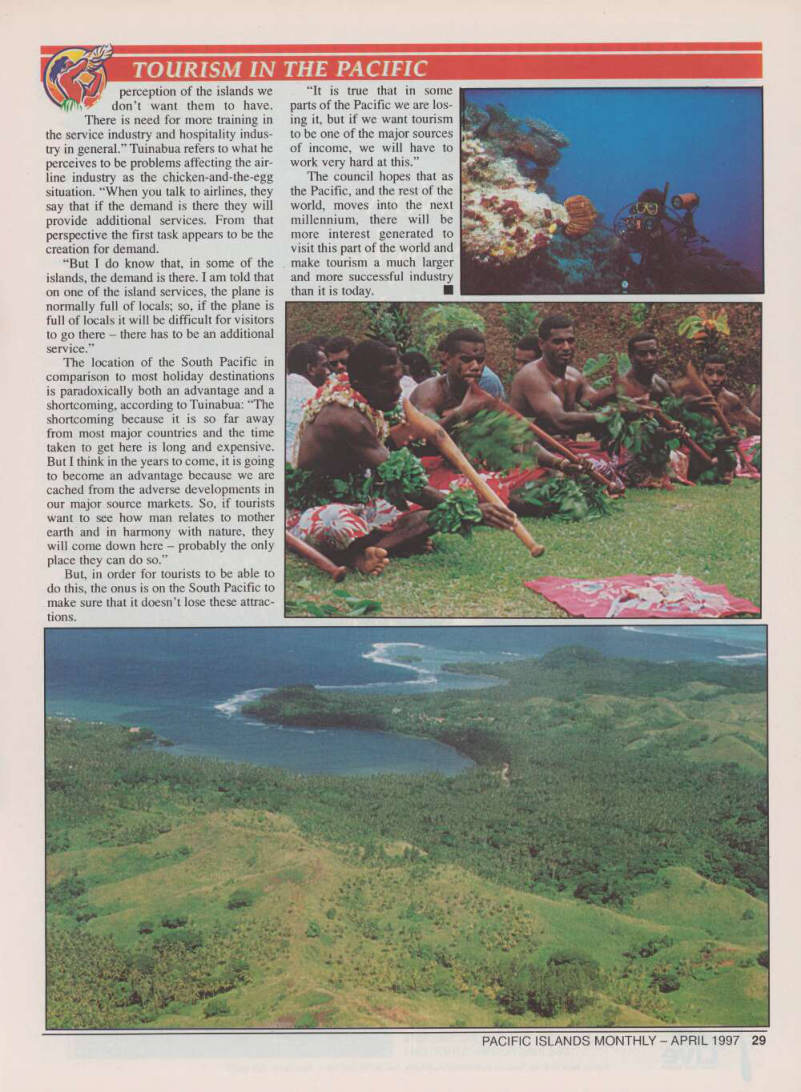
And, Tuinabua maintains, the Pacific is not without its share of sights and sounds; “Attractions in the South Pacific range from volcanic islands to coral atolls, from rich and colourful birdlife to rich, diverse and colourful marinelife.
“Our cultures are different - from the captivating, even sensuous, performance of the Tahitians to the serene tauluga of the Tongan girl; then there are the more energetic performances from our Melanesian friends.
“Then, of course, we don’t have over crowding like most other countries.
Tourists can still find a private beach here and if they go to a place like Wakaya Island in Fiji - then it’s absolute paradise.
“The South Pacific is unique in its own way.”
As the region looks into the future, there are three major upcoming events which would work to the advantage of the islands, he adds.
“We have the millennium, America’s Cup in 1999 and then the Sydney Olympics. This new millennium is the dawn of the Pacific century.
“But we have to be prepared for these three major events. We will be talking to the America’s Cup people and people in
Sydney to try and coordinate these events.
With these three major events happening in this part of the world, people’s interest in the Pacific is going to remain. Publicity will focus on the South Pacific and with this will be awareness and with the aware ness the yearning to come to the South Pacific.”
However, despite the promises of these international events and the increase in visitor arrivals, all is not sunshine with the tourism industry in the Pacific.
The clouds on the horizon come in the form of the region’s airline services, infrastructure, hotel capacity of some of the island destinations and human resource development in the service industry.
“People who come to the Pacific are seasoned travellers and when they come here they have these high bench marks based on their experience in other popular tourist destinations.
Based on these experiences they gauge our performance; the way we serve, treat and look after them.
“So, unless we have trained people in the hotels, in our restaurants and, unless we meet these expectations, it is possible that they [tourists] will go away with a
perception of the islands we don’t want them to have.
There is need for more training in the service industry and hospitality indus try in general.” Tuinabua refers to what he perceives to be problems affecting the air line industry as the chicken-and-the-egg situation. “When you talk to airlines, they say that if the demand is there they will provide additional services. From that perspective the first task appears to be the creation for demand.
“But I do know that, in some of the islands, the demand is there. I am told that on one of the island services, the plane is normally full of locals; so, if the plane is full of locals it will be difficult for visitors to go there - there has to be an additional service.”
The location of the South Pacific in comparison to most holiday destinations is paradoxically both an advantage and a shortcoming, according to Tuinabua: “The shortcoming because it is so far away from most major countries and the time taken to get here is long and expensive.
But I think in the years to come, it is going to become an advantage because we are cached from the adverse developments in our major source markets. So, if tourists want to see how man relates to mother earth and in harmony with nature, they will come down here - probably the only place they can do so.”
But, in order for tourists to be able to do this, the onus is on the South Pacific to make sure that it doesn’t lose these attrac tions.
“It is true that in some parts of the Pacific we are los ing it, but if we want tourism to be one of the major sources of income, we will have to work very hard at this.”
The council hopes that as the Pacific, and the rest of the world, moves into the next millennium, there will be more interest generated to visit this part of the world and make tourism a much larger and more successful industry than it is today. ■