Bikinians return
p. 15 · Read in the full issue
The excitement for Bikinians of returning to their home islands for the first time in 51 years was tempered by the realisation for many of the elders that it may be the last time they set foot on the land of their ances tors. The historic visit to Bikini included women who had not been to the former nuclear test site since they were relocat ed in 1946 by the US Navy when they were young children.
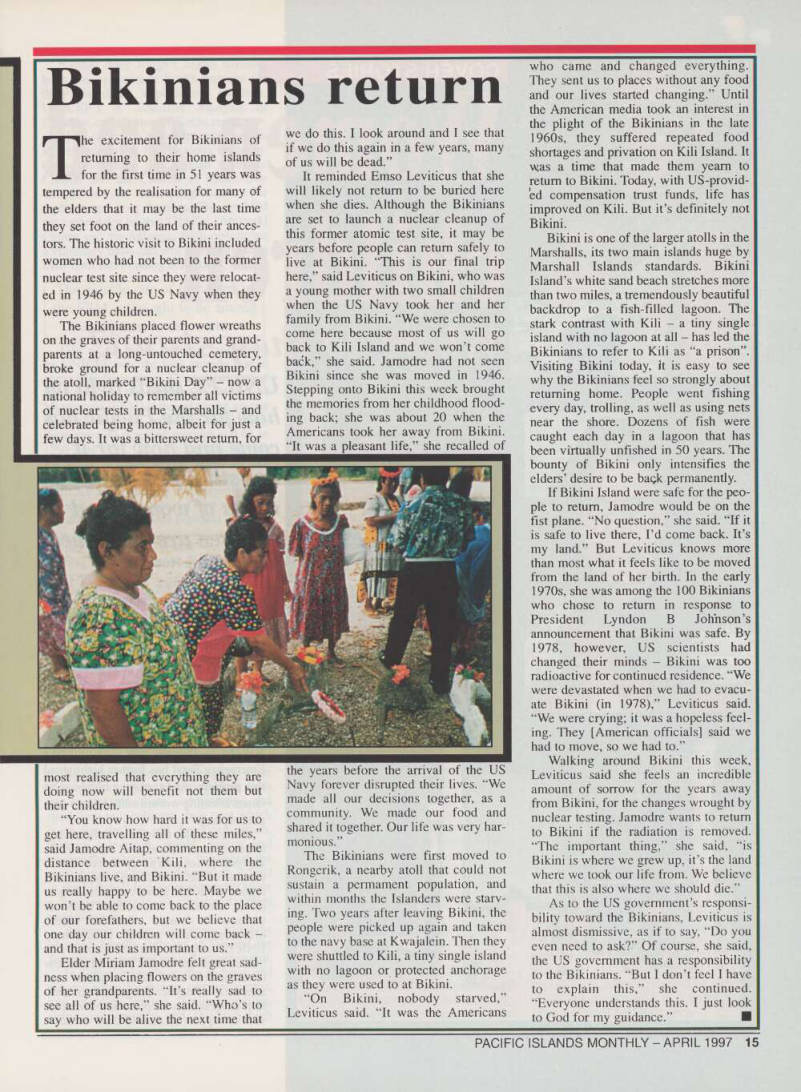
The Bikinians placed flower wreaths on the graves of their parents and grand parents at a long-untouched cemetery, broke ground for a nuclear cleanup of the atoll, marked “Bikini Day” - now a national holiday to remember all victims of nuclear tests in the Marshalls - and celebrated being home, albeit for just a few days. It was a bittersweet return, for
most realised that everything they are doing now will benefit not them but their children.
“You know how hard it was for us to get here, travelling all of these miles,” said Jamodre Aitap, commenting on the distance between Kili, where the Bikinians live, and Bikini. “But it made us really happy to be here. Maybe we won’t be able to come back to the place of our forefathers, but we believe that one day our children will come back and that is just as important to us.”
Elder Miriam Jamodre felt great sad ness when placing flowers on the graves of her grandparents. “It’s really sad to see all of us here,” she said. “Who’s to say who will be alive the next time that
we do this. I look around and I see that if we do this again in a few years, many of us will be dead.”
It reminded Emso Leviticus that she will likely not return to be buried here when she dies. Although the Bikinians are set to launch a nuclear cleanup of this former atomic test site, it may be years before people can return safely to live at Bikini. “This is our final trip here,” said Leviticus on Bikini, who was a young mother with two small children when the US Navy took her and her family from Bikini. “We were chosen to come here because most of us will go back to Kili Island and we won’t come back,” she said. Jamodre had not seen Bikini since she was moved in 1946.
Stepping onto Bikini this week brought the memories from her childhood flood ing back; she was about 20 when the Americans took her away from Bikini.
“It was a pleasant life,” she recalled of
the years before the arrival of the US Navy forever disrupted their lives. “We made all our decisions together, as a community. We made our food and shared it together. Our life was very har monious.”
The Bikinians were first moved to Rongerik, a nearby atoll that could not sustain a permament population, and within months the Islanders were starv ing. Two years after leaving Bikini, the people were picked up again and taken to the navy base at Kwajalein. Then they were shuttled to Kili, a tiny single island with no lagoon or protected anchorage as they were used to at Bikini.
“On Bikini, nobody starved,”
Leviticus said. “It was the Americans
who came and changed everything.
They sent us to places without any food and our lives started changing.” Until the American media took an interest in the plight of the Bikinians in the late 19605, they suffered repeated food shortages and privation on Kili Island. It was a time that made them yearn to return to Bikini. Today, with US-provid ed compensation trust funds, life has improved on Kili. But it’s definitely not Bikini.
Bikini is one of the larger atolls in the Marshalls, its two main islands huge by Marshall Islands standards. Bikini Island’s white sand beach stretches more than two miles, a tremendously beautiful backdrop to a fish-filled lagoon. The stark contrast with Kili - a tiny single island with no lagoon at all - has led the Bikinians to refer to Kili as “a prison”.
Visiting Bikini today, it is easy to see why the Bikinians feel so strongly about returning home. People went fishing every day, trolling, as well as using nets near the shore. Dozens of fish were caught each day in a lagoon that has been virtually unfished in 50 years. The bounty of Bikini only intensifies the elders’ desire to be baqk permanently.
If Bikini Island were safe for the peo ple to return, Jamodre would be on the fist plane. “No question,” she said. “If it is safe to live there, I’d come back. It’s my land.” But Leviticus knows more than most what it feels like to be moved from the land of her birth. In the early 19705, she was among the 100 Bikinians who chose to return in response to President Lyndon B Johnson’s announcement that Bikini was safe. By 1978, however, US scientists had changed their minds - Bikini was too radioactive for continued residence. “We were devastated when we had to evacu ate Bikini (in 1978),” Leviticus said.
“We were crying; it was a hopeless feel ing. They [American officials] said we had to move, so we had to.”
Walking around Bikini this week, Leviticus said she feels an incredible amount of sorrow for the years away from Bikini, for the changes wrought by nuclear testing. Jamodre wants to return to Bikini if the radiation is removed.
“The important thing,” she said, “is Bikini is where we grew up, it’s the land where we took our life from. We believe that this is also where we sholild die.”
As to the US government’s responsi bility toward the Bikinians, Leviticus is almost dismissive, as if to say, “Do you even need to ask?” Of course, she said, the US government has a responsibility to the Bikinians. “But I don’t feel I have to explain this,” she continued.
“Everyone understands this. I just look to God for my guidance.” ■