Women and
pp. 16-17 · Read in the full issue
Cover Stories
childern Where do they stand?
UNICEF sheds light on how far die Pacific has come and how far it has still to go as far as
rights of women and
children are concerned
By Bernadette Hussein
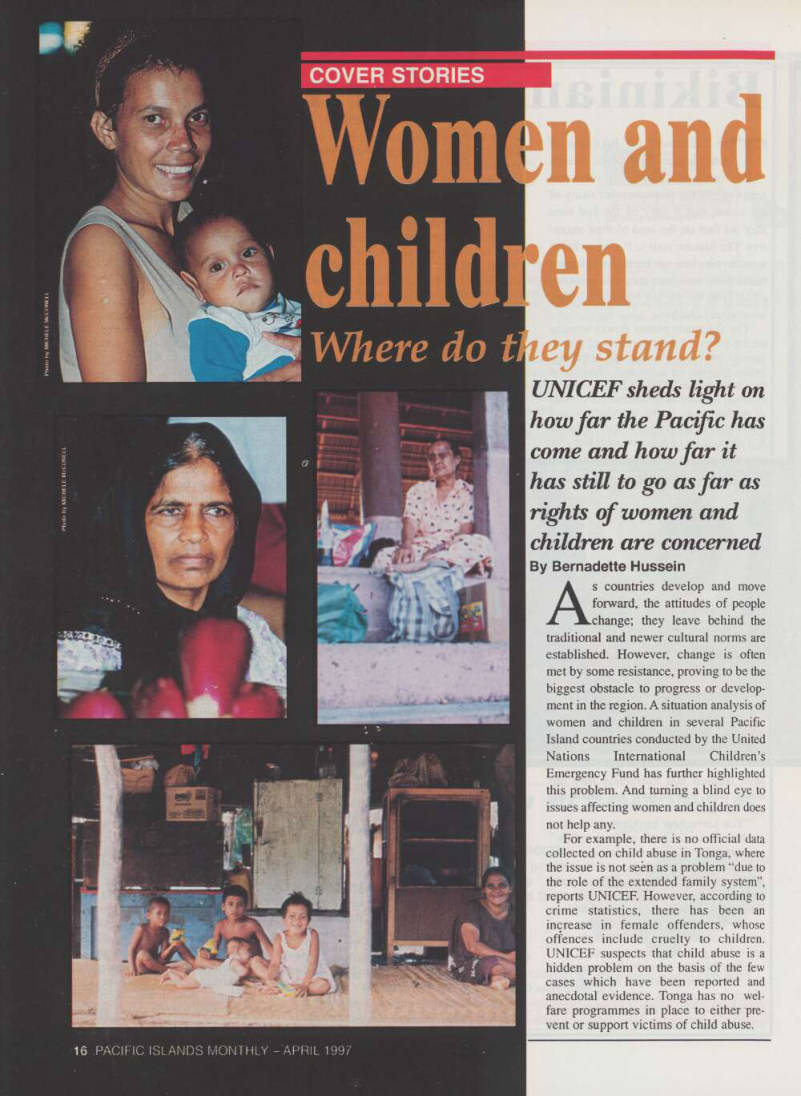
As countries develop and move forward, the attitudes of people change; they leave behind the traditional and newer cultural norms are established. However, change is often met by some resistance, proving to be the biggest obstacle to progress or develop ment in the region. A situation analysis of women and children in several Pacific Island countries conducted by the United Nations International Children’s Emergency Fund has further highlighted this problem. And turning a blind eye to issues affecting women and children does not help any.
For example, there is no official data collected on child abuse in Tonga, where the issue is not seen as a problem “due to the role of the extended family system”, reports UNICEF. However, according to crime statistics, there has been an increase in female offenders, whose offences include cruelty to children.
UNICEF suspects that child abuse is a hidden problem on the basis of the few cases which have been reported and anecdotal evidence. Tonga has no wel fare programmes in place to either pre vent or support victims of child abuse.
Neither does Tonga’s health ministry have any appropriate health services for the disabled, especially children, UNICEF’s A Situation Analysis of Children and Women in Tonga reports.
Most of Tonga’s welfare work seems to be undertaken by religious organisa tions, including the Roman Catholic Church and the Church of Latter Day Saints, which run programmes for orphans and poor families. The disabled are catered for by the ’Ofa Tui ’ Amanaki Centre and the Aalonga. Both operate on a voluntary basis and rely on donations or their own fund-raising activities.
The suicide rate of teenagers in the FSM is thought to be among the highest in the world.
One of the more startling revelations by UNICEF was the high suicide rate in some island countries. The suicide rate of teenagers in the Federated States of Micronesia (FSM) is thought to be among the highest in the world. In 1989 alone there were 33 reported suicides and 61 in 1991 and 1992. The average suicide rate for FSM is calculated at about 20 per 100,000 persons (double the US rate), the UNICEF report states. The majority who commit suicides are young men (a shock ing 200 out of 100,000 persons) and rea sons given are predominantly anger (75- 80 per cent), with ‘shame’ and ‘family feuding’ (often related to familial incest) as secondary reasons, the report said.
The Marshall Islands also records a high suicide rate for teenage males. Of the 88 suicides between 1988 and 1994, 87 were committed by young men, the majority of whom were between 16 and 25 years of age, UNICEF stated.
The youth bureau at the ministry of social services conducts health promotion workshops and coordinates youth projects with local youth clubs and organisations, but there is an obvious need for more identity-building programmes and recre ational outlets for the country’s youth.
As the report highlights, the Marshallese youth are struggling with two crucial transitions - adolescence; and straddling two cultures, their own which is on the decline and American which, through television, music, videos and newspaper advertising, is becoming the most dominant for this generation. Adults in the Marshall Islands customarily adopt a passive attitude of non-involvement toward youth.
Attempts to get comments from the Marshall Islands embassy in Fiji and the Tongan government proved unsuccessful.
In Tonga, crime is on the increase and reasons given for this are unemployment, low income, limited family planning, abandoned mothers and children, high
school dropouts and domestic violence.
Domestic violence is not seen as an official problem in Tonga
But domestic violence is not seen as an official problem in Tonga either. “It is known that the number of cases reported is more than what is being officially noted,” UNICEF states. The number of cases increased from 20 in 1987-88 to more than 40 in 1989-90. The only ser vices available to victims are the police, hospital or informal services such as elders, church ministers or relatives.
As for Fiji, the report refers to it as having a subculture of violence. This sit uation is recognised by health and social welfare providers but is not well reflected in social statistics because the data is not well collected. In Fiji, it is generally con sidered appropriate for the male head of the family to discipline his wife and chil dren in any physical manner, UNICEF states.
Domestic violence appears to be increasing in Fiji, a problem that is diffi cult to measure because most cases go unreported. There are several reasons for domestic violence and they extend from alcohol abuse to social and material pres sures on families. But people are becom ing aware of the criminal nature of domestic violence and, with women becoming more conscious of their rights, more cases are now being recorded.
Police records show that 400 per cent of all murders committed in Fiji between 1992 and mid-1995 were domestic relat ed. Records also show that such murders are increasing each year with a 40 per cent rise each year since 1992.
In the Marshall Islands, alcohol is seen as a serious problem accounting for poor health and social problems as well as spouse and child abuse, which is quite common. The National Women’s Policy statement for the country observed that women from all age groups and econom ic strata and from both urban and rural areas told stories of injuries suffered at the hands of husbands or boyfriends.
While no study has been carried out to indicate the exact nature and extent of domestic violence, it is common knowl edge that a large number of women were subjected to physical violence in the home. On the issue of legal support, since 1990, more women have been filing suits in the high court to obtain child support from their husbands.
The report said that the high court had adopted'the stance of favouring women for child support. In cases of separation where couples were not formally married, the court has ruled that common law mar riage is tantamount to formal marriage.
The ruling has provided many women
with the legal status to obtain court orders requiring their former husbands to pro vide child support. Under Fiji law, the courts have powers to ensure that children are financed and maintained by their par ents, whether they live together or sepa rately. Fiji has agreements to enforce child maintenance court orders with sev eral countries, including Australia, New Zealand, Canada, the United Kingdom and some Pacific Island countries.
But, despite this, children are still not
benefitting. Although orders are given to
parents to pay up, very few do so.
According to the UNICEF report, magis trates were often reluctant to send default ers to prison as they would be less able to pay. But Fiji’s Department of Social Services denied the allegation, saying most defaulters ended up in prison. And, if they defaulted again, they were sent back to prison until they paid.
Also affecting island women is dis crimination in the workforce. There has been an increase in the number of women workers in Fiji working under conditions trade unions and welfare organisations
consider exploitative. However, despite
the increased number of working women, they comprise only 21 per cent of the workforce, mainly because many occupa tions are reserved for men. In Tonga, no woman has ever been appointed a cabinet minister. To date, there have only been three women representatives in the Legislative Assembly. Since women can not be nobles, no woman can represent the nobles in the Legislative Assembly.
As far as official records go, there has been no woman elected as a town or dis trict officer, states UNICEF.
“Women are getting educated, getting smarter and they recognise their rights - and want them.”
Decision-making and politics have tra ditionally been the role of men in Tongan society. But the director of the United Nations Development Fund (UNDP), Noeleen Heyzer, said this would eventu ally change. There were many countries around the world which were holding tightly on to its traditions and the place it gave to women but, over the years, they all gave in,” Heyzer said. “Women are getting educated, getting smarter and they recognise their rights - and want them.
When that happens, it will just be hard to stop,” she said.
The Pacific is not without hope. Most island governments are working on recti fying laws and conventions relating to women and children to help minimise and, hopefully, bring to an end - the lev els of abuse and disparity. The first step is always recognising that problems do exist and need redress.