A history of Bikini
pp. 12-14 · Read in the full issue
March 7,1946 167 Bikinians are removed by the United States Navy so that Operation Crossroads, the first post-World War II nuclear tests, can be conducted. They are moved to Rongerik Atoll, pro vided tents and a two-week supply of food.
July 1,1946 The first test of Operation Crossroads, Able, is exploded at Bikini; three weeks later an underwater shot, Baker, is tested, sinking a target fleet of US and Japanese war ships.
Late 1946 Bikinians make first of many requests to return home; food shortages begin occurring fre quently.
February, 1948 On the verge of starvation, the Bikinians are relocated to the navy base at Kwajalein.
November, 1948 The Bikinians move to southern Kili, a single island with no lagoon or protected anchorage.
Early 1950 s In January 1951, the 40-foot ship pro vided for the Bikinians by the US Trust Territory administration washes onto the reef at Kili and sinks. Rough seas and shortage of vessels cause food supplies to run critically low several times between 1951 and 1953, even necessitating an air drop of emergency food rations at one point March 1,1954 Despite wind blowing toward inhab ited islands to the east of Bikini, the Bravo hydro gen bomb is tested. At 15 megatons, it is 1000 times the strength of the bomb that obliterated Hiroshima and 13 times the force of all nuclear tests conducted in the continental US. It contami nates Bikini Island and many of the northern islands in the Marshalls in a snow storm of radioactive fallout.
May, 1955 Operation Redwing involves 17 hydro gen and atomic bomb tests at Bikini and Enewetak; three of the Bikini shots are H-bombs in the three-to-five-megaton range.
November, 1956 US officials arrive on Kili with $U525,000 in cash, promises of a SUS3OO,OOO trust fund and an agreement that will absolve the US from any future claims by the Bikinians. (“Future claims,” it reads, “by Bikinians based on the use of Bikini by the government of the United States ... or on the moving of the Bikini people from Bikini Atoll to Kili Island, shall be against them [the representatives of the Bikinians] and not against the [US] government.” The Bikinians sign the agreement. The trust fund begins providing about SUSIS per person annually in compensa tion.
August, 1958 US nuclear testing at Bikini and Enewetak atolls ends after 12 years and 67 atmos pheric and underwater explosions (23 at Bikini).
Early 1960 s Food shortages on Kili continue.
June, 1968 President Lyndon B Johnson promises the Bikini people that they can move back to their home following an Atomic Energy Commission report which says, “The exposures to radiation that would result from the repatriation of the Bikini peo ple do not offer a significant threat to their health and safety.” 1969 Following a cursory removal of radioactive debris from Bikini, AEC scientists declare, “There’s virtually no radiation left and we can find no dis cernible effect on either plant or animal life.”
Late 1972 The Bikini Council votes not to return the entire community, but says it will not prevent individuals from returning as part of the US-spon sored resettlement effort. Three Bikini families return to live in houses newly built on Bikini Island.
June, 1975 The US Department of the Interior reports “higher levels of radioactivity than originally thought” at Bikini, commenting that “it appears to be hotter or questionable as to safety”.
August, 1975 An AEG study on local foods grown on Bikini Island points out the need to prohibit con sumption of pandanus, breadfruit and coconut crabs because of high radiation levels.
October, 1995 The Bikinians file a lawsuit against the US government in US federal court, demanding a complete scientific survey of Bikini and the north ern Marshall Islands.
December, 1975 The US agrees to conduct the radiological survey as demanded by the Bikinians, but three years of bureaucratic infighting among US agencies over costs of the survey delay it from starting until 1978.
June, 1977 A Department of Energy (formerly AEG) study states bluntly, “All living patterns involving Bikini Island exceed federal [radiation] guidelines for 30-year population doses.”
April, 1978 Medical examinations reveal radiation levels in many of the 139 people on Bikini well above US “permissible” levels.
September, 1978 The Bikinians are evacuated from Bikini a second time. The resettlement attempt ends in failure.
The US government provides a SUS6-million trust fund for the Bikinians.
Early 1981 The Bikinians file a class action lawsuit against the US government seeking SUS4SO mil lion in compensation, claiming that the US “breached its fiduciary obligations to the Bikinians by failing from 1972 to 1978 to conduct a thorough radiological survey of Bikini”. 1982 The US provides a resettlement trust fund of SUS2O million to the Bikinians; in 1989, it is sup plemented with an additional SUS9O million for the cleanup and rehabilitation of Eneu and Bikini islands, as well as to provide for improved living conditions for Bikinians living on Kili, Ejit and Majuro.
October, 1986 The Compact of Free Association with the US goes into effect, providing the Marshalls with a SUSISO-million nuclear compen sation trust fund to produce SUS27O million over the 15-year life of the Compact (SUS7S million for the Bikinians in SUSS-million annual increments; roughly half of which is distributed quarterly, the balance is invested). In exchange, the Marshalls agrees to espouse all claims. The Bikinians’ lawsuit and lawsuits of other Marshall Islanders, worth about SUSS billion, are dismissed.
September, 1995 Scientists declare Eneu Island safe for habitation, following treatment of contami nated soil with potassium fertiliser that blocks the uptake of cesium by root crops.
Mid-1995 The Bikini Council votes to review the possibility of nuclear waste storage on Bikini Atoll; two months later it passes a resolution stating that “because our old men and old women still desire to return to their homeland ... we will not be pursuing the nuclear waste option for our islands”.
January, 1996 To provide an economic base for a future resettlement, the Bikini Council signs an agreement with Marshalls Dive Adventures, a divi sion of Robert Reimers Enterprises, to establish a scuba-dive operation at Bikini.
June, 1996 The first foreign scuba divers begin a arriving to dive on the wrecks of the sunken World War II fleet, including the world’s only divable air- craft carrier, the USS Saratoga, two submarines, ? the Nagato, flagship of Admiral Yamamoto from which he ordered the attack on Pearl Harbor, and % other battleships.
But, for the first time, the momentum has swung towards a resettlement. Over the past several years, the Bikinians have invested a portion of their US-provided trust funds to construct base camp facili ties - a dock, power plant, barracks for workers, etc - on Eneu Island, from which the cleaup at Bikini Island, seven miles to the north, will be staged.
Radiological studies, after a quarter cen tury, have pinpointed the primary sources of exposure on the atoll and, key to a resettlement, discovered ways to block as much as 90 per cent of the possible radia tion dose people would get from living there. All of the scientific studies would be for nothing without the confidence of the Bikinians, which had not been forth
coming until recently.
Today, again another first, the Bikinians are expressing confidence in the scientific recommendations they are receiving, advice which maintains that Eneu is safe for habitation now, while the rest of the atoll can be rehabilitated and the people returned safely. The Bikinians have been nothing if not sceptical of the pronouncements of safety by US scien tists, and with good reason considering the mistakes that scientist have made in the past, resulting in excessive radiation exposure to islanders who moved back to Bikini in the 19705. This healthy scepti cism was demonstrated during the brief visit to Bikini, when visiting Bikinians bought every available bottle of imported purified water at a local store rather than drink island water treated with a reverse osmosis purifying process that has been laboratory tested in the US and found to contain no detectable levels of radiation.
With the exception of fish, the Bikinians ate only imported foods during the five day visit.
Despite the bottled water purchases, there is a definite shift in attitudes. Dr William Robison, who has supervised radiological studies at Bikini for close to 25 years, also commented on this change.
After years of mistrust of US scientific data, the Bikinians are much more acept ing of the data and assumptions advanced by the scientists. At least part of the rea son the Bikinians are buying Dr Robison’s analysis is that his work has been reviewed twice by US National Academy of Sciences panels and by sci entists from the International Atomic Energy Agency, to name a few. “My work’s been reviewed by 12 different committees,” Dr Robison said. “That’s a lot of reassurance for the Bikinians. It’s important that the Bikinians feel confi dence (in the data) so that they can make their own informed decisions about a nuclear cleanup and resettlement.”
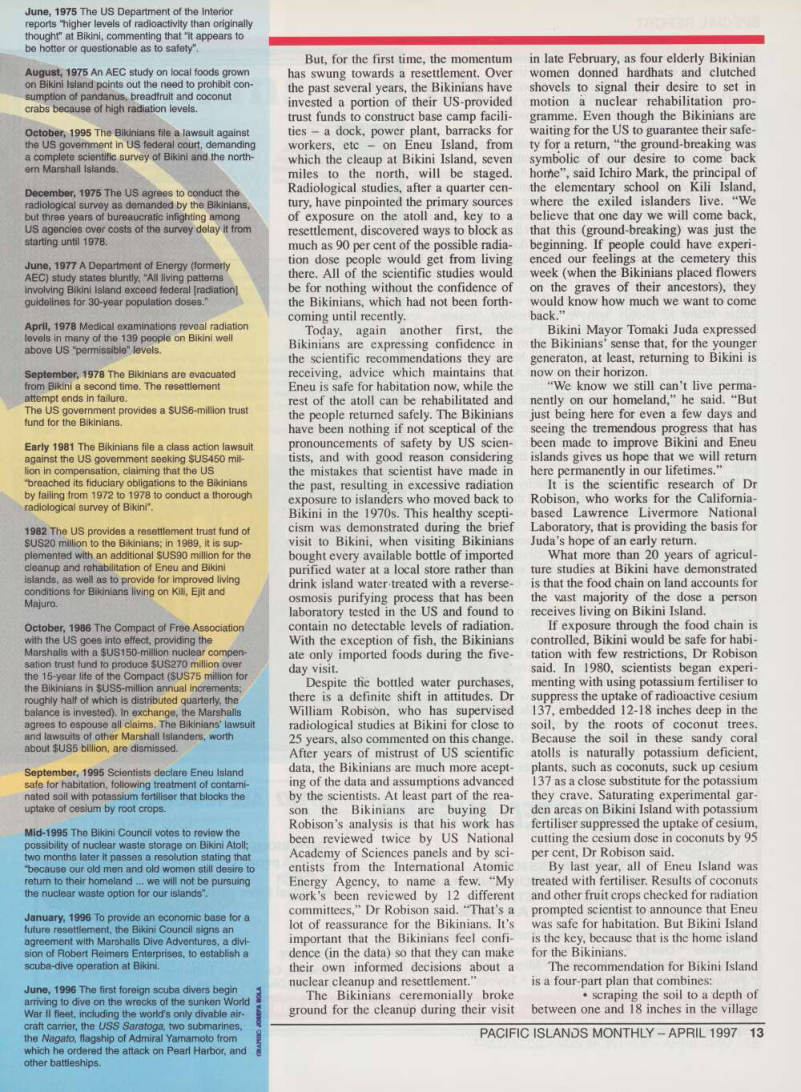
The Bikinians ceremonially broke ground for the cleanup during their visit
in late February, as four elderly Bikinian women donned hardhats and clutched shovels to signal their desire to set in motion a nuclear rehabilitation pro gramme. Even though the Bikinians are waiting for the US to guarantee their safe ty for a return, “the ground-breaking was symbolic of our desire to come back hon'ie”, said Ichiro Mark, the principal of the elementary school on Kill Island, where the exiled islanders live. “We believe that one day we will come back, that this (ground-breaking) was just the
beginning. If people could have experi
enced our feelings at the cemetery this week (when the Bikinians placed flowers on the graves of their ancestors), they would know how much we want to come back.”
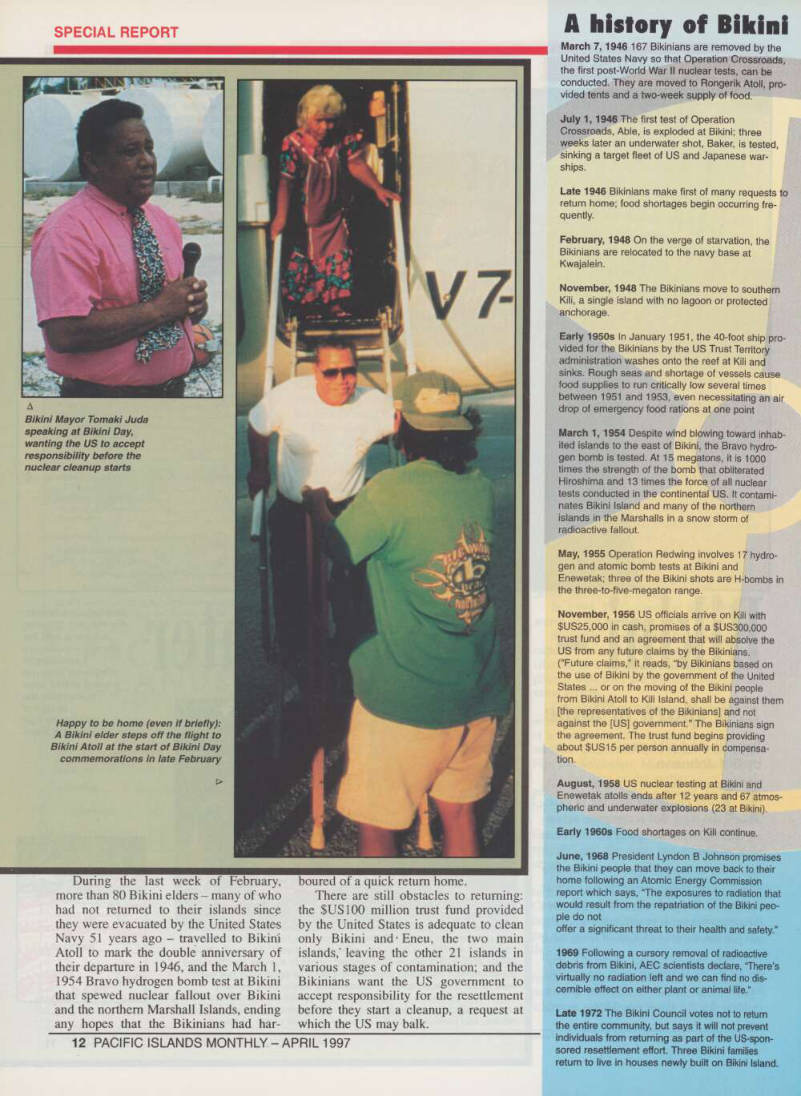
Bikini Mayor Tomaki Juda expressed the Bikinians’ sense that, fpr the younger generaton, at least, returning to Bikini is now on their horizon.
“We know we still can’t live perma nently on our homeland,” he said. “But just being here for even a few days and seeing the tremendous progress that has been made to improve Bikini and Eneu islands gives us hope that we will return here permanently in our lifetimes.”
It is the scientific research of Dr Robison, who works for the California based Lawrence Livermore National Laboratory, that is providing the basis for Juda’s hope of an early return.
What more than 20 years of agricul ture studies at Bikini have demonstrated is that the food chain on land accounts for the vast majority of the dose a person receives living on Bikini Island.
If exposure through the food chain is controlled, Bikini would be safe for habi tation with few restrictions, Dr Robison said. In 1980, scientists began experi menting with using potassium fertiliser to suppress the uptake of radioactive cesium 137, embedded 12-18 inches deep in the soil, by the roots of coconut trees.
Because the soil in these sandy coral atolls is naturally potassium deficient, plants, such as coconuts, suck up cesium 137 as a close substitute for the potassium they crave. Saturating experimental gar den areas on Bikini Island with potassium fertiliser suppressed the uptake of cesium, cutting the cesium dose in coconuts by 95 per cent. Dr Robison said.
By last year, all of Eneu Island was treated with fertiliser. Results of coconuts and other fruit crops checked for radiation prompted scientist to announce that Eneu was safe for habitation. But Bikini Island is the key, because that is the home island for the Bikinians.
The recommendation for Bikini Island is a four-part plan that combines: • scraping the soil to a depth of between one and 18 inches in the village
area to ensure that radioactive material is removed from the area where people will spend the bulk of their time; • blanketing the village with a two-inch layer of small coral rocks, as is customary in this country but which will have the added impact of acting as a shield against any possible resid ual contamination that exists; • dousing the rest of the island with potassium fertilis er to block cesium uptake by fruit crops; and • continuing US Department of Agriculture food sup plements to ensure that the Bikinians continue a diet heavy on imported foods, at least at the outset of the resettlement.
Dr Robison said that, with this remedial action, Bikini’s background radiation dose would be well within acceptable international limits. “A person living at Bikini (under these cir cumstances) would receive about 280 millirems annually,” Dr Robison said. “This is well within the range of normal back ground radiation levels.”
Bikini leaders have for years said they wanted to scrape the entire island to simply remove the dreaded “poison”, as islanders call the radioactive materials embedded in the soil.
However, while they haven’t announced any shift in their desire for ain extensive scrape, this may change behind the weight of recommendations by scientists. An lAEA report on Bikini issued late last year declared that scraping all of Bikini, aside from being astronomically expensive, would be an ecological disaster because it would remove topsoil that has taken centuries to develop on this coral island. And, the lAEA said, such a scrape would be unnecessary because the potassium fertiliser option reduces the radioactive content of fruit plants by 95 per cent.
Dr Robison, who visits Bikini repeatedly each year to follow up on ongoing scientific experiments, said that “when the reme dial work starts at Bikini, we’ll be there to look at the food crops and make sure that what we said is what is in fact happening”.
“We’ll monitor the village after it is scraped to make sure there are no ‘hot spots’ of radiation. Scientific support for the cleanup is very important, it’s a key part of any resettlement pro gramme. The people need to know what’s happening and have the reassurances that it is working.”
But a decision on cleanup methods won’t be made until after Bikini leaders meet with top American officials in Washington, DC, probably in early April. Mayor Juda is adamant that the highest levels of the US government must endorse the planned nuclear cleanup, not just scientists, to avoid a repeat of the aborted resettlement attempt in the 19705. “We cannot start the cleanup until high US officials give it to us in writing that they will stand behind us if we come back,” Juda said. The Bikinians want the US government to accept any liability if the resettle ment goes awry, and Bikinians are exposed to hazardous levels of radiation. “We’re ready to start,” Juda said. “But we need something in writing from the United States first.” ■
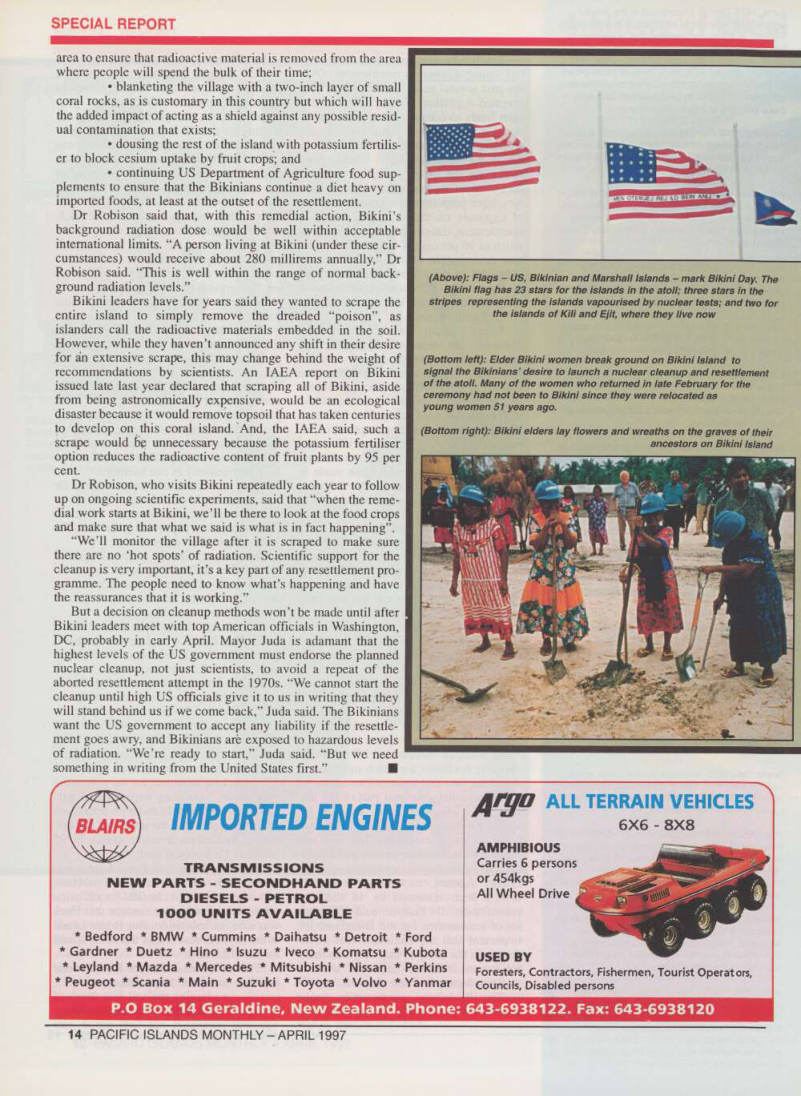
(Above): Flags - US, Bikinian and Marshall Islands - mark Bikini Day. The Bikini flag has 23 stars for the islands in the atoll; three stars in the stripes representing the islands vapourised by nuclear tests; and two for the islands of Kili and Ejit, where they live now
(Bottom left): Elder Bikini women break ground on Bikini Island to signal the Bikinians’ desire to launch a nuclear cleanup and resettlement of the atoll. Many of the women who returned in late February for the ceremony had not been to Bikini since they were relocated as young women 51 years ago. (Bottom right): Bikini elders lay flowers and wreaths on the graves of their ancestors on Bikini Island