Talking
pp. 37-38 · Read in the full issue
Interview
with Dunn
South Pacific Commission
Secretary-General Boh Dunn
talks to Kalinga Seneviratne
on perceptions that the Pacific
may he relying too heavily on
colonial powers
PIM: When you took over as secre tary-general here, it was said that you wanted to make this a lean and efficient organisation. What was the crisis then?
Dunn: This was the opinion of the metropolitan members of the organisa tion, Australia, New Zealand, United States and France, the United Kingdom had left the organisation. The US was talking about leaving. Thus, there were growing concerns among donors of the long-term future of the organisation. I guess the world crisis was a little bit of an exaggeration in regard to that situation.
But, certainly, the key problem the organ isation had to address was the relationship with the donors.
PIM: I believe the SPC review team has said that the SPC needs to carve out a niche for itself in the region. Do you believe in this?
Dunn: I don’t think it needs to estab lish a niche. The SPC has a well estab lished role in the region. And that is the provision of applied research, technical advice to the island territory members in
regard to particular regional issues which
show quite remarkable cost benefits in regard to their needs to be handled from a central location. A very good example of this is in regard to resource management.
Many of the island countries and territo ries find it extremely difficult to maintain the cost of independent technical research and advice.
An organisation like the SPC is some thing that is always going to be needed in the Pacific. It’s quite a discreet niche and no other organisation infringes on that.
In the past, the South Pacific Forum tended to expand into technical areas and
now, of course, the Forum Secretariat has taken the decision to retreat quite clearly back to areas of political involvement.
This leaves the role of the SPC very clear ly defined. In fact, it is exactly the role to which it was assigned in the Canberra agreement 50 years ago.
PIM: Over the past two decades or so, most Pacific Island countries have devel oped what would be called “aid-driven” economies. Now the aid is decreasing and those countries are facing severe econom ic problems. Do you think these aid-driv en economic policies have been a failure?
And what options are left to them?
Dunn; Well, I don’t tend to talk about failures and faults in this situation. It is a matter of understanding that these small economies have managed extremely well, maintaining democratic institutions. The fact that there are increasing economic pressures is causing quite marked adjust ments in these countries.
These small economies are showing a great deal of adoptiveness to cope with quite enormous pressures. I don’t join this
general feeling of pessimism about the
economies of the countries in this region.
PIM: But isn’t there a general feeling of gloom in the region about its future?
Dunn: I don’t detect that. Not at all. I think there’s some feeling of gloom among the commentators on the region.
You can certainly read a lot of horror sto ries about this and that and so on.
Travelling and working in the region, this is not something I pick up from countries themselves.
PIM: About 90 per cent of the SPC budget is funded by the former colonial powers in the region, which means many of the consultancies go to citizens of these countries. To overcome the current eco nomic problems, many of the Pacific Island nations may have to blend some of their traditional subsistence economic models into the new environment. In such a situation, would it be that these consul tants are not the appropriate people to advise the island countries?
Dunn: As a matter of fact, it’s obvious the SPC does very little of its work through consultancies. A great proportion of what we do is is done by permanent staff, of course, represented by all the countries of the Pacific. There’s a wide spread of nationalities in this organisa tion. I would say there is a very strong understanding of the problems of these countries. We are not an organisation that spends a lot of money on high-price con sultants. It’s just the opposite.
PIM: I have been covering the South Pacific for the past five years and a com plaint I hear very often from professionals in this area is that most of the aid pro grammes implemented in this region have a very high percentage of foreign consul tants, which is not conducive to encourag ing and developing local expertise. You have been involved with the Australian aid programme for a long time. What are your general impressions on that?
Dunn; I can’t really comment on that as a generality, but certainly, as far as the SPC is concerned, that’s not a criticism that applies to us at all. That sort of state ment would bear strong analysis.
It’s by nature almost being a political statement and one would need to look very closely at the actual figures involved.
Certainly, as far as Australia is concerned and certainly most other donors as well, the percentage of the aid funds that go into consultants’ pockets will be quite small.
PIM: Would you see the SPC develop ing into a more grassroots -development oriented organisation? In other words, as you are looking to cut costs, would you have less headquarters staff and more people at grassroots level working for you so that Noumea would be a more coordi nation centre?
Dunn: Frankly, I don’t think this is an organisation that would be well placed to undertake what would normally be known as grassroots activity. That’s not what the SPC’s on about, nor is it what it claims to be on about. If you are interested in fund ing grassroots activity, you should do what Australia and New Zealand do -
Dunn...“An organisation like the SPC is something which is always going to be needed in the Pacific
fund non-govemmental organisations -
people who are in a position to work hap pily at village level very cost effectively.
It’s not something that a regional organi sation like the SPC can do. What we are
involved in is issues and problems which have a regional significance, where we can have a cost-effective input. A good example of that is the future of tuna resources in the Pacific. You have to have
an organisation which can provide data, provide research, data which measures the health of those tuna stocks, which pro vide information of value to discussions which occur between countries of the Pacific with regard to the future of that industry. That is something which you have to have this organisation do. You wouldn’t decribe that as grassroots inter vention. This is the greatest resource the region has and you simply have to have the information which relates to its future.
PIM: Your predecessor, George Ati Sokomanu, has tried to woo Asian coun tries to join the SPC. How do you see the scope for more Asia-Pacific links through the SPC?
Dunn; There’s excellent future in link age, particularly with those Asian coun tries who are users of resources in the Pacific - both land-based and sea-based resources. I think there’s real room for quite a contribution by these countries.
One of the interesting things at the moment is if you take fisheries or research in forestry, the researching cost of this activity in the region through our organisation is provided by donors, who themselves have very little to do with the actual use of those resources. Countries who are very much involved in the use of those resources might very well make a greater contribution to work which is associated with the maintenance of the long-term future of this work. Just this week, Japan made a very large contribu tion to our education training centre for the provision of classrooms. One could see this as a very strong development. ■
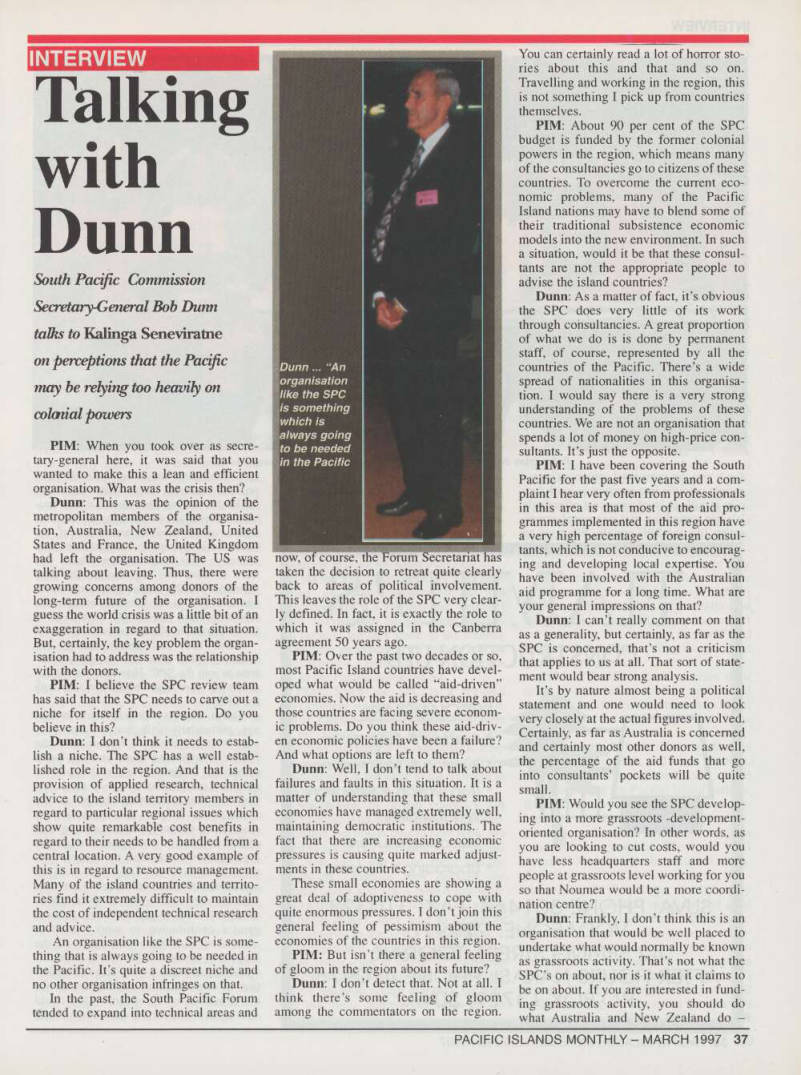
Polynesian dancers at the SPC open day last month Picture: Kaimga seneviratne