SPC’s golden year
p. 35 · Read in the full issue
Spc
But challenges lie ahead
Text and photography by
Kalinga Seneviratne
In keeping with the policy of the new management team led by Secretary- General Bob Dunn to minimise costs of running the South Pacific Commission (SPC), the Noumea-based headquarters decided to open its doors to the host city public rather than invite leaders from around the region for a big birthday bash to celebrate its 50th anniversary.
They drew up a three-day programme beginning with a formal invitees-only evening function on February 6 with speeches from local leaders, traditional dances and choir singing from New Caledonia, followed by an open-air cock tail party on the gardens of its spacious premises on the fashionable Anse Vata beachfront.
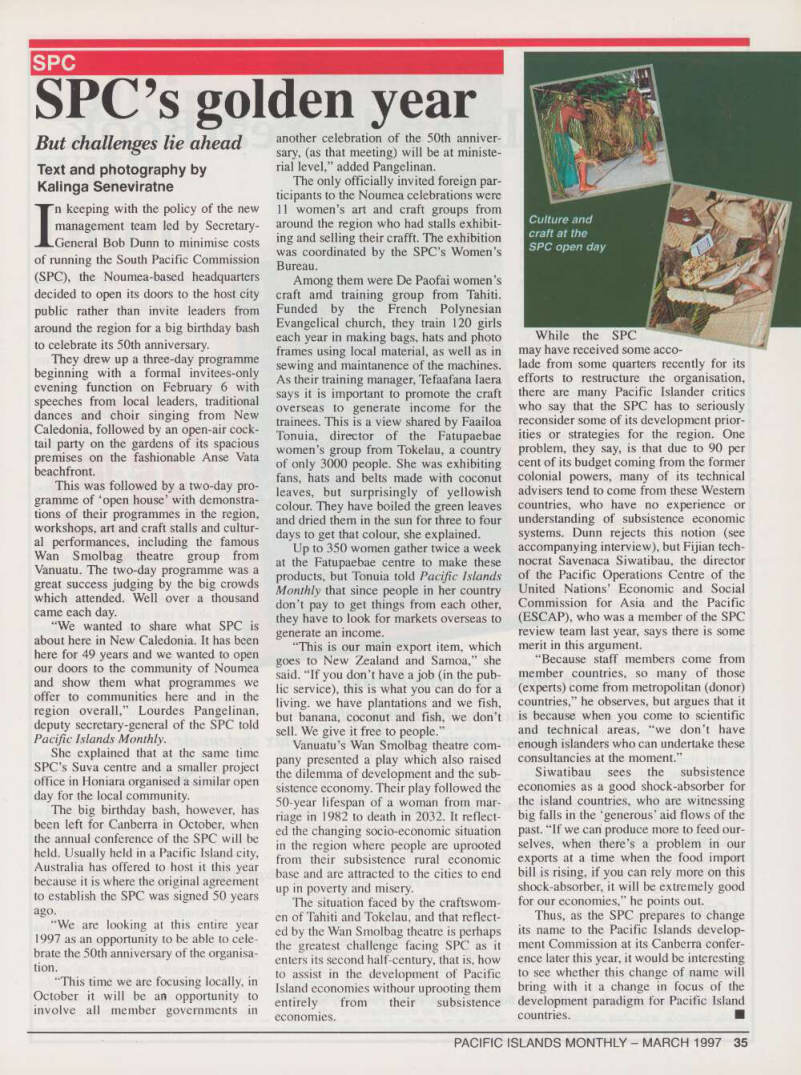
This was followed by a two-day pro gramme of ‘open house’ with demonstra tions of their programmes in the region, workshops, art and craft stalls and cultur al performances, including the famous Wan Smolbag theatre group from Vanuatu. The two-day programme was a great success judging by the big crowds which attended. Well over a thousand came each day.
“We wanted to share what SPC is about here in New Caledonia. It has been here for 49 years and we wanted to open our doors to the community of Noumea and show them what programmes we offer to communities here and in the
region overall,” Lourdes Pangelinan,
deputy secretary-general of the SPC told Pacific Islands Monthly.
She explained that at the same time SPC’s Suva centre and a smaller project office in Honiara organised a similar open day for the local community.
The big birthday bash, however, has been left for Canberra in October, when the annual conference of the SPC will be held. Usually held in a Pacific Island city, Australia has offered to host it this year because it is where the original agreement to establish the SPC was signed 50 years ago.
“We are looking at this entire year 1997 as an opportunity to be able to cele brate the 50th anniversary of the organisa tion.
“This time we are focusing locally, in October it will be an opportunity to involve all member governments in
another celebration of the 50th anniver sary, (as that meeting) will be at ministe rial level,” added Pangelinan.
The only officially invited foreign par
ticipants to the Noumea celebrations were 11 women’s art and craft groups from around the region who had stalls exhibit ing and selling their crafft. The exhibition was coordinated by the SPC’s Women’s Bureau.
Among them were De Paofai women’s craft amd training group from Tahiti.
Funded by the French Polynesian Evangelical church, they train 120 girls each year in making bags, hats and photo frames using local material, as well as in sewing and maintanence of the machines.
As their training manager, Tefaafana laera says it is important to promote the craft overseas to generate income for the trainees. This is a view shared by Faailoa Tonuia, director of the Fatupaebae women’s group from Tokelau, a country of only 3000 people. She was exhibiting fans, hats and belts made with coconut leaves, but surprisingly of yellowish colour. They have boiled the green leaves and dried them in the sun for three to four days to get that colour, she explained.
Up to 350 women gather twice a week at the Fatupaebae centre to make these products, but Tonuia told Pacific Islands Monthly that since people in her country don’t pay to get things from each other, they have to look for markets overseas to generate an income.
“This is our main export item, which goes to New Zealand and Samoa,” she said. “If you don’t have a job (in the pub lic service), this is what you can do for a living, we have plantations and we fish, but banana, coconut and fish, we don’t sell. We give it free to people.”
Vanuatu’s Wan Smolbag theatre com pany presented a play which also raised the dilemma of development and the sub sistence economy. Their play followed the 50-year lifespan of a woman from mar riage in 1982 to death in 2032. It reflect ed the changing socio-economic situation in the region where people are uprooted from their subsistence rural economic base and are attracted to the cities to end up in poverty and misery.
The situation faced by the craftswom en of Tahiti and Tokelau, and that reflect ed by the Wan Smolbag theatre is perhaps the greatest challenge facing SPC as it enters its second half-century, that is, how to assist in the development of Pacific Island economies withour uprooting them entirely from their subsistence economies.
While the SPC may have received some acco lade from some quarteHs recently for its efforts to restructure the organisation, there are many Pacific Islander critics who say that the SPC has to seriously reconsider some of its development prior ities or strategies for the region. One problem, they say, is that due to 90 per cent of its budget coming from the former colonial powers, many of its technical advisers tend to come from these Western countries, who have no experience or understanding of subsistence economic systems. Dunn rejects this notion (see accompanying interview), but Fijian tech nocrat Savenaca Siwatibau, the director of the Pacific Operations Centre of the United Nations’ Economic and Social Commission for Asia and the Pacific (ESCAP), who was a member of the SPC review team last year, says there is some merit in this argument.
“Because staff members come from member countries, so many of those (experts) come from metropolitan (donor) countries,” he observes, but argues that it is because when you come to scientific and technical areas, “we don’t have enough islanders who can undertake these consultancies at the moment.”
Siwatibau sees the subsistence economies as a good shock-absorber for the island countries, who are witnessing big falls in the ‘generous’ aid flows of the past. “If we can produce more to feed our selves, when there’s a problem in our exports at a time when the food import bill is rising, if you can rely more on this shock-absorber, it will be extremely good for our economies,” he points out.
Thus, as the SPC prepares to change its name to the Pacific Islands develop ment Commission at its Canberra confer ence later this year, it would be interesting to see whether this change of name will bring with it a change in focus of the development paradigm for Pacific Island countries. ■
Culture and craft at the SPC open day