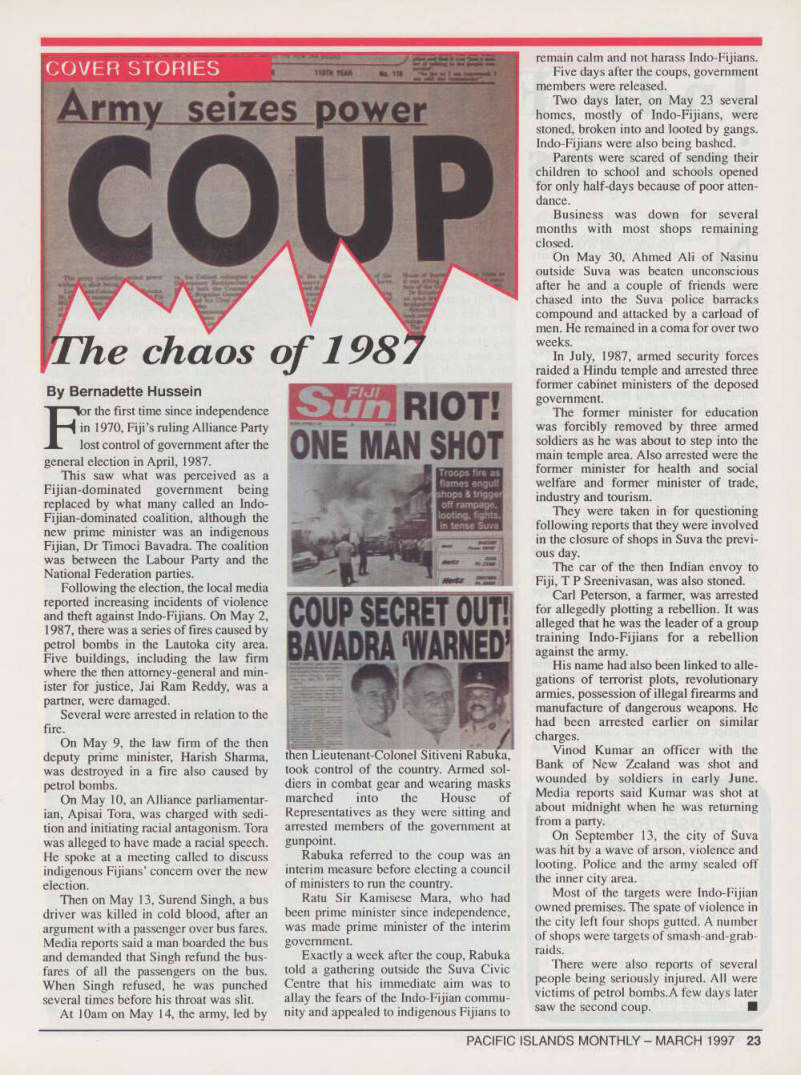
The chaos of 1987
p. 23 · Read in the full issue
By Bernadette Hussein
For the first time since independence in 1970, Fiji’s ruling Alliance Party lost control of government after the general election in April, 1987.
This saw what was perceived as a
Fijian-dominated government being
replaced by what many called an Indo-
Fijian-dominated coalition, although the
new prime minister was an indigenous Fijian, Dr Timoci Bavadra. The coalition was between the Labour Party and the National Federation parties.
Following the election, the local media reported increasing incidents of violence and theft against Indo-Fijians. On May 2, 1987, there was a series of fires caused by petrol bombs in the Lautoka city area.
Five buildings, including the law firm where the then attorney-general and min ister for justice, Jai Ram Reddy, was a partner, were damaged.
Several were arrested in relation to the fire.
On May 9, the law firm of the then deputy prime minister, Harish Sharma, was destroyed in a fire also caused by petrol bombs.
On May 10, an Alliance parliamentar ian, Apisai Tora, was charged with sedi tion and initiating racial antagonism. Tora was alleged to have made a racial speech.
He spoke at a meeting called to discuss indigenous Fijians’ concern over the new election.
Then on May 13, Surend Singh, a bus driver was killed in cold blood, after an argument with a passenger over bus fares.
Media reports said a man boarded the bus and demanded that Singh refund the bus fares of all the passengers on the bus.
When Singh refused, he was punched several times before his throat was slit.
At 10am on May 14, the army, led by
then Lieutenant-Colonel Sitiveni Rabuka, took control of the country. Armed sol diers in combat gear and wearing masks marched into the House of
Representatives as they were sitting and
arrested members of the government at
gunpoint.
Rabuka referred to the coup was an interim measure before electing a council of ministers to run the country.
Ratu Sir Kamisese Mara, who had been prime minister since independence, was made prime minister of the interim government.
Exactly a week after the coup, Rabuka told a gathering outside the Suva Civic Centre that his immediate aim was to allay the fears of the Indo-Fijian commu nity and appealed to indigenous Fijians to
remain calm and not harass Indo-Fijians.
Five days after the coups, government members were released.
Two days later, on May 23 several homes, mostly of Indo-Fijians, were stoned, broken into and looted by gangs.
Indo-Fijians were also being bashed.
Parents were scared of sending their children to school and schools opened for only half-days because of poor atten dance.
Business was down for several months with most shops remaining closed.
On May 30, Ahmed Ali of Nasinu outside Suva was beaten unconscious after he and a couple of friends were chased into the Suva police barracks compound and attacked by a carload of men. He remained in a coma for over two weeks.
In July, 1987, armed security forces raided a Hindu temple and arrested three former cabinet ministers of the deposed government.
The former minister for education was forcibly removed by three armed soldiers as he was about to step into the main temple area. Also arrested were the former minister for health and social welfare and former minister of trade, industry and tourism.
They were taken in for questioning following reports that they were involved in the closure of shops in Suva the previ ous day.
The car of the then Indian envoy to Fiji, T P Sreenivasan, was also stoned.
Carl Peterson, a farmer, was arrested for allegedly plotting a rebellion. It was alleged that he was the leader of a group training Indo-Fijians for a rebellion against the army.
His name had also been linked to alle
gations of terrorist plots, revolutionary
armies, possession of illegal firearms and manufacture of dangerous weapons. He had been arrested earlier on similar
charges.
Vinod Kumar an officer with the Bank of New Zealand was shot and wounded by soldiers in early June.
Media reports said Kumar was shot at about midnight when he was returning from a party.
On September 13, the city of Suva was hit by a wave of arson, violence and looting. Police and the army sealed off the inner city area.
Most of the targets were Indo-Fijian owned premises. The spate of violence in the city left four shops gutted. A number of shops were targets of smash-and-grab raids.
There were also reports of several
people being seriously injured. All were
victims of petrol bombs.A few days later saw the second coup. ■