10 years
pp. 18-22 · Read in the full issue


Cover Stories
10 years later...
Nearly 10 years after Fiji’s first military coup, asylum seekers are still awaiting the outcome of their applications. Yet, questions abound on the authenticity of their claims and the sort of immigration procedures in place to verify such claims
Since Fiji’s military coups in 1987, over 51,240 people have left the country in search of what they hoped would be better and brighter futures. The number of people who left in 1987 was 5394 compared with 3048 in 1986, an increase of 77 per cent. Fiji’s Bureau of Statistics has attributed this mainly to the political instability in the
country at the time. Of those who left Fiji at the time, 363 were Fijians while 4395
were Indo-Fijians.
Some left immediately after the coups, thanks to their permanent resident status in other countries, some went on tourist visas and illegally overstayed their per mits, while a small number sought and gained political asylum or refugee status.
Although the number of asylum seek
ers from Fiji may be small compared with some other parts of the world, ques tions have been raised about the proce dures used by various countries to grant political asylum or refugee status as well as concern that the facts offered by asy lum seekers may have been fabricated.
“There is no set procedure that must be followed. But, basically, the authori ties of the foreign country concerned need to establish first how genuine is the claim in seeking asylum or refuge in a foreign country,” John Tevita, the direc tor of immigration in Fiji, said.
“This is a long and time-consuming process which can involve govemment to-government consultations by the appropriate authorities which would nor mally be the foreign ministries.
“This department would normally be required to establish from records the person’s true identity as a Fiji citizen and other relevant personal details that may be necessary.”
Fiji’s Foreign Affairs Department,
however, has said that the department has not to date been required to provide any such information on Fiji citizens.
Fiji’s Bureau of Statistics figures show that from 1987 to 1992 over 6070 Fiji citizens left for the US.
In the nine years since the coups, more than 1000 Fijians, presumably mostly Indo-Fijians, have used stories of persecution in Fiji to secure permanent or temporary legal status in the United States. (The US immigration system is vigorous in its insistence in not collect ing ethnic data.) It is now much harder to secure asy lum in the US than it was a couple of years ago, before the Clinton administra tion began a drastic change in the screen ing system.
Fewer Indo-Fijians seek this status with each passing year, but for some 1200 Indo-Fijians, it has given them a chance to begin life all over again in America.
When the coups came to Fiji, there were not many Indo-Fijians living in the
US as compared to Australia and New Zealand, so the American immigrantvisas-for-relatives system was of little use to Indo-Fijians. And the US was not busily looking for refugees in Fiji as it was in Vietnam and among several groups within Russia. So Indo-Fijians who were really persecuted or who felt they were, or who simply wanted to emigrate to the US had one remaining obscure option - they could fly to the US and then apply for asylum once they got there.
The extent to which to which they had, in fact, actually been persecuted, in previous years, played little role in their ability to secure temporary legal presence and the ability to work legally in the US.
Before January 3, 1995, Indo-Fijians, or anyone could apply at an office of the
US Immigration and Naturalisation Service (INS). There was an extensive process before one could be judged to be an asylee on a permanent basis (one small step from full immigrant status), but there was no screening at all for those seeking temporary asylum status and the work
permit that accompanied it.
There was no interview, No fee.
Nothing.
All one had to do was fill out the right form (1-589) and mail it to the INS. After a couple of months, the applicant got the work permit, but the actual interview for the permanent status of the asylee might not take place for many years. About 900
Indo-Fijians applied for asylum years ago
and continue to work legally in the US
waiting until their cases are called.
Another 300 have gone through the permanent status interview and secured a favourable ruling from an INS officer or from a judge acting on cases rejected by INS staff. At no point in this process does a US government official call or send a letter to Fiji asking about what happened to the individual in question. The US offi cials made their decision (often unfavourable to the applicant) on the basis of written and verbal testimony pre sented to them in US government office buildings. In fact, a large majority of the Indo-Fijian cases that did not come to a final decision resulted in denials, but that is not the end of the story.
The part of the American Justice Department that says that an asylum applicant has a bad claim is different from the unit in the department which deports aliens. The latter has so few resources, and so many high-priority criminal aliens to cope with, that rejected asylum appli cants are rarely, if ever, deported. They stay in the US in a sort of limbo, not pre sent legally but facing no active pressure to leave the country.
Since January, 1995, the lot of an asy lum seeker is less attractive. The Justice Department hears cases quickly and rejects most of them. Most importantly, the applicant does not get a work permit until the application is approved or has been in motion for six months. If there is a negative decision in less than six months, then there is never a work permit or a chance to work legally in the US.
The number of Fiji citizenswho tried to use this programme in the US since the coups was as follows:
1988 - 31 1989 - 192 1990- 421 1991 - no data 1992 - 360 1993 - 263 1994- 164 1995 - 62
At the last count last year, there were, in addition to the 963 Fijian applications pending in INS offices, hundreds more waiting for decisions in the courts.
At least two of these cases made it to the step just below the US Supreme Court, that of the Circuit Courts of Appeals. Both of these cases involved Indo-Fijians named Prasad, both were heard in the West Coast Circuit; one won and one lost.
The loser was Kamla Prasad, described by the judge as a “cook and a taxi driver [who] departed Fiji in October of 1987, soon after the coup”.
“Prasad contended that in September of 1987, while he was driving his taxi, he was stopped at a roadblock by a number
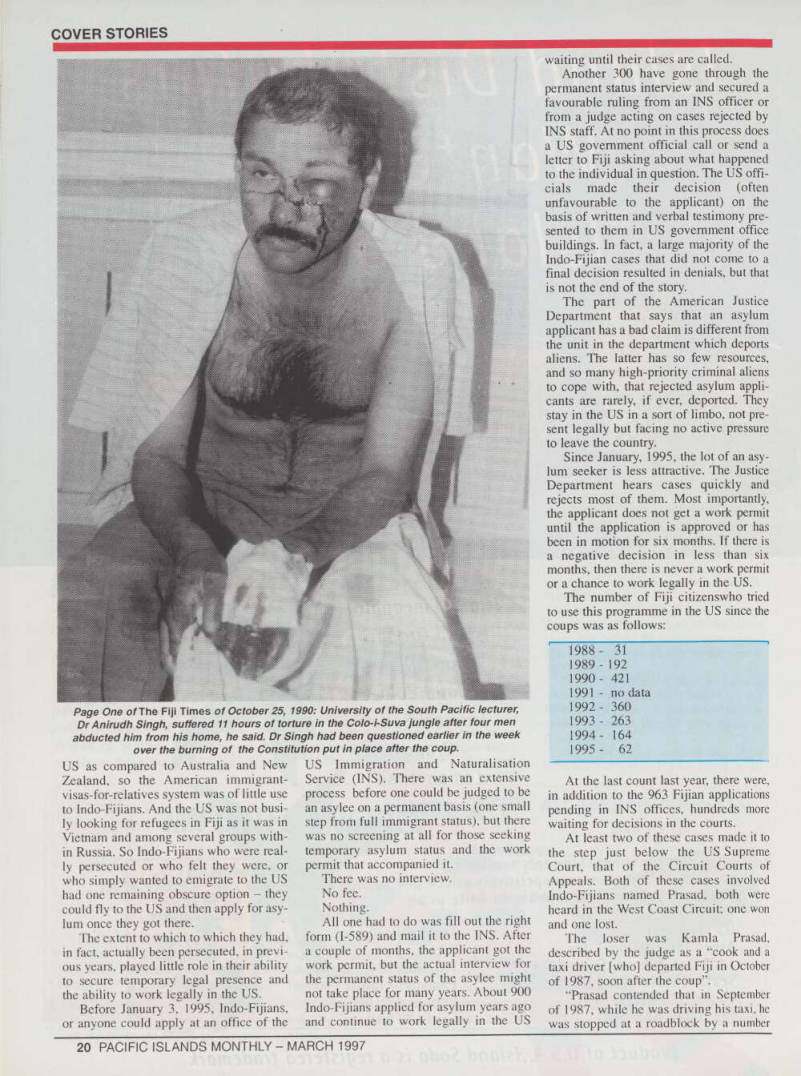
Page One of The Fiji Times of October 25, 1990: University of the South Pacific lecturer, Dr Anirudh Singh, suffered 11 hours of torture in the Colo-i-Suva jungle after four men abducted him from his home, he said. Dr Singh had been questioned earlier in the week over the burning of the Constitution put in place after the coup.
of ethnic Fijians, some of whom were dressed in military uniforms ... Prasad was taken to ... a jail cell. At some point Prasad was hit on his stomach and kicked from behind. His captors questioned Prasad regarding his support for the eth nic Indian Labour Party. Prasad assumed that if he continued his active support for the Labour Party, he would again be arrested and beaten. After four to six hours, Prasad was released.”
The judges found (early in 1995) Kamla had been mistreated in Fiji but not to the extent that he could prove that he was a political refugee under US law.
About a year later, the case of Gaya Prasad came before different judges of the same court.
According to the judge’s decision: “One year before the 1987 general elec tion in Fiji, Prasad became active as a local delegate of the Hindu-dominated Labour Party. He was also the secretary of the labour union at the cement factory where he had worked for 16 years.”
The judges continued that Prasad had been out of the country during the coup and upon his return found that “civil rights were severely restricted” and he “testified that friends in the Labour Party told him he would be killed if he contin
ued organising”.
“Prasad was jailed twice and beaten by military officers three times. He was forced to resign from his job as a chemist’s assistant on threat of being fired ... during his detention he was questioned about his involvement with the ousted Labour Party, beaten with a gun and uri nated on by his military interrogators. He was also forced to lick the officer’s spit off the floor ... After a scecond coup in
September, 1987, Prasad was again jailed,
this time for two days. He was beaten less severely than the first time...”
It is difficult to verify such claims as there were no records of such abuse kept by the Fiji Police Force during Fiji’s coup era. The Fiji Labour Party, of which he claimed to be a strong supporter, were not aware of his identity. Many people had “used the party’s name” to seek asylum, a spokesman for the party added.
On September 9, 1996, the Los Angeles Daily Journal reported that the United States Court of Appeal for the Ninth Circuit held that Indo-Fijians who were subjected to government-sanctioned persecution, were not ineligible for asy lum simply because all Indo-Fijians could be considered eligible for asylum.
This was said during the judgment delivered on a Ranjit Singh, his wife and daughter who were admitted to the US as visitors in May, 1989 and applied for asy lum in June.
On July 18, 1991, their application was denied.
The paper reported that evidence
showed that Indo-Fijians had been sub jected to discrimination, harassment and
violence by indigenous Fijians.
The alleged attacks included women being raped in front of their children, bru tal beatings, detainees being forced to walk naked on the street while holding human excrement, forced swims in sewage pools and children being beaten.
Additionally, several Hindu temples were burned.
The Singhs testified that they received death threats and there were attempts on their lives. They said that police did not respond to crime reports even when the attackers were identified.
But, according to police in Fiji, there
are no records kept from that time because the situation was out of hand and the military had taken over police duties.
The immigration judges held that the Singhs faced harassment and discrimina tion but that this was not persecution since the majority of Indo-Fijians suffered the same treatment and were still in Fiji.
It was decided that any harassment and discrimination suffered by Singh and his family did not constitute persecution because Singh “failed to establish that anyone in Fiji was interested in him”. On October 31, 1994, the Singhs’ appeal was dismissed and they were ordered volun
tary departure.
Another country which many people
left for was New Zealand. Of the 5394 people who left Fiji in 1987, 1025 went to New Zealand. The majority of the people who left Fiji at the time were Indo-Fijians.
However, unlike the US, New Zealand did not grant political asylum to any Fiji citizen. However, the criteria for perma nent residency in respect of applicants from Fiji was greatly liberalised.
Consequently, almost 10 times as many migrants from Fiji were accepted in 1988 compared with 1986.
From 1987 to 1995, 14,525 people from Fiji were approved for residence in New Zealand.
Media reports of the time highlighted that the majority of Indo-Fijians leaving were mainly business people. In the first weeks after the coup, the high commis sion was rejecting about half the visitor permit applications received because they felt Indo-Fijians had a false impression that it would be easy to hop on a plane for New Zealand.
A better indicator of Indo-Fijians’ post-coup panic was the waiting list of 500 visitor permit applications on top of the 900 visitor permits dealt with each month in May and June.
The high commission was also, at the time, flooded with hundreds of applica tions from students wanting to study in New Zealand.
Figures from the Bureau of Statistics showed that most people left Fiji for Australia after the military coups.
Statistics showed that of the 5394 people who left Fiji in 1987, 2566 emigrated to Australia.
Shortly after the first coup in May 1987, the chairman of the Foreign Affairs
Committee of Australia’s opposition Liberal Party, Senator Rob Hill, said Australia should consider opening its doors to Fiji’s Indian community.
He said Australia had a responsibility to those of another community who felt they had no place in the society and had lost their political rights and would prefer to emigrate.
He has said technically Fiji Indians did not fill the refugee category but there were humanitarian categories under which they could be considered.
Australia is one of 123 countries which have signed the United Nations Conventions and Protocols relating to the status of refugees.
In Australia there is a two-stage pro cessing structure for those applying for asylum. These are the primary and the review stages.
At the end of November, 1995 there were 209 applicants from Fiji at the pri mary stage.
Asylum seekers are given a protection
visa until their cases are dealt with. Once the asylum is granted they may get per mission to work in Australia and seek financial assistance from the Asylum Seeker Assistance Scheme. The Liberal government is trying to reduce the pro cessing time in a bid to slash funding for this scheme.
Many asylum seekers entered
Australia on tourist or student visas and then applied for a protection visa.
But the Australian Embassy in Fiji said records available did not indicate granting or formal processing of requests for polit
ical asylum.
Despite the fact that there were many
genuine cases of persecution during Fiji’s
‘coup era’ (see following story), the reali ty that many of the asylum seekers may have fabricated or, at least, exaggerated their stories of terror and abuse exists.
A Fijian Pacific Island community worker in Sydney, Australia, said he knew of two indigenous Fijians who had received refugee status in Australia by lying about their living situations in Fiji.
One of them is an elderly Fijian who is working for a well-to-do Australian woman who had the right kind of influ ence and contacts to make this possible.
The second, he said, was a relative who openly boasts about how he managed to work the system to be able to stay.
The PIC worker said that he felt some immigration agents were active in encour aging fabricated stories about supposed
hardships endured in Fiji because they
made a living off these people trying to migrate. He also said these people were selfish and did not care about the reper cussions these lies had on Fiji.
He said people like this often received funding from Australian institutions because their political view pleased the Australian government. A Sydney Fijian immigration agent said he did not see what was wrong if people made up stories about their lives in Fiji.
“If that is what they need to do to make it possible to leave Fiji, then good luck to them,” he said. As far as he was con cerned, as long as the “Rabuka regime” was in place, there was no justice for any
Fijian. ■
Researched by: Bernadette Hussein, David North, Atama Raganivatu, Kalinga Seneviratne, Lili Tuwai