Bougainville
pp. 13-15 · Read in the full issue
Crisis
Is there a solution?
By Sam Vulum
Apolitical solution for the Bougainville crisis will not be reached as long as leaders remain divided over the issue. What is a serious national issue has become a political game over the past eight years, used to score political points. The situation on Bougainville has caused massive destruc tion to property and human life, forcing misery upon thousands on the island and in other parts of the country. Two security force members were killed in a Bougainville Revolutionary Army ambush in mid-January, the first casual ties for 1997.
There is a lack of any real political will
and commitment towards finding solu tions to the problem. Peace efforts by the government have always been met with different responses, causing divisions between leaders. On record, there has never been an absolute compromise between leaders on any of the initiatives taken so far.
The recent heated debate between Prime Minister Sir Julius Chan and one of PNG’s most senior statesmen. Sir Michael Somare, is another clear indica tion of the type of political approach that has taken root over the years. It appears that a major division has developed between leaders over the issue. One fac tion is being led by Sir Julius and the other by Sir Michael.
The debate was over a visit by a group of members of parliament led by Sir Michael to Bougainville in January, it was
their second visit in a bid to negotiate the release of five security force members captured and held hostage by the BRA following the Kangu massacre.
It appears that a major division has developed between leaders
Sir Julius accused the MPs, including his own provincial affairs and local-level government minister, Peter Barter, of breaching protocol by not consulting with or informing him about the trip. He said there was potential for the government losing ground if any of the MPs had been
taken hostage.
The other members of the delegation were Wewak MP Bernard Narokobi, South Bougainville MP Michael Laimo and Bougainville MP John Momis. Sir Julius told parliament that the delegation was not a parliamentary delegation because it didn’t have his, cabinet’s or parliament’s approval.
However, Sir Michael, in presenting a report on their visit, blamed the “difficul ty of solving the Bougainville crisis” on Sir Julius’ “one-man efforts”.
“It is clear that the Bougainville prob lem is being addressed by one man and that one man [seems] to me to be either deliberately or intentionally refusing to or not courageous enough to - turn all the stones available to him,” he said, adding that the prime minister did not have the courtesy to acknowledge the delegation’s briefing with him.
He thanked Speaker Sir Rabbie Namaliu as “head of the legislature” for facilitating the mission. He said the trip had been taken on humanitarian grounds.
However, Sir Julius said the two trips did not give Sir Michael the authority to speak on solving the crisis. He said the report would be accepted as from a pri vate MPs’ team rather than as a parlia mentary report.
Sir Rabbie, who was caught in the crossfire, told parliament he would be neutral and support both the national gov ernment and “consider favourably” any parliamentarians’ initiatives to restore peace, minimise human suffering and
resolve the Bougainville dispute.
The legislature (parliament) had spent up to KBO,OOO ($U552,300) on the two trips. Sir Rabbie said his decision to accept the MPs’ request to fund the trip was based on the facts that; • the four MPs had been formal ly invited to visit the hostages and hold talks with rebel leaders; • it was a real opportunity to attempt to secure the hostages’ release; • the security of the delegation
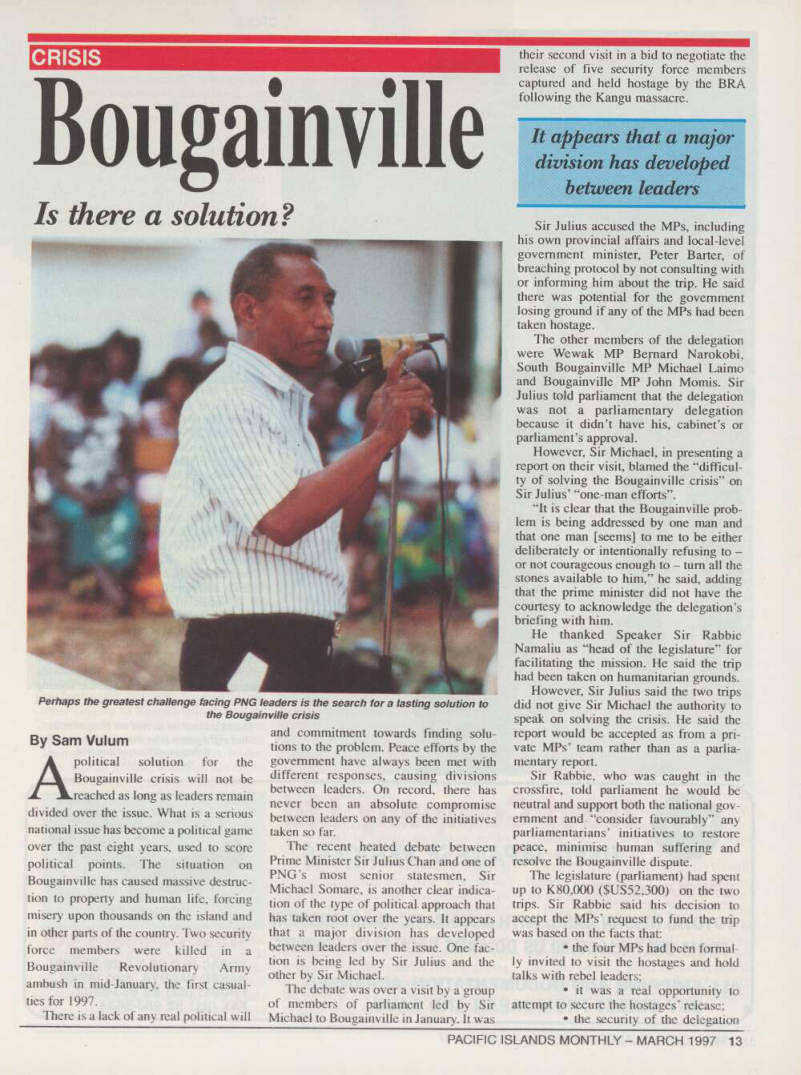
Perhaps the greatest challenge facing PNG leaders is the search for a lasting solution to the Bougainville crisis
had been assured by the rebels; • it was a real opportunity for the legislature to contribute to the execu tive government to establish some mean ingful dialogue with the rebels; and • the four MPs and their staff were risking their lives. “As speaker of parliament, I have to be neutral. I fully support the national government’s initia tives to restore peace on the island.
“Likewise, I will consider any move by MPs if it will help minimise human suffering and lead to a peaceful resolution of the dispute.”
Ijape said the government would help in any way it could to enable rebel leaders leave the island
The division was clearly apparent when a vote was taken on the Langui trip report. Thirty-five members voted for the report and 34 voted against it.
With the national election only months away, the future of the peace process lies with whoever takes the helm of politics after June.
For the Sir Julius faction, Bougainville was the first issue addressed by the gov ernment upon taking office in 1994. Only days after his election. Sir Julius met with Bougainville Revoloutionary Army Commander Sam Kauona in Solomon Islands and signed the Honiara Accord.
A series of peace initiatives were made, including the deployment of the South Pacific peacekeeping force, and the failed KlO-million (SUS6.S-million) Operation High Speed 11. Sir Michael also played a major role in the Bougainville peace efforts, which involved the signing of the first peace deal on a New Zealand
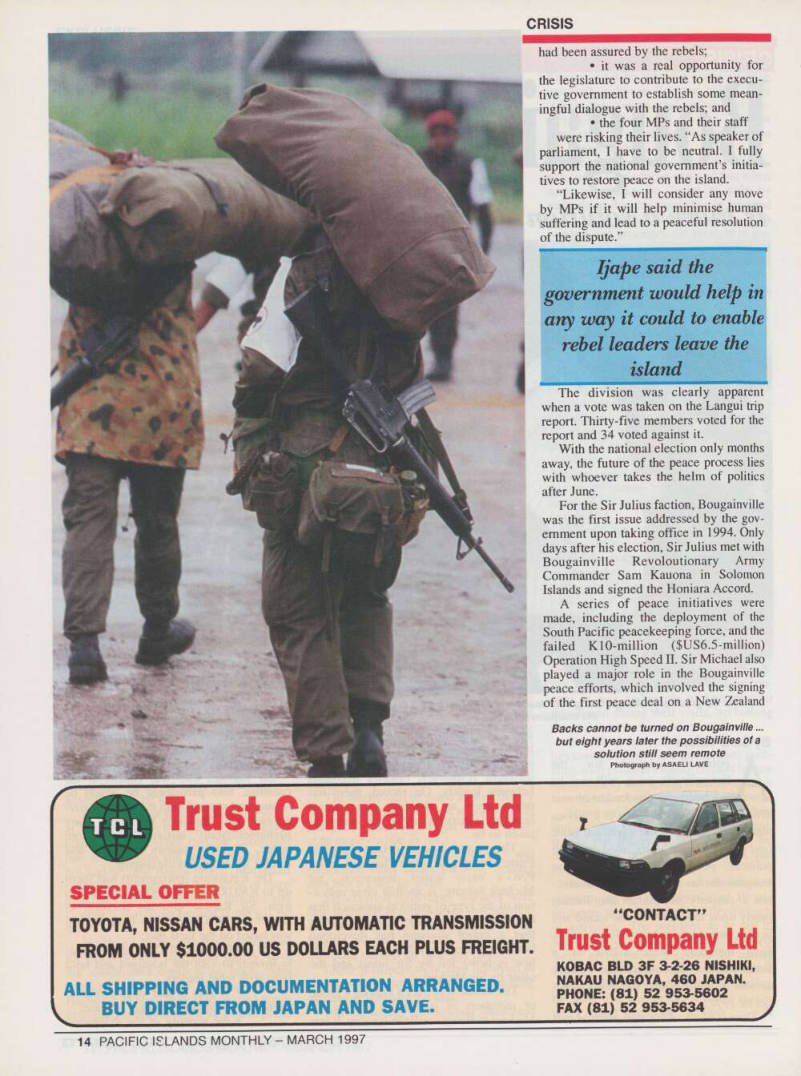
Backs cannot be turned on Bougainville ... but eight years later the possibilities of a solution still seem remote Photograph by ASAELI LAVE
Navy boat, the Endeavour, hence named the Endeavour Accord. Sir Michael,
accompanied by fellow Sepik MP
Narokobi, signed the accord with BRA leaders.
Teaming up with Narokobi, Momis and Laimo, they formed what looked to be an influential pact which might turn out some positive results if given the nec essary backing. Although they failed to release the captives on both occasions, at least they established some form of dia logue with the rebels.
One major hurdle was that there was no guarantee on the part of the leaders
that they were genuiney representing the
views of their government - or their own.
This concern was highlighted by BRA leaders during the meeting.
The government’s opposition to the visit was evident in the move by Defence Minister Mathias Ijape placing a total ban on further private visits by leaders and other citizens to Bougainville. Ijape said he had made the decision to safeguard the safety of leaders and citizens. The latest attempt by Ijape to assist BRA leaders seek asylum in other countries has drawn mixed reactions from different quarters.
“We see no reason for
BRA leadership leaving
Bougainville as they are
safe and in control of the island”
The general secretary of the outlawed Bougainville Interim Government (BIG) sought and was granted asylum in Holland in February, 1996, having been forced to flee after his house on Koala Ridge, Honiara, Solomon Islands, was
burnt down by six masked men believed to be Bougainvilleans.
The PNG government had strongly condemned the move. However, a day before the crisis reached its ninth year, the government was seen to have unofficially changed its stand. Ijape announced on December 24 that the government had offered to help Bougainville leaders secure political asylum, although Sir Julius had yet to public acknowledge any such move at the time of writing.
Seen as the latest peace initiative, Ijape said the government would help in any way it could to enable rebel leaders on Bougainville to leave the island and settle in another country.
Ijape said he had considered the polit ical asylum proposal for some time and believed that Christmas Eve was an appropriate time for the announcement.
He said, “I am willing to negotiate this for them with the national government. I firmly believe the move will create
greater understanding and cooperation
among all parties in the conflict.”
He said once Francis Ona, Joseph Kabui, Sam Kauona and other hard-line rebels left, the security forces would be
gradually withdrawn.
Ijape said if the rebel leadership con sidered political asylum, the defence force could be totally withdrawn in the name of peace.
“I hope this new proposal is digested during Christmas and New Year as the year of reconciliation and peace,” Ijape said. However, the Bougainville Transitional Government, feels otherwise.
Premier Gerard Sinato said such action would result in independence for
Bougainville. The general feeling among
BTG government members is that the MPs should not raise the rebels’ expecta tions on long-term measures, saying that
long-term measures should be left for them as the legitimate authority to discuss with both the national government and rebel leaders.
The BRA has clearly indicated its willingness
to negotiate a political
solution
“The withdrawal of security forces from Bougainville is one of the conditions set by the BRA. This must not happen ... this would mean independence for
Bougainville,” Sinato said. Speaking
against the possibility of granting political
asylum to rebel BTG leaders Ona, Kabui and Kauona, Sinato questioned whether this was the “prize for all the bloodshed on Bougainville”.
“We have to face these rebel leaders, talk to them and agree on a peaceful solu tion to the crisis ... Our position is clear.
We want to proceed with dialogue to pur sue the national government’s undertak
ings for Bougainville.
“At no stage [have] Bougainville lead ers and the prime minister discussed
granting political asylum to BRA/BIG
hardliners,” he said. The BRA meanwhile has branded the offer of asylum as “calcu lating, ill-informed, nonsensical and very dangerous”. Ona is firm on his stand that the only way he is going to leave Bougainville is “in a coffin”, while BIG spokesman Moses Havini said they would never accept any such offer from the likes of Ijape, which was a move to destabilise
BRA leadership.
“That is the last thing BRA leaders will accept. We see no reason for BRA
leadership leaving Bougainville as they
are safe and in control of the island,”
Havini said.
“We would like to suggest, however,
that PNG start accepting political asylum
seekers from other countries such as West Papua, East Timor, Burma and Nigeria, who have sought asylum in PNG,” Ona said. Havini has repeated calls for the total withdrawal of security forces from Bougainville who would be replaced by a neutral international peacekeeping force under United Nations mandate.
The BRA has clearly indicated its will
ingness to negotiate a political solution
for the Bougainville.
Havini said that the BIG/BRA were
being pressured by sections of the
Bougainville community, including
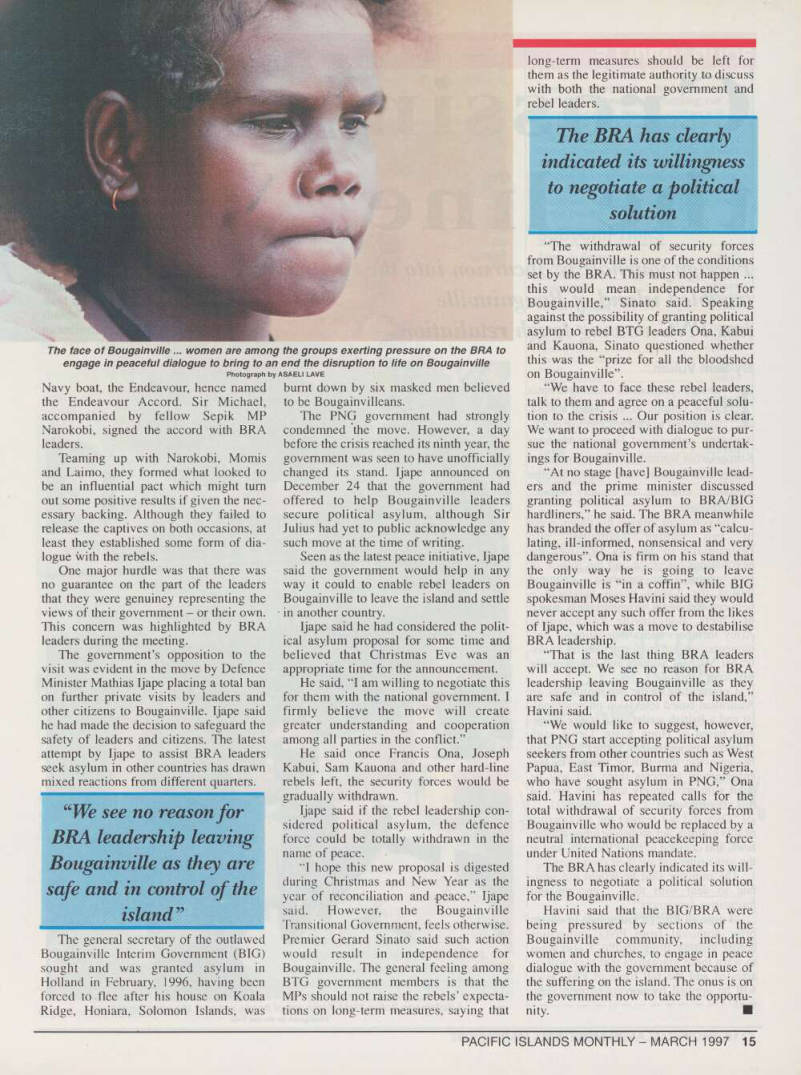
women and churches, to engage in peace dialogue with the government because of the suffering on the island. The onus is on the government now to take the opportu
nity. ■
The face of Bougainville...women are among the groups exerting pressure on the BRA to engage in peaceful dialogue to bring to an end the disruption to life on Bougainville Photograph by ASAELI LAVE