punishment
pp. 10-12 · Read in the full issue

Exclusive
Crime and punishment
Former criminal and gang leader speaks out on what he sees as the the nation’s problems in and out of prison of PNG’s escalating crime problem
By Sam Vulum
The failure by Papua New Guinea’s
education system to fully equip youths for employment, the brutal treatment of crime offenders by police and prison officials, and corruption are some of the causes of the escalating crime prob lem in the country, at least as far as one former gang leader in Port Moresby is concerned.
At least two national politicians and several senior public servants are alleged to be using their premises to hide stolen vehicles and weapons used in criminal activities. A former gang leader in Port Moresby said they had used their posi tions to contribute to the escalating law and order problem in the country.
He said criminals stored the vehicles and weapons in such places because they were safe from the police.
The involvement of influential people and the use of weapons, he said, was a new trend that had developed in the 19905, with crime becoming more sophis ticated than in the 70s and the 80s. In those days, he said, youth commited crime because they wanted recognition and respect from other youth. The type of crime committed then mainly involved breaking-in and entering, stealing and car thefts.
The former leader said that today, criminal gangs in the city were more pro
fessionally organised and helped each
other. If a gang was planning a job, he said, it would approach other gangs for manpower, weapons and vehicles. And he claimed that many gangs had established strong links with members of the police and defence forces to have access to their weapons. The weapons were immediately returned after use. he said.
The former gang leader’s allegations come at a time when the police commis
sioner Bob Nenta is under fire for alleged cases of maladministration and nepotism in the force. Nenta denied the allegations in a petition presented to Prime Minister Sir Julius Chan by the Police Association in January calling for his removal from the top post.
The petition also claimed that K 93,000 ($U559,550) of curfew money had been used to buy a vehicle for the commission er and another substantial amount was placed in an interest-bearing account, still
awaiting maturity. The prime minister had
yet to act on the petition at time of writ
ing.
“None of the allegations have sub stance and they will not hold water,”
Nenta said, accusing the association of trying to destabilise the police force.
Two politicians were arrested for their alleged involvement with criminal ele ments. In the first case, police raided the politician’s premises in 1996 but his case was later dismissed because of a lack of evidence. The fate of the other politician, arrested for allegedly attempting to import arms, is yet to be decided by a Leadership Tribunal.
A public servant was arrested in con nection with a major Port Moresby rob bery. Police say they are aware of promi nent figures being involved with criminal elements and are doing all they can to
bring them to justice.
The former gang leader, who has been involved in criminal activities since 1975, says he has watched crime grow and flourish before his eyes over the years, placing the blame for this on police cor ruption, the state of prisons and the stan dard of education in the country.
The leader, who preferred not to use his name for security reasons, told Pacific- Islands Monthly that the education sys tem is such that only the top students con tinue their education after Grade six and Grade eight while the rest return home.
The situation is made worse when those who complete Grade 10 and others
who go as far as university level cannot find employment after completing their studies.
“Being unemployed is not much fun.
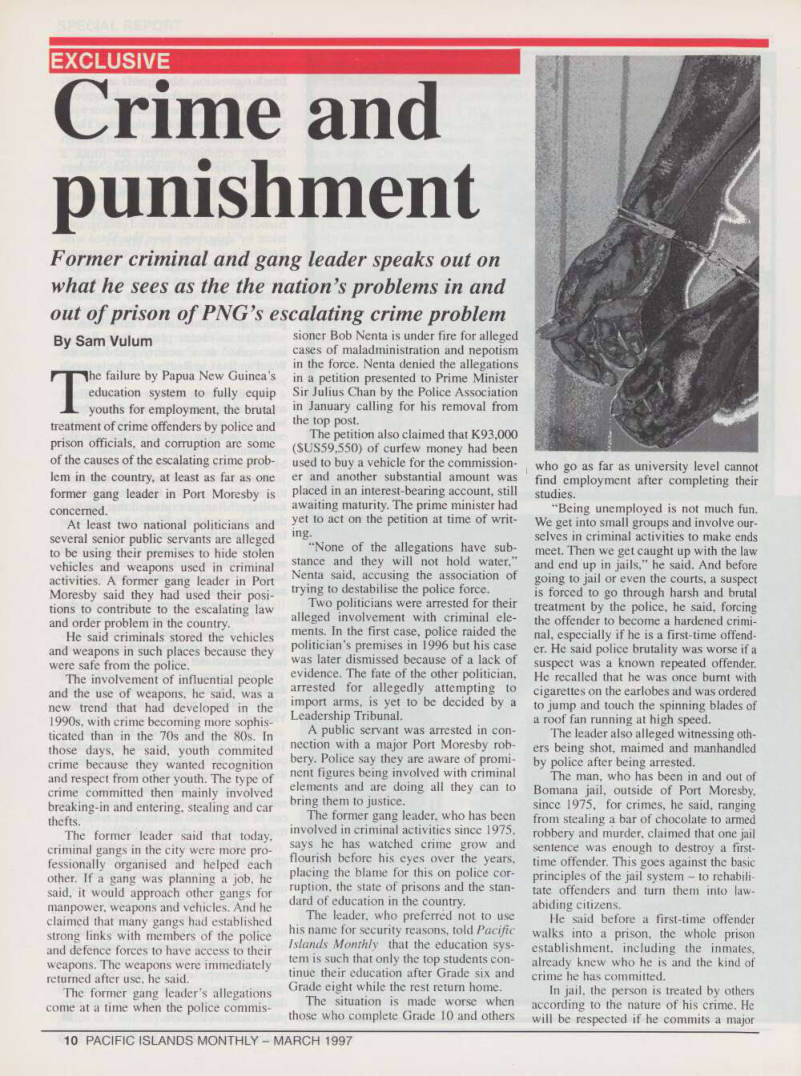
We get into small groups and involve our selves in criminal activities to make ends meet. Then we get caught up with the law and end up in jails,” he said. And before going to jail or even the courts, a suspect is forced to go through harsh and brutal treatment by the police, he said, forcing the offender to become a hardened crimi nal, especially if he is a first-time offend er. He said police brutality was worse if a suspect was a known repeated offender.
He recalled that he was once burnt with cigarettes on the earlobes and was ordered to jump and touch the spinning blades of a roof fan running at high speed.
The leader also alleged witnessing oth ers being shot, maimed and manhandled by police after being arrested.
The man, who has been in and out of Bomana jail, outside of Port Moresby, since 1975, for crimes, he said, ranging from stealing a bar of chocolate to armed robbery and murder, claimed that one jail sentence was enough to destroy a first time offender. This goes against the basic principles of the jail system - to rehabili tate offenders and turn them into law
abiding citizens.
He said before a first-time offender walks into a prison, the whole prison establishment, including the inmates, already knew who he is and the kind of crime he has committed.
In jail, the person is treated by others according to the nature of his crime. He will be respected if he commits a major
crime like armed robbery, but he will be subjected to constant harassment and ridicule if has stolen a chicken.
While there, he realises that he is a nobody. His time in prison encourages him to commit bigger crimes once he gets out of jail, especially the first-time offender, so that the next time he walks in, he’ll be respected. He picks up ideas on how to commit more crime and defend himself in court.
“They build up their links in jail. It’s like a school, the former leader said.
He said new and weak prisoners suffer the most. The most humiliating experience is sexual abuse. This, he said, usual-
ly occured during the regular fellowship
sessions, organised by the various church denominations for prisoners. The victim or the “lost sheep”, the term used by prisoners, is identified beforehand and when everyone is going for the fellowship the attackers attempt to discourage him from attending. He is “raped” if he agrees to stay back. Other times, such innmates are made to drink soapy water or their own urine - These prisoners are often convicted
policemen, security personnel and police
informers. Sometimes, for their own safety, such inmates are kept away from the others. The area is referred as “Iraq” by prisoners.
“You have to show that you don’t get pushed around. Sometimes you have to join well-known groups in jail for protec tion,” he said.
There are rules in place in prison to deal with those who carry out such activ ities. One form of punishment involves locking up the conflicting parties in cage like enclosures and having them physical ly fight it out.
The former leader also recalled that the maximum security, for hardened crim inals, used to be a man-made hell. He said that once he was thrown into the maxi mum security cell for trying to escape after cutting through a steel bar. He had used a four-inch hacksaw smuggled to him by a friend who worked in the work shop hidden in the hem of a towel.
He was in for murder then and had decided to escape after being told by other inmates that he would get life sentence for the offence.
He worked out the plan with three other friends. They took turns to cut the
bar during four morning roll-call periods.
After each cutting session, they used soap and burnt tyre ashes to hide their work. It was never discovered by warders on rou tine checks. On the day of their planned escape, they waited until midnight and then made for the security fences. They had to climb and jump over four high
security fences with razor-sharp edges, he said.
He recalls he managed to get over the first fence when he slipped, raising the security alarm. He panicked and, when jumping off, twisted his ankle. Only one member of the group managed to escape but was later caught making his way to
Port Moresby.
He said that he suffered the worst beat ing he could remember during his days as a criminal. He was thrown into the maxi mum security cell, stripped and made to sit the first night under a running tap.
Although he had his clothes back, he was made to spend the next few nights on the concrete floor. He said the cold was unbearable at times and he had to do sev eral push-ups regularly to keep himself warm.
He said that about four days later, he was issued two blankets. His daily routine included removing his waste from a half filled bucket of water. He rinsed the buck et, returned it and had breakfast. He also came out in the evening to have dinner but spent the whole day in his cell block.
Most of these problems were high lighted at a week’s gathering of gang leaders and government authorities in 1985 at the Goldie Army Barracks near Port Moresby, led by the former correc tional services commissioner, the late
Pius Kerepia. During the retreat, the gang leaders discussed their needs and prob lems, and ways of solving the crime prob lem with government authorities.
They were visited by government min isters and other leaders, including the
governor-general.
A lot of issues were raised and dis cussed. However, most of them have never been taken on board by successive governments, he said.
During his last stint in prison in 1995 at Bomana jail - the former gang leader claims he discovered that the consump tion of marijuana and home-brewed alco hol had become rife in prison. Marijuana is being smuggled into the prison in huge quantities and consumed by inmates and alcohol is also being brewed in the jail, he said.
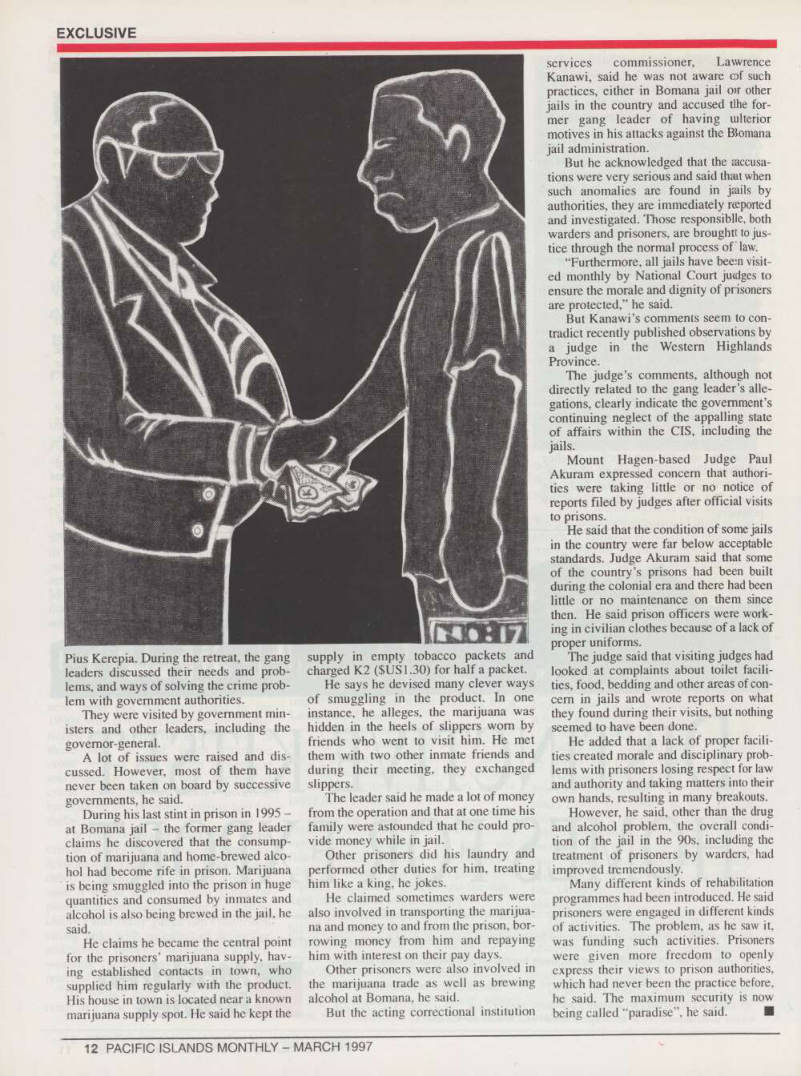
He claims he became the central point for the prisoners’ marijuana supply, hav ing established contacts in town, who supplied him regularly with the product.
His house in town is located near a known marijuana supply spot. He said he kept the
supply in empty tobacco packets and charged K 2 (SUSI.3O) for half a packet.
He says he devised many clever ways of smuggling in the product. In one instance, he alleges, the marijuana was hidden in the heels of slippers worn by friends who went to visit him. He met them with two other inmate friends and during their meeting, they exchanged slippers.
The leader said he made a lot of money from the operation and that at one time his family were astounded that he could pro vide money while in jail.
Other prisoners did his laundry and performed other duties for him, treating him like a king, he jokes.
He claimed sometimes warders were also involved in transporting the marijua na and money to and from the prison, bor rowing money from him and repaying him with interest on their pay days.
Other prisoners were also involved in the marijuana trade as well as brewing alcohol at Bomana, he said.
But the acting correctional institution
services commissioner, Lawrence Kanawi, said he was not aware of such practices, either in Bomana jail o>r other jails in the country and accused tlhe for mer gang leader of having uilterior motives in his attacks against the Blomana
jail administration.
But he acknowledged that the zaccusa tions were very serious and said thait when such anomalies are found in jails by authorities, they are immediately reported and investigated. Those responsible, both warders and prisoners, are broughtt to jus tice through the normal process of law.
“Furthermore, all jails have bee;n visit ed monthly by National Court jucdges to ensure the morale and dignity of prisoners are protected,” he said.
But Kanawi’s comments seem to con
tradict recently published observations by
a judge in the Western Highlands Province.
The judge’s comments, although not directly related to the gang leader’s alle
gations, clearly indicate the government’s
continuing neglect of the appalling state
of affairs within the CIS, including the
jails.
Mount Hagen-based Judge Paul
Akuram expressed concern that authori ties were taking little or no notice of reports filed by judges after official visits to prisons.
He said that the condition of some jails in the country were far below acceptable standards. Judge Akuram said that some of the country’s prisons had been built during the colonial era and there had been little or no maintenance on them since then. He said prison officers were work ing in civilian clothes because of a lack of proper uniforms.
The judge said that visiting judges had looked at complaints about toilet facili ties, food, bedding and other areas of con cern in jails and wrote reports on what they found during their visits, but nothing seemed to have been done.
He added that a lack of proper facili ties created morale and disciplinary prob lems with prisoners losing respect for law and authority and taking matters into their own hands, resulting in many breakouts.
However, he said, other than the drug and alcohol problem, the overall condi tion of the jail in the 90s, including the treatment of prisoners by warders, had
improved tremendously.
Many different kinds of rehabilitation programmes had been introduced. He said prisoners were engaged in different kinds of activities. The problem, as he saw it, was funding such activities. Prisoners were given more freedom to openly express their views to prison authorities, which had never been the practice before, he said. The maximum security is now being called “paradise”, he said. ■