Striking oil
pp. 48-49 · Read in the full issue
Development
PNG’s second petroleum development project takes off as interest builds in nickel and cohalt mining
By Ruth Waram
Work is already under way on the development of Papua New Guinea’s second
petroleum development project, located
approximately 500 kilometres north-west of Port Moresby.
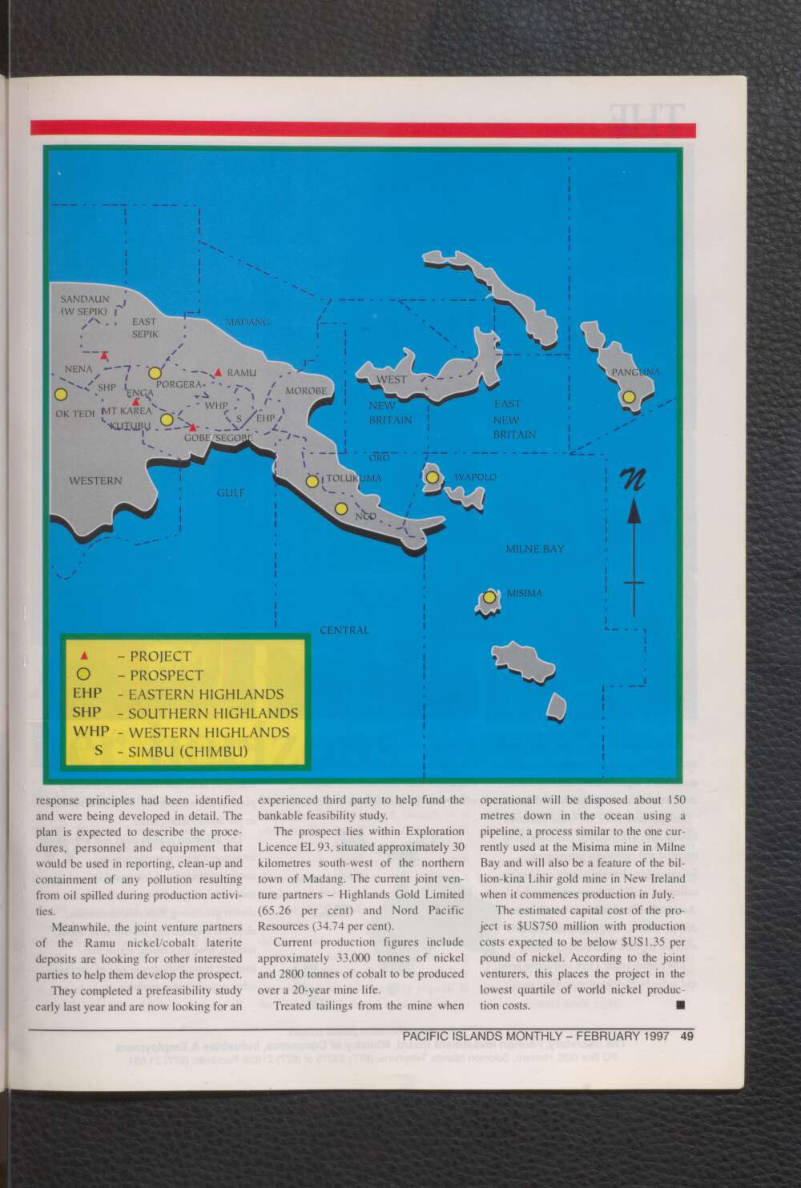
The Gobe petroleum development pro ject includes the development of two sep arate oil fields. South East Gobe and Gobe Main are located 85 kilometres southeast of the current producing Kutubu fields in PNG’s Southern Highlands
province.
The two fields are located approxi mately 15 kilometres from the existing Kutubu export pipeline, in rugged moun tainous and swampy country, with one field lying across the Gulf and Southern Highlands provinces.
The two fields are forecast to produce at a combined peak rate of approximately 50,000 barrels of oil per day for over five years.
Direct benefits to the state from the project include direct taxes and duties through the petroleum income tax (50 per cent), payroll taxes, import duties and, if appropriate, additional profits tax of 50 per cent on after-tax profits.
Indirect benefits to people in the pro ject area include employment, education, training and educational assistance.
Project employment during construction
is expected to exceed 1000 while employ ment during production is expected to be much less.
Non-cash benefits to the project area landowners include the funding of com munity development and public health programmes.
The joint venture partners in the two
fields, which include some of the biggest names in the business, submitted their applications for two petroleum develop ment licences and a pipeline licence on April 12 last year and had expected gov ernment approval by October. The pro cess normally takes about six months.
However, landowners claiming they
were not being considered by the devel oper for civil works contracts and wanting greater equity in the project, stopped phase one of the civil works.
The developer then withdrew all machinery from the project site, while the landowners and the government held sev eral meetings to address the landowners’ demands.
Under government policy, landowners in petroleum project areas will receive a two-per-cent free equity in any project while landowners in mining project areas will receive a five-per-cent-free equity.
When submitting their applications,
the joint venturers had forecast first oil to be produced by December this year.
However, the delays mean first oil from the fields is expected by March 1998.
PNG’s mining and petroleum minister, John Giheno, after several meetings with landowners, granted the two development licences and a pipeline licence to the Gobe joint venturers on Christmas Eve.
The field will be developed under a joint venture arrangement between the various licencees in the project, with Chevron Niugini, also the developer of the Kutubu project, being the operator.
After months of negotiations, landowners from the project area signed a Memorandum of Understanding (MOU) with the developer, Chevron Niugini, which are prerequisites to granting a licence.
As per the MO A, the landowners’ equity in the project will be held by a trustee company, whose memorandums and articles of association will need to be approved by the state under a deed of trust.
The landowners’ two-per-cent equity will come from the state’s 22.5-per-cent equity in the project, with the state also bearing their cost of production until first oil, after which they will be required to fulfil all financial commitments like other
joint venturers.
The money from the sale of the landowners’ share of oil will be paid into an escrow account and used to pay royal ties, joint-venture cash calls, contribute to an abandonment fund for the project, and to maintain a balance in the escrow account sufficient to pay joint-venture cash calls for three months.
The MOA to be reviewed two years after the signing also addresses local busi ness opportunities, dispute resolution pro cedures and training and localisation.
Two petroleum licences are required to develop the fields because the SE Gobe discovery straddles two licence areas.
Following the completion of the appraisal drilling, the two licence parties decided to utilise the field.
The developers have said that the close proximity of the two fields provides them with an opportunity to reduce develop ment and operating costs.
According to Chevron, the Gobe pro ject is designed to function as a closed system, with only minor environmental discharges of site rain water run-off, treat ed sewerage effluent and combustion gas.
They said during periods when the water injection well is not available, some treated produced water may be discharged after additional infiltration.
Chevron has also said they have an oil spill response plan for the Kutubu project and the Gobe plan will be integrated into it. Measures will include the adoption of
stringent design standards, computerised
leak detection for the export pipeline, a
high degree of training, secondary con
tainment around higher risk areas and design measures to minimise the volume of a possible spill.
Chevron said last year that their spill
response principles had been identified and were being developed in detail. The plan is expected to describe the proce dures, personnel and equipment that would be used in reporting, clean-up and containment of any pollution resulting from oil spilled during production activi ties.
Meanwhile, the joint venture partners of the Ramu nickel/cobalt laterite deposits are looking for other interested parties to help them develop the prospect.
They completed a prefeasibility study early last year and are now looking for an
experienced third party to help fund the
bankable feasibility study.
The prospect lies within Exploration Licence EL 93, situated approximately 30 kilometres south-west of the northern town of Madang. The current joint ven ture partners - Highlands Gold Limited (65.26 per cent) and Nord Pacific Resources (34.74 per cent).
Current production figures include
approximately 33,000 tonnes of nickel and 2800 tonnes of cobalt to be produced over a 20-year mine life.
Treated tailings from the mine when
operational will be disposed about 150 metres down in the ocean using a pipeline, a process similar to the one cur rently used at the Misima mine in Milne Bay and will also be a feature of the bil lion-kina Lihir gold mine in New Ireland when it commences production in July.
The estimated capital cost of the pro ject is SUS7SO million with production costs expected to be below SUSI.3S per pound of nickel. According to the joint venturers, this places the project in the lowest quartile of world nickel produc tion costs. ■