Chewing the
pp. 38-39 · Read in the full issue
Lifestyle
qat
The Middle East’s answer to kava
Text and photography by lan Williams
In some Pacific Islands, maidens used to chew on the kava and then spit it into a bowl with water for the men to drink. Around the horn of Africa, in Yemen and Djibouti, the men chew their own local kava equivalent, qat, and only recently have women taken to the stuff.
To look at Yemeni men in the afternoon, you’d think that they had developed a tumourous growth in their cheeks. Once the sun reaches its height, most men repair to their mafraj, a high-ceilinged, relatively cool room, and lounge there on cushions around the wall, stripping the fresh green leaves of the qat bush, and then pushing them into a big ball in their cheeks.
No one will discuss business, or much else, except over qat. Onder Yucer the United Nations Development Programme representative in Yemen says he found himself at a big disadvantage when he first went there. He didn’t want to try the stuff until he found that no one would sign any agreements, or discuss serious projects except at a gat-chewing session.
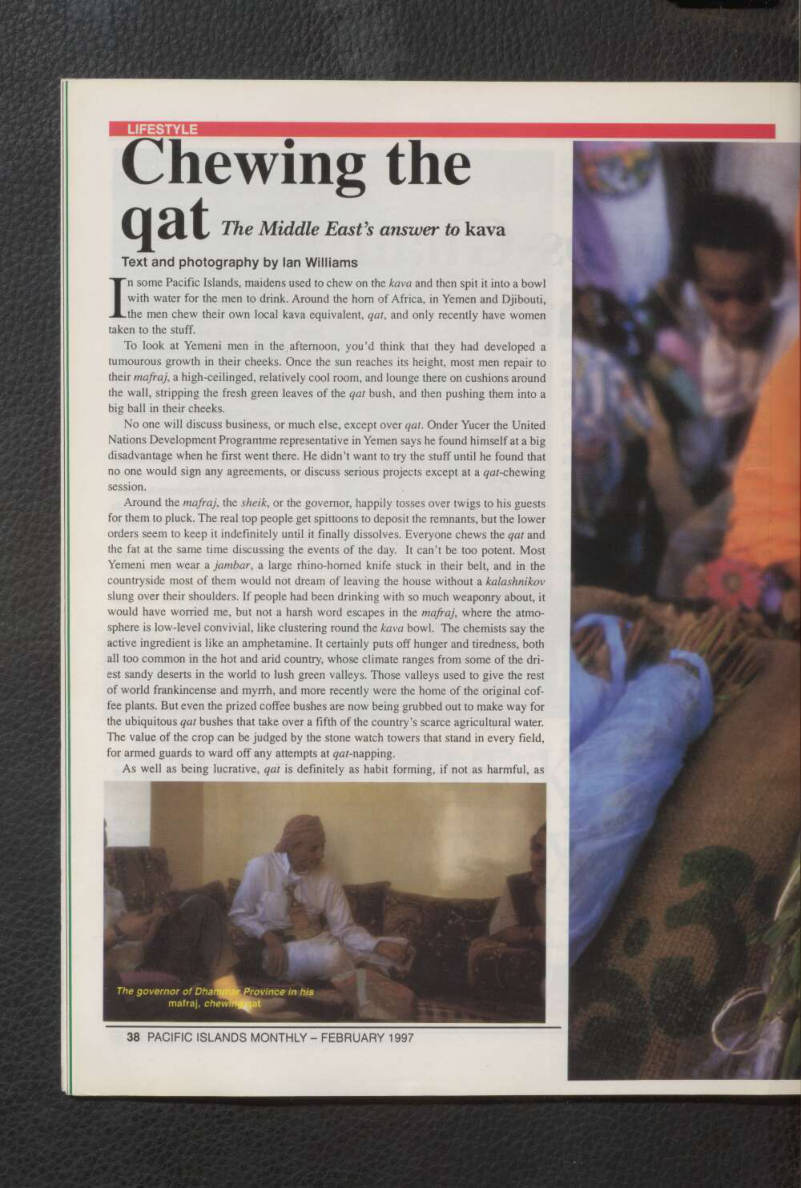
Around the mafraj, the sheik, or the governor, happily tosses over twigs to his guests for them to pluck. The real top people get spittoons to deposit the remnants, but the lower orders seem to keep it indefinitely until it finally dissolves. Everyone chews the qat and the fat at the same time discussing the events of the day. It can’t be too potent. Most Yemeni men wear a jambar, a large rhino-homed knife stuck in their belt, and in the countryside most of them would not dream of leaving the house without a kalashnikov slung over their shoulders. If people had been drinking with so much weaponry about, it would have worried me, but not a harsh word escapes in the mafraj, where the atmo sphere is low-level convivial, like clustering round the kava bowl. The chemists say the active ingredient is like an amphetamine. It certainly puts off hunger and tiredness, both all too common in the hot and arid country, whose climate ranges from some of the dri est sandy deserts in the world to lush green valleys. Those valleys used to give the rest of world frankincense and myrrh, and more recently were the home of the original cof fee plants. But even the prized coffee bushes are now being grubbed out to make way for the übiquitous qat bushes that take over a fifth of the country’s scarce agricultural water.
The value of the crop can be judged by the stone watch towers that stand in every field, for armed guards to ward off any attempts at gar-napping.
As well as being lucrative, qat is definitely as habit forming, if not as harmful, as
The governor of Dhammar Province in his mafraj, chewing qat
cigarettes. There are lots of scare stories about the health effects, but one doctor con fessed that the main effect is couch potato disease. People who spend eight hours with no more exercise than chomping their jaws on qat, will suffer more heart attacks than if they exercised, he suggested.
However, nobody ever died of an overdose. In fact, the bad effects of qat aren’t real ly pharmacological, but environmental. Even apart from the water, once the qat is out of the blue plastic bag that it’s sold in for freshness, the customers throw them away to blow in the desert winds. Miles from any habitation, like jellyfish of the desert, the bags float about until they lodge themselves against shrubs, cacti or roadside fences.
However, that’s not the way the World Bank looks at it. They judge qat to be narcotic and refuse to recognise any of the economic activity it generates as a part of the Gross Domestic Product. Of course, it is happy to include a newly opened cigarette factory. As a result, according to some estimates, one-third of the country’s income is not counted.
Across the Red Sea, in Djiboutiu, qat has become a problem. For a start, they spell it khat, and then they can’t grow it themselves. In fact, Djibouti is one of the driest places in the world and they can hardly grow anything. Its main reason for existing was that the French wanted a base and the locals clustered around the port.
To try to keep it as a colony, the French tried to get the minority Afar tribe in the north disgruntled against the Somalis. This was not a nice thing to do. The Somalis were fair ly ferocious warriors in their own right, and the Afars used to make necklaces of their enemies’ dried testicles, which suggests that they weren’t exactly pacifists either, since one can hardly imagine voluntary donors of such beads.
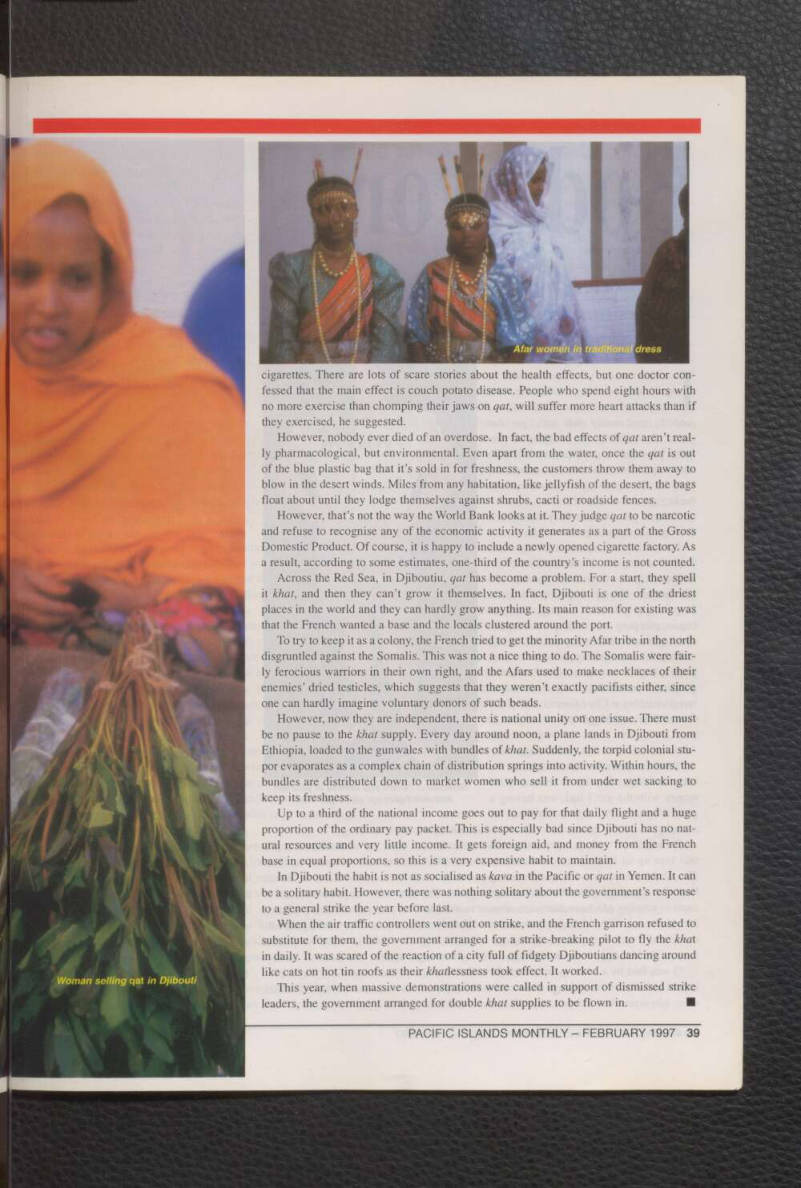
However, now they are independent, there is national unity on one issue. There must be no pause to the khat supply. Every day around noon, a plane lands in Djibouti from Ethiopia, loaded to the gunwales with bundles of khat. Suddenly, the torpid colonial stu por evaporates as a complex chain of distribution springs into activity. Within hours, the bundles are distributed down to market women who sell it from under wet sacking to keep its freshness.
Up to a third of the national income goes out to pay for that daily flight and a huge proportion of the ordinary pay packet. This is especially bad since Djibouti has no nat ural resources and very little income. It gets foreign aid, and money from the French base in equal proportions, so this is a very expensive habit to maintain.
In Djibouti the habit is not as socialised as kava in the Pacific or qat in Yemen. It can be a solitary habit. However, there was nothing solitary about the government’s response to a general strike the year before last.
When the air traffic controllers went out on strike, and the French garrison refused to substitute for them, the government arranged for a strike-breaking pilot to fly the khat in daily. It was scared of the reaction of a city full of fidgety Djiboutians dancing around like cats on hot tin roofs as their khat\essness took effect. It worked.
This year, when massive demonstrations were called in support of dismissed strike leaders, the government arranged for double khat supplies to be flown in. ■
Afar women in traditional dress
Woman selling qatin Djibouti