Boutros-Ghali
p. 37 · Read in the full issue
United Nations
The Boutros-Ghali incident
By Ian Williams
The appointment of Kofi Annan as United Nations secretary-general at the end of last year was general ly welcomed by Pacific diplomats, even if there was some regret over the circum stances that created the vacancy and even if the Fijian contingent in Lebanon may have triggered off his dismissal.
Despite immense pressure from US diplomats, the Pacific held the line along with most of the world against the US move to sack Boutros Boutros-Ghali as secretary-general. Ambassador Neroni Slade of Samoa commented, “I have the impression that most of the people in the Pacific appreciated his special qualities and the energy he put into trying to re form the organisation while defending its independence.”
Of course, such appreciation did not help the Egyptian diplomat to keep his job. The whole point of having a veto is that it outvotes everybody else! However, like “the ultimate deterrent”, it does not make you very popular when you do use it and US Ambassador Madeline Albright made few friends when she vetoed his appointment. As a result, many countries who would have been happy to see the secretary-general changed for a newer model, rallied to his defence in protest against the way it was done.
The US State Department had toured the world to find supporters for the bust- Boutros campaign, with little or no suc cess. A major reason for that was that they could not produce any coherent reasons
why they opposed him so vehemently.
Many diplomats saw the campaign as either a personal vendetta by Albright against Boutros-Ghali, or a case of pan-
dering to the anti-UN faction of the Republican Party. The only coherent rea son ever produced was that the US Congress would not allow the US to hand over the SUSI.S million arrears owed to the UN while Boutros-Ghali was at the helm.
The rest of the world saw no reason why a bunch of politicians not known for their concern for other countries’ opinions or welfare should decide who was to lead the world body, and noted carefully that they had not promised to pay even if Boutros-Ghali’s head were handed over on a platter. And, of course, their suspi cions were proven within days when Senator Jesse Helms’ aides said that the
chairman of the Senate Foreign Relations Committee would want to check Kofi Annan’s record before considering paying the back dues.
While the stated reasons for the cam paign were vague there were plenty of suggestions, in one of which the Pacific was tragically involved in an occasion that may have sealed Boutros-Ghali’s fate. The last straw for the American administration seems to have been his refusal to bury the report on the Israeli shelling of the UN camp in south Lebanon manned by Fijian peacekeepers. During their incursion into Lebanon, on April 18 last year, Israeli artillery killed over 130 Lebanese refugees and critically wounded two
Fijians.
The report by a Dutch officer drew upon statements by the Fijians, among others, to conclude that there was no way that the shelling could have been acciden tial. The White House, concerned with protecting its ally and equally worried at
offending the vociferous pro-Israeli
domestic lobby in an election year, want ed it quashed. In a revealing incident, when the acting Israeli ambassador went to see Boutros-Ghali and told him that publishing the report would open deep wounds in Israeli society, the secretary general is said to have rebutted his request with the words, “And your shells opened deep wounds in the Lebanese at Qana.” Of course, there is no way that he could or should have suppressed such a report but it is a measure of US attitudes towards the UN that they should have expected it.
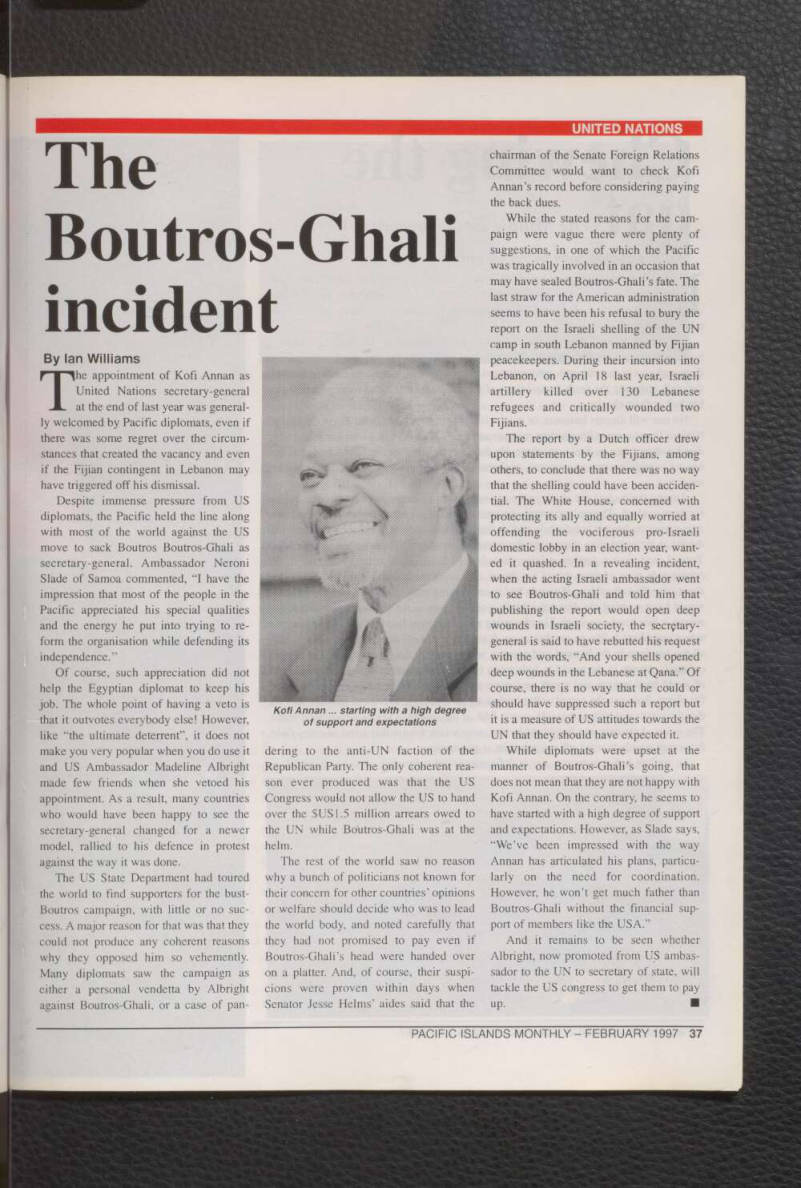
While diplomats were upset at the manner of Boutros-Ghali’s going, that does not mean that they are not happy with Kofi Annan. On the contrary, he seems to have started with a high degree of support and expectations. However, as Slade says, “We’ve been impressed with the way Annan has articulated his plans, particu larly on the need for coordination.
However, he won’t get much father than Boutros-Ghali without the financial sup port of members like the USA.”
And it remains to be seen whether Albright, now promoted from US ambas sador to the UN to secretary of state, will tackle the US congress to get them to pay up. ■
Kofi Annan ... starting with a high degree of support and expectations