Olter replaced
pp. 17-19 · Read in the full issue
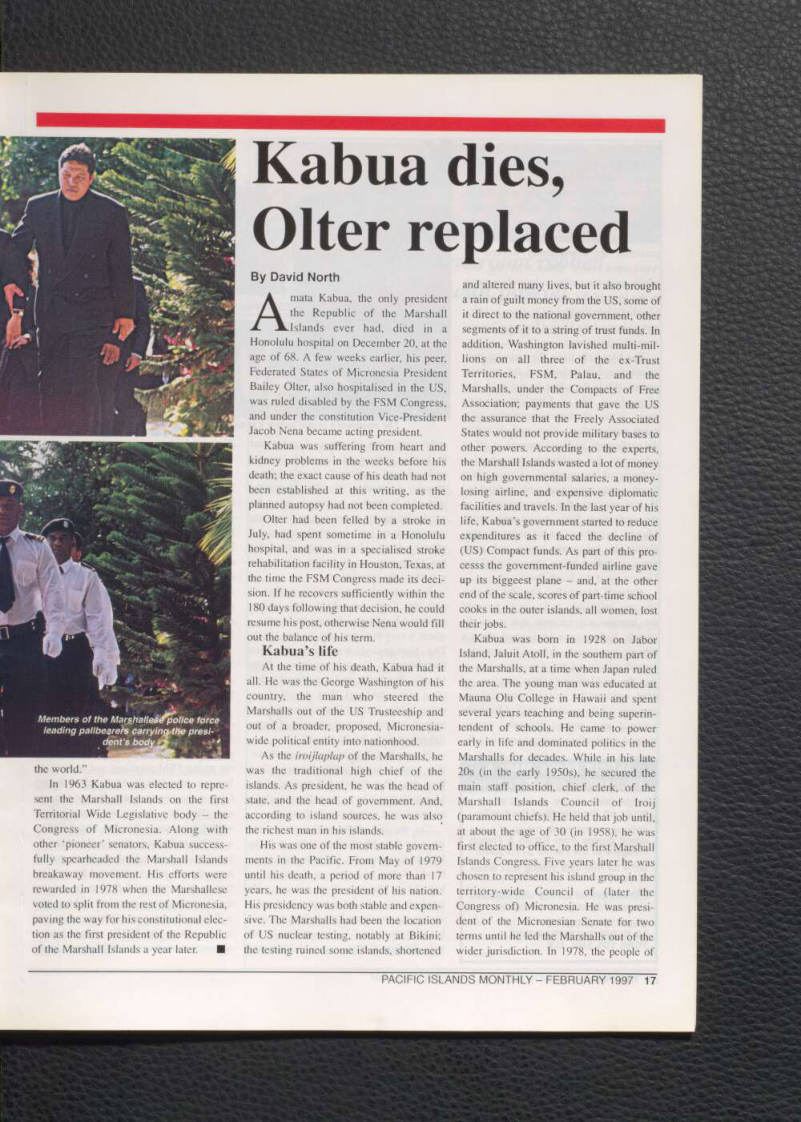
Kabua dies, Olter replaced
By David North
Amata Kabua, the only president the Republic of the Marshall Islands ever had, died in a Honolulu hospital on December 20, at the age of 68. A few weeks earlier, his peer, Federated States of Micronesia President Bailey Olter, also hospitalised in the US, was ruled disabled by the FSM Congress, and under the constitution Vice-President Jacob Nena became acting president.
Kabua was suffering from heart and kidney problems in the weeks before his death; the exact cause of his death had not been established at this writing, as the planned autopsy had not been completed.
Olter had been felled by a stroke in July, had spent sometime in a Honolulu hospital, and was in a specialised stroke rehabilitation facility in Houston, Texas, at the time the FSM Congress made its deci sion. If he recovers sufficiently within the 180 days following that decision, he could resume his post, otherwise Nena would fill out the balance of his term.
Kabua’s life
At the time of his death, Kabua had it all. He was the George Washington of his country, the man who steered the Marshalls out of the US Trusteeship and out of a broader, proposed, Micronesia wide political entity into nationhood.
As the iroijlaplap of the Marshalls, he was the traditional high chief of the islands. As president, he was the head of state, and the head of government. And, according to island sources, he was also the richest man in his islands.
His was one of the most stable govern ments in the Pacific. From May of 1979 until his death, a period of more than 17 years, he was the president of his nation.
His presidency was both stable and expen sive. The Marshalls had been the location of US nuclear testing, notably at Bikini; the testing ruined some islands, shortened
and altered many lives, but it also brought a rain of guilt money from the US, some of it direct to the national government, other segments of it to a string of trust funds. In addition, Washington lavished multi-mil lions on all three of the e\-Trust Territories, FSM, Palau, and the Marshalls, under the Compacts of Free Association; payments that gave the US the assurance that the Freely Associated States would not provide military bases to other powers. According to the experts, the Marshall Islands wasted a lot of money on high governmental salaries, a money losing airline, and expensive diplomatic facilities and travels. In the last year of his life, Kabua’s government started to reduce expenditures as it faced the decline of (US) Compact funds. As part of this pro cesss the government-funded airline gave up its biggeest plane - and, at the other end of the scale, scores of part-time school cooks in the outer islands, all women, lost
their jobs.
Kabua was bom in 1928 on labor Island, Jaluit Atoll, in the southern part of the Marshalls, at a time when Japan ruled the area. The young man was educated at Mauna Olu College in Hawaii and spent several years teaching and being superin tendent of schools. He came to power early in life and dominated politics in the Marshalls for decades. While in his late 20s (in the early 19505), he secured the main staff position, chief clerk, of the Marshall Islands Council of Iroij (paramount chiefs). He held that job until, at about the age of 30 (in 1958), he was first elected to office, to the first Marshall Islands Congress. Five years later he was chosen to represent his island group in the territory-wide Council of (later the Congress of) Micronesia. He was presi dent of the Micronesian Senate for two terms until he led the Marshalls out of the wider jurisdiction. In 1978, the people of
the Marshalls voted for independence thus assuring several Micronesian govern ments where one had sufficed under US rule - and by the end of that year, Kabua was a member-at-large of the Marshall Islands Constitutional Convention. In the next year he was elected the nation’s first president. He subsequently worked out Associated States status with the US, which gave the nation independent status in the eyes of the world. He also led the Marshalls into the United Nations in 1991, and addressed the United Nations General Assembly that year.
The Marshalls has a Westminster-style democracy, but without, so far, political parties. While the office Kabua held, that of president, has an American-sounding name, it has all the characteristics of a prime ministership - election from within the parliament, with one’s tenure in office subject to the continuing support of a majority of its members. (Kabua never faced serious opposition to his leadership.) He was one of the five elected members of the parliament from the capital island, Majuro. In addition to his national roles, Kabua also held many region-wide posi tions, including being chancellor of the University of the South Pacific.
Kabua’s Marshalls, like the Cooks, Vanuatu, and Nauru, had been the target of the international conmen that roam the islands; Kabua, once he learned about a scheme last year to defraud his treasury, moved with speed and directnesss to cor rect the problem, a healthy reaction not seen universally under those circum stances. Apparently, the Marshalls escaped any serious financial injury, beyond paying for some government offi-
dais’ trips from Majuro to London and back (see “Wave of financial ‘scams’ strikes Island countries”. Pacific Islands Monthly September, 96). The Marshalls, under his leadership, bearing in mind the
rapidly increasing population and growing
pressure on the land, mounted a strong and effective family planning programme that has, along with out-migration, slowed the growth of the population.
International relations trivia buffs will note that Kabua brought the US its first territorial boundaries dispute in decades albeit, a very mild one - in the late 1980 s.
The background was this: the then
Republican Congresswoman from
Hawaii, Pat Saiki, had introduced a bill (that got nowhere) that would have expanded the State of Hawaii’s boundaries to include Wake Island (the site of fierce fighting early in World War II).
No one had thought much about Wake, then a minor-league military outpost, in a long time. But Saiki’s bill reminded the Marshalls that it had a long-dormant claim on that island, which it calls Enekio.
“In the old days, young men were taken by their Marshallese elders to Wake Island in canoes for initation into man hood,” Kabua told me once. I asked if he had been through that process. He laughed, “No, the missionaries had put a stop to that business long before it would have involved me.” He is survived by his wife, Emlain Kabua, seven children and
28 grandchildren.
The successions On January 14, the Nitijela elected Imata Kabua to be the new president; he is the long-time senator from Kwajalein and was a supporter of his relative, Amata Kabua. Oddly, neither the Ministry of Foreign Affairs in Majuro nor the RMI embassies in New York or Washington could provide - on the day of his inaugu ration three days later - such basic infor mation as his year of birth, his education or his relationship to the late president, beyond the vague term “cousin”.
The ministry estimated his age as “between 50 and 55” and said he had served as a minister without portfolio in his cousin’s government.
However, the politics of succession are considerably more complex in FSM.
Jacob Nena, from Kosrae and once the governor of that FSM state, is currently the acting FSM president and is likely to become president in May unless Bailey Olter makes an unexpectedly good recov ery. (But then American Samoa’s Just retired governor, A P Lutali, also felled by a stroke, and also hospitalised in Hawaii, came back to his islands to finish out his term, though he was defeated for re-elec tion in November, 1996.) Let us assume that Nena becomes president in May; that will leave the vice-presidency vacant, and set in motion the FSM’s unique leader ship-selection process. FSM, sensibly for
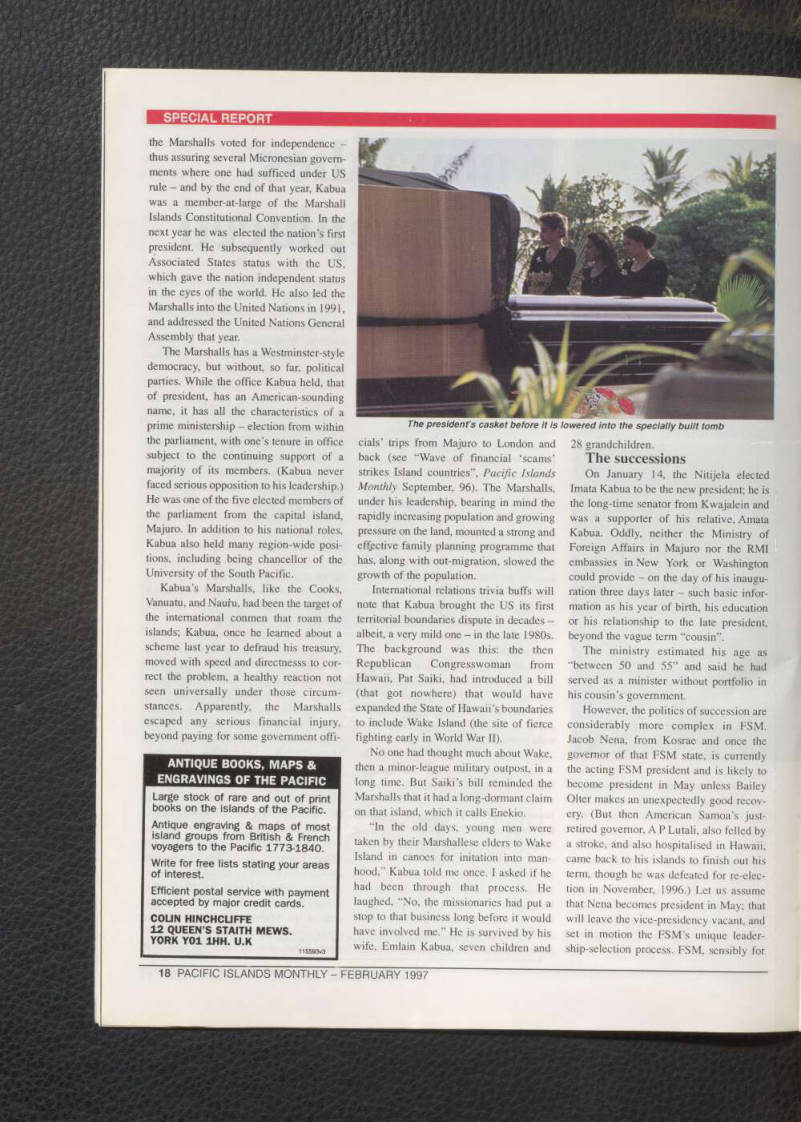
The president's casket before it is lowered into the specially built tomb
a small nation, has a one-house legisla ture. It consists of 10 members elected for two-year terms on the basis of popu lation, and four members (one from each state) elected for four-year terms. Every four years, FSM’s Congress we are talking 14 people in total - elects one of the four-year members to be president and another to be vice-president. There is an informal rotation system in place, and Olter (from Pohnpei) was in his second term, and Kosrae’s Nena was vice-presi dent. Both Olter and Nena, once elected by their colleagues, had to give up their four-year-seats in the congress, and by elections were held.
Should Nena become president, as expected, the congress will need to choose a new vice-president among the three men eligible for the post, the four year senators from Pohnpei, Yap and Chuuk, who are, respectively, Leo Falcam, Joe Urusemal and Redley Killion. The four-year senator from Kosrae would also be nominally eligible, but it would be precedent-shattering for a single state to hold both top FSM posts.
Then, once one of those three becomes vice-president, a by-election will be needed to fill the balance of the four-year term as senator. The next two-year elec tions take place later in 1997, and the next four-year-elections in 1999.
The three senators, incidentally, have no real option about becoming vice-pres ident should they be chosen by their peers. In yet another FSM constitutional anomaly, a senator chosen for president or vice-president either accepts the posi tion, or gets ejected from the parliament.
The succession in the Marshalls was rather more straight-forward. The parlia ment (Nitijela) under these circumstances simply elects a new leader in the Westminster manner, and that leader becomes both head of state and head of government. After Kabua’s hospitalisa tion and before his death, the Nitijela had selected Transportation Minister Kunio Lemari to serve as acting president.
Following Kabua’s death, parliament
appeared to ignore a constitutional provi
sion that would have seemed to make the speaker of the senate, Kessai Note, the acting president. ■