mourning
pp. 14-17 · Read in the full issue
Special Report
A region in
Nation unites for AmataKahua’s funeral
Text and photography by Alfred Sasako After President Amata Kabua died in a Honolulu hospital on December 20, the Republic of the Marshall Islands went into national mourning. The death of the 68-year-old president had shaken the country’s politi cal and chiefly systems to their founda tions. It was a death that has also left a vacuum in the chairmanship of the region’s premier political bloc, the South Pacific Forum.
Whatever divides the 50,000 Marshallese at home, was promptly and appropriately forgotten. The nation was united, if only temporarily. The mood in the nation’s capital, Majuro, clearly showed that during the state funeral on January 6. Clad in mourning costumes, they came from all over the archipelago chiefs, clansmen, women and children - to bid farewell to their founding president
and iroijlaplap (paramount chief).
The ‘locals’ were joined in the 30°- Celcius Majuro heat by dignitaries, including four heads of state, four prime ministers and senior ministers all from the South Pacific Forum as well as diplomats, officials, businessmen and friends from far and near. Messages of condolences came from all around the world, including one from the president of Israel. US President Bill Clinton was represented by a special envoy at the colourful and mov ing four-hour state funeral.
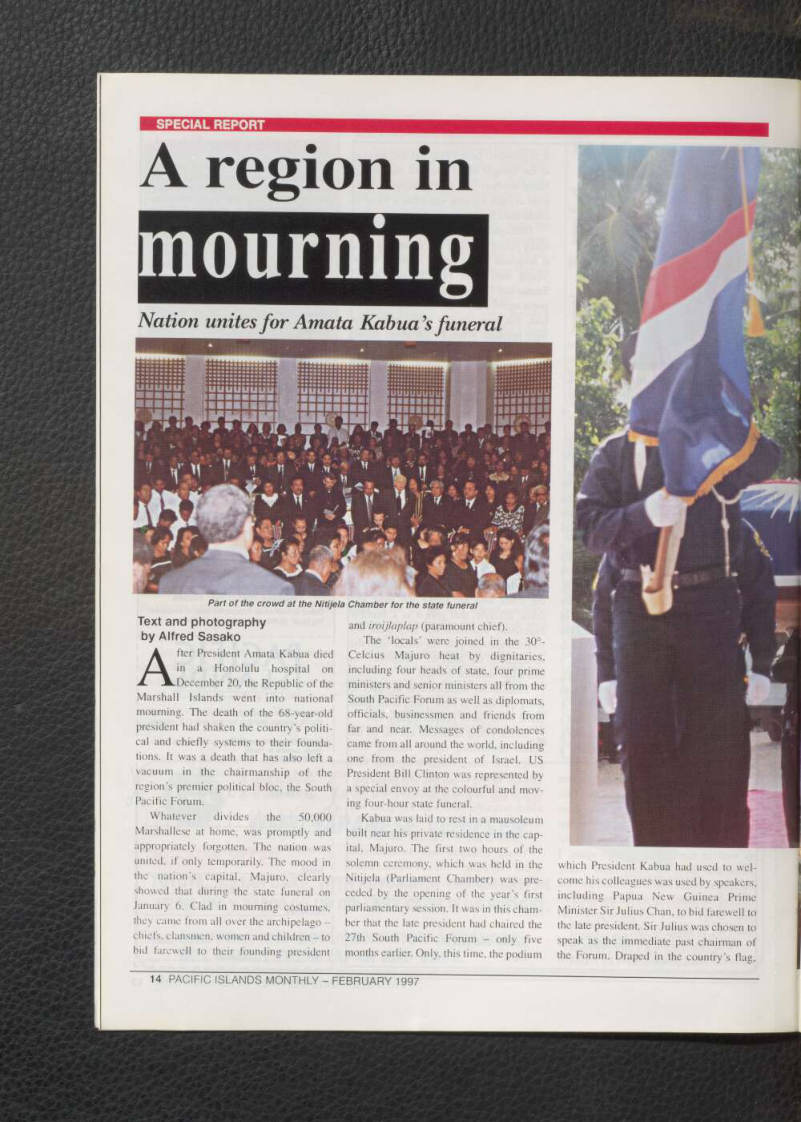
Kabua was laid to rest in a mausoleum built near his private residence in the cap ital, Majuro. The first two hours of the solemn ceremony, which was held in the Nitijela (Parliament Chamber) was pre ceded by the opening of the year’s first parliamentary session. It was in this cham ber that the late president had chaired the 27th South Pacific Forum - only five months earlier. Only, this time, the podium
which President Kabua had used to wel come his colleagues was used by speakers, including Papua New Guinea Prime Minister Sir Julius Chan, to bid farewell to the late president. Sir Julius was chosen to speak as the immediate past chairman of the Forum. Draped in the country’s flag.
Part of the crowd at the Nitijela Chamber for the state funeral
the casket bearing Kabua’s body lay just behind the speaker’s chair surrounded by floral tributes. Hanging on the wall above was Kabua’s signed portrait. Well over 600 people packed the Nitijela Chamber about three times its seating capacity with the crowd spilling outside on either
side of the building.
Hundreds descended on the private res idence compound to watch the president’s body finally being laid to rest.
Many who spoke at the funeral were lost for words in attempting to describe
the schoolteacher-turned-politician,
lamenting that there were no words to ade quately describe the depth of his under standing, his humbleness and the role he played at home and abroad. Kabua was a “friend”, “mentor”, “statesman”, “region al leader” and a “world citizen”.
At home, he was a loving and dedicat ed husband, father and grandfather. At national level, President Kabua was a hero, a “George Washington” of the Marshall Islands - a man who led his country to independence from the United States, a man who successfully negotiated the 15-year Compact of Free Association with the United States. The agreement provides the Marshall Islands with SUSI billion as compensation for nuclear test
ing. It expires in 2001.
At an earlier funeral service held in Honolulu before his body was flown back to Majuro aboard a US Air Force jet, the
country’s foreign minister, Phillip Muller,
described his late boss as the “George Washington of Marshall Islands”.
“He was more than a leader, friend and conqueror. President Kabua was a shining beacon. His spontaneous, overpowering
awe would be missed by those who came to know him and work with him,” Muller said.
Speaking in Honolulu, US Senator Daniel Akaka, a long-time friend, said President Kabua’s death was a “tremen dous loss”. Kabua, he said, was one of the giants of the generation who helped shape not only the destiny of the Marshall Islands but those of other Pacific Island nations as well.
Education minister Christopher Loeak, who read President Kabua’s official eulo gy, bemoaned his daunting task of describ ing a man who had come to be the symbol of the Marshall Islands. “It is a daunting task for us all to attempt to mourn, in a befitting manner, the loss of someone who had become an inextricable part of our lives; someone who had become more than just a leader, more than just a coun sellor,” Loeak said. “It is a difficult task to attempt to draw out in a few words the dis tilled essence of this great man, this great visionary. He shall forever be admired for so perfectly harmonising within himself the best qualities there are to be found in a leader.
“President Kabua was our solid rock, our Gibraltar. He was the vanguard of our struggles, our experiences and our chal lenges. In moments of uncertainties, he was our true, wise and unfailing guide. In times of trouble, he was our armour. In
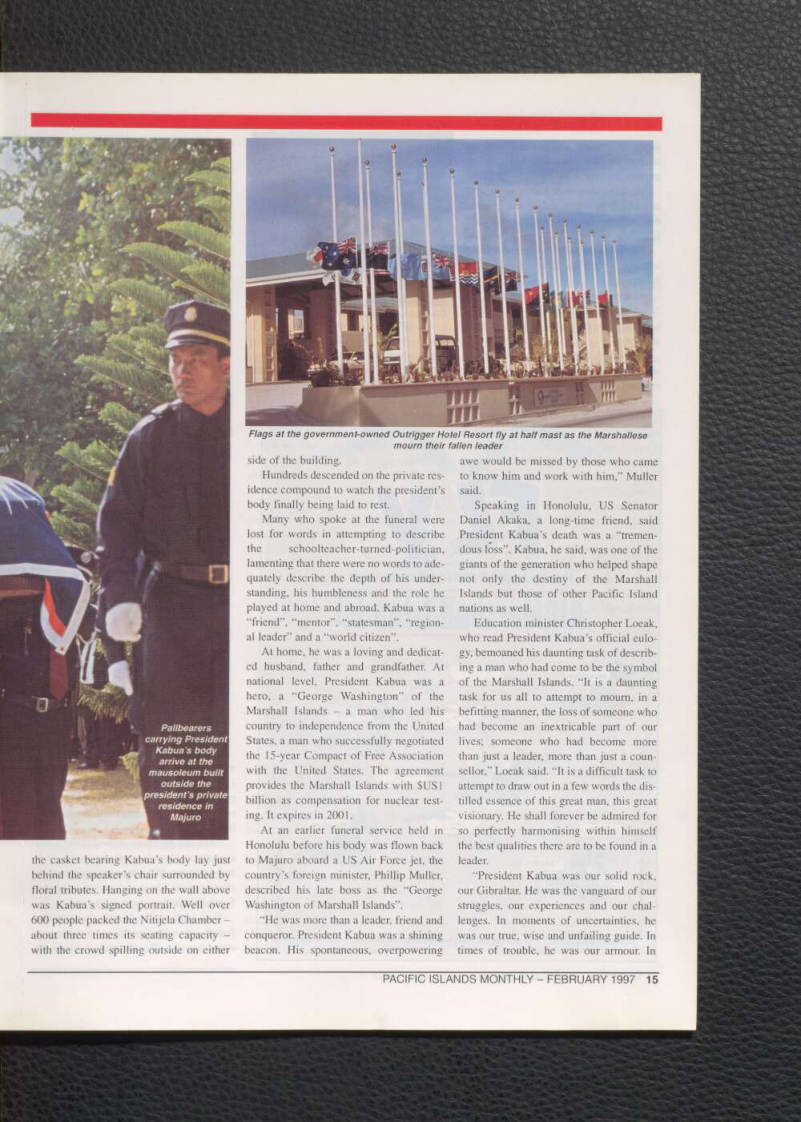
Flags at the government-owned Outrigger Hotel Resort fly at half mast as the Marshallese mourn their fallen leader
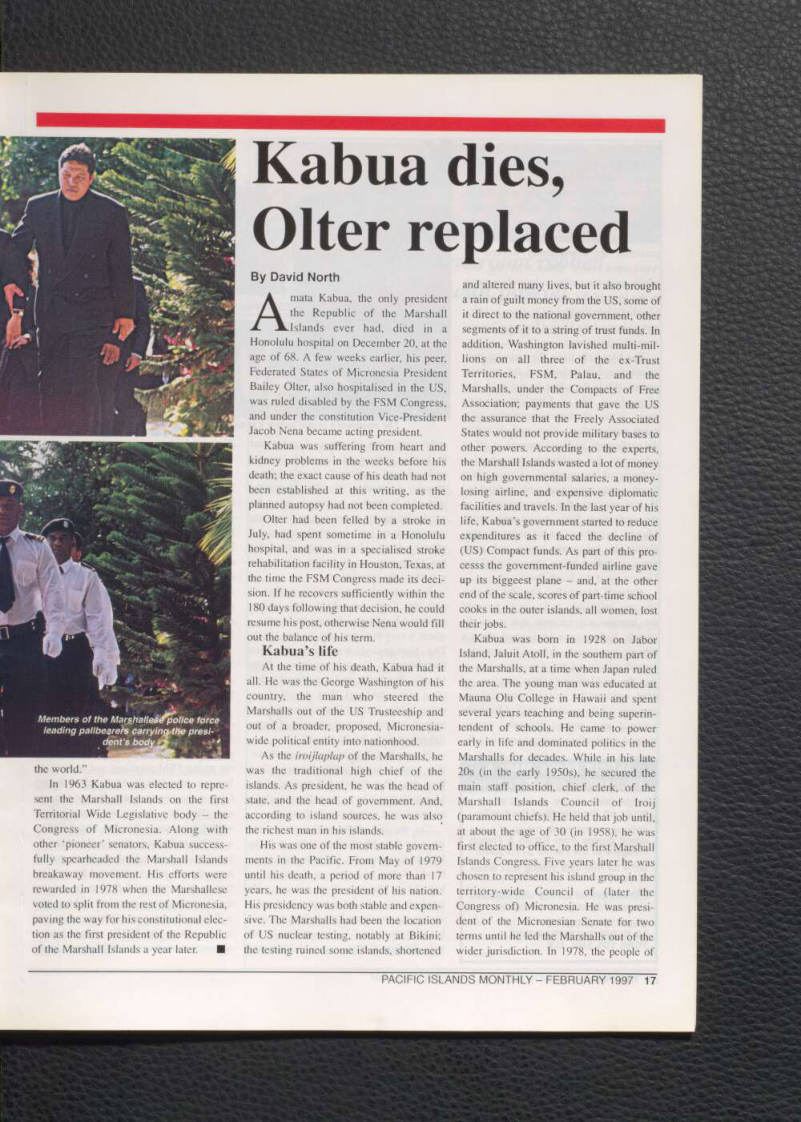
Pallbearers
carrying President
Kabua's body
arrive at the mausoleum built outside the
president's private
residence in
Majuro
times of stormy weather, he was our anchor. He was our rare and precious national treasure, dear and beloved.”
Sir Julius described Kabua as “heredi tary chief, president, father and grandfa ther of the Republic of the Marshall Islands”.
“He was a pillar of strength, vision and wisdom, both a friend and mentor,” Sir Julius said.
At regional level, Kabua was seen as a “kind and humble man who had ... brought humanity into the business of internation al politics”.
“President Kabua’s drive, the under standing of his country, people and regional commitment was fittingly dis-
played during the 27th South Pacific Forum which the late president hosted last September," he said. “It was a magnificent performance. His great command perfor-
mance, the people’s (South Pacific) Forum in Majuro in September, is potent proof that you do not have to be an eco nomic power of dehumanised size to carry the message.
“The late president showed through his countrymen how a government can run and develop a difficult and complex small island nation. The world, and more so the South Pacific, has lost a great man.”
Said Muller; “President.Kabua was the founder of regional solidarity and a states man for peace. He was truly a citizen of
Governor John Wahee of Hawaii, represent ing Bill Clinton, speaks at the funeral
Lady Emlain Kabua (centre) supported by family members arrives at the mausoleum for the burial
the world.”
In 1963 Kabua was elected to repre sent the Marshall Islands on the first Territorial Wide Legislative body - the Congress of Micronesia. Along with other ‘pioneer’ senators, Kabua success fully spearheaded the Marshall Islands breakaway movement. His efforts were rewarded in 1978 when the Marshallese voted to split from the rest of Micronesia, paving the way for his constitutional elec tion as the first president of the Republic of the Marshall Islands a year later. ■
Members of the Marchallese police force leading pallbearers carrying the presi dent's body